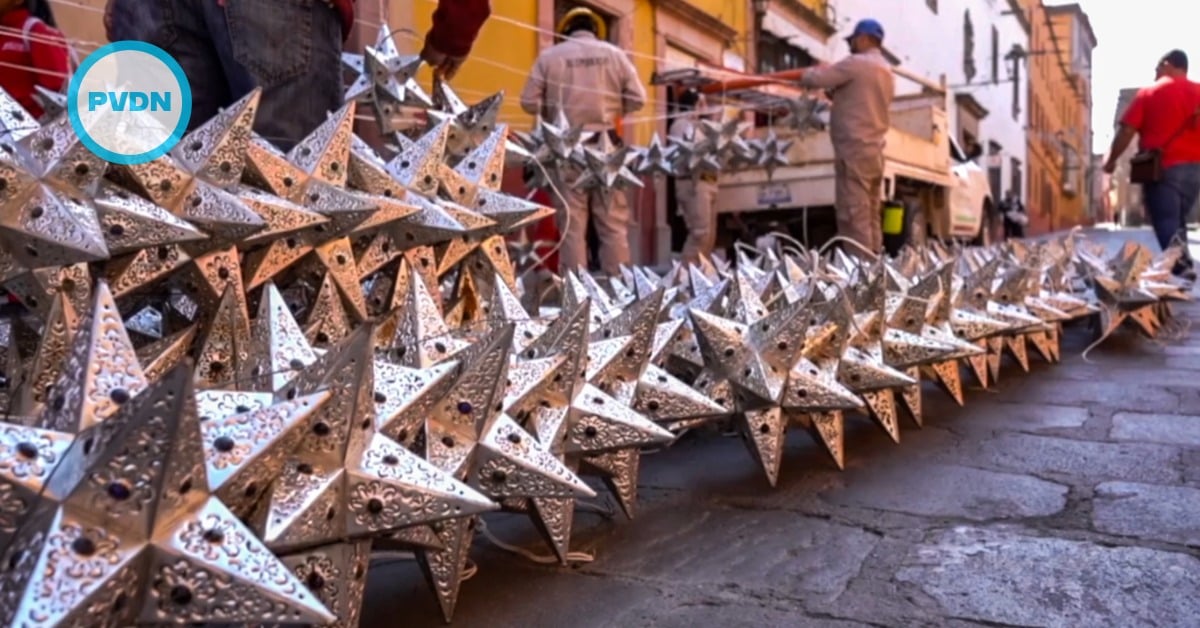
San Miguel de Allende’s historic center lights up with thousands of artisan brass star lanterns, a free seasonal gift from the city.
As another year winds down, San Miguel de Allende is doing what it does best: turning its historic center into a sea of warm, handmade light. Municipal crews have begun stringing thousands of brass star lanterns above the colonial streets, a now-familiar ritual that signals the start of the year-end holidays in this highland city of Guanajuato.
The stars, made in local workshops from sheets of brass cut, soldered and punched by hand, hang over narrow cobblestone streets lined with stone facades and balconies. By night, they glow like floating constellations, reflecting off church towers and plazas and casting patterned light on the people walking below. For many residents, the first evening when the lights come on has become the real start of the festive season.
San Miguel star lanterns
City hall describes the decorations as a gift from the municipal government to residents and visitors. The program is led by the Public Services and Quality of Life department, whose crews spend days installing the lanterns and checking cables and connections so that the lights can stay on safely through the holidays. Officials say the goal is not only to decorate the streets, but to put local artisans at the center of the city’s public image.
Each lantern begins its life in a small workshop, often run by families who have spent generations working with brass and tin. Sheets of metal are cut into pointed segments, soldered together into three-dimensional stars and then fitted with glass and electrical wiring. Because each piece is hand-worked, no two stars are exactly alike. Some are simple geometric shapes; others carry punched patterns, colored glass or small details that only reveal themselves when the bulbs are lit.
In past seasons, the stars have stretched across main streets such as Hidalgo, Relox, San Francisco, Umarán, Cuna de Allende and Correo, turning the core of the historic center into a kind of open-air gallery for metalwork. Last year, the city reported more than 4,600 brass stars hanging over the center and nearby neighborhoods, underscoring the scale of the effort and the amount of artisan labor behind the decorations.
The city frames the project as a celebration of essence and local talent, language that reflects how closely San Miguel’s identity is tied to its craft traditions. The same artisans who spend the rest of the year making lamps, mirrors and decorative pieces for homes and hotels now see their work suspended above the streets where they live. Officials have described each star as carrying “the heart” of its maker, a reminder to look up and recognize the people whose hands shape the city’s night-time image.
A seasonal gift with deep roots
San Miguel is one of Mexico’s principal production centers for brass star lanterns, alongside places such as Taxco and Tonalá. For decades, these pieces have hung not only in local homes but also in markets, patios, and hotels around the country and abroad. Their popularity has helped sustain a local economy of metalworkers who sell both to visiting tourists and to wholesale buyers who ship the lanterns worldwide.
The municipal decoration program builds on that heritage. By buying directly from local workshops, the city injects cash into small businesses at the end of the year, when families face school fees, celebrations and other expenses. For artisans, seeing their stars above the main streets is not only a source of income but also a form of recognition that their craft is part of the city’s public life, not just souvenirs for visitors to take away.
The stars have also become part of how San Miguel markets itself in the crowded field of holiday destinations. Night-time photographs of the lanterns suspended over stone streets, with the silhouette of the parish church in the background, circulate widely on social media and in tourism campaigns. For visitors, walking under the glowing stars is now as much a seasonal ritual as drinking atole in the plaza or listening to carols in the Jardín Principal.
At the same time, city officials insist that the first audience for the decorations is the people who live here. The municipal government has emphasized that the stars are installed for the sanmiguelenses before anyone else, and has invited residents to stroll the center, look up and take pride in a craft that grew out of their own neighborhoods. That message connects the visual spectacle to a quieter goal: reinforcing a sense of shared ownership over the historic center, which can feel increasingly dominated by tourism.
The lanterns will remain in place through the close of the year-end festivities, lighting the way for holiday shoppers, families leaving evening mass and visitors exploring the city after dark. When the season ends and the cables come down, the streets will return to their usual look. But for a few weeks, San Miguel de Allende once again becomes what many residents say they cherish most: a small city where everyday life and artisan work meet in the glow of brass and glass above their heads.