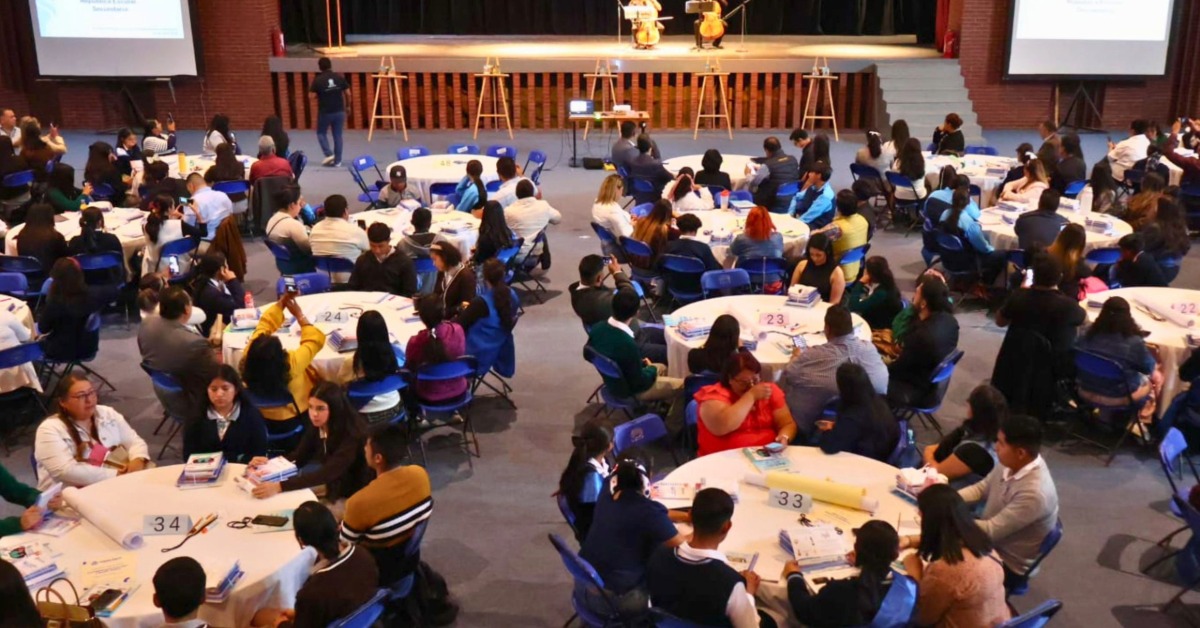
More than 480 students from northern Guanajuato, including San Miguel de Allende, participated in a regional school leadership meeting to strengthen student participation and promote safer school environments.
The meeting brought together primary and secondary students from Dolores Hidalgo, San Diego de la Unión, San Miguel de Allende, Ocampo, and San Felipe. They are part of República Escolar, a state education program that promotes student leadership, civic values, dialogue, and participation in school life.
The event was held at the Auditorio Mariano Abasolo in Dolores Hidalgo. Students worked with teachers to exchange ideas, identify problems in their schools, and develop proposals to improve classroom and campus life.
For international residents in San Miguel, the event may seem small at first glance. But it points to a greater effort in Guanajuato’s school system. The state is trying to give students a more active role in shaping school culture, not only through academics, but also through democratic participation and shared responsibility.
What happened at the regional meeting
The gathering was formally organized as the Encuentro Regional de Presidentes y Presidentas de República Escolar. In practical terms, it was a regional meeting for student leaders already participating in the program.
Students participated in activities focused on leadership, dialogue, teamwork, and problem-solving. The focus was not only on the student government in name. The program asks students to examine real issues in their schools and suggest ways to improve them.
That can include matters such as school coexistence, respect among classmates, inclusion, and safer learning spaces. Students are encouraged to speak, listen, negotiate, and think beyond their own classroom.
The meeting also gave participants a chance to hear from students in nearby municipalities. That regional approach matters in northern Guanajuato, where schools often serve communities with different social and economic conditions.
What República Escolar means in Guanajuato
República Escolar is a student participation model promoted by the Guanajuato Secretariat of Education. It works much like a school-based civic exercise.
Students elect representatives through a school process. Those representatives then take part in activities that promote leadership, responsibility, respect, and democratic values.
The program is designed to teach students how civic life works by letting them practice it early. Instead of learning only about democracy in a textbook, students experience campaigns, elections, representation, and decision-making within their school community.
Earlier state education materials describe República Escolar as a model rooted in human rights, civic values, dialogue, participation, and peaceful coexistence. The program has also involved teachers, school directors, parents, and education officials.
That broader support is important. Student leadership programs usually work best when adults guide them rather than take over. In this model, students are expected to lead, but the school community helps make their projects realistic.
Why this matters beyond the classroom
For many foreign residents, Mexico’s education system can feel hard to understand. Public education is organized differently from systems in the United States and Canada. Programs like República Escolar show how Mexican schools often connect education with community values and civic formation.
The program is not only about choosing student representatives. It is also about teaching young people how to participate in public life with respect and responsibility.
That matters in a country where civic participation is often discussed in adult political terms. República Escolar brings the idea down to the school level. Students learn how to listen to classmates, propose solutions, and work within a shared structure.
In Guanajuato, the program also connects with concerns many families recognize anywhere: school safety, bullying, student confidence, and respect among peers. The meeting in Dolores Hidalgo placed those themes at the center of the conversation.
A local link for San Miguel families
San Miguel de Allende is best known internationally for tourism, colonial architecture, arts, and its large foreign community. But it is also a working city with families, schools, teachers, and students dealing with everyday local issues.
The participation of San Miguel students in this regional meeting shows that the municipality is part of broader educational efforts across northern Guanajuato. It also shows that local students are being invited to participate in conversations about how their schools function.
For parents, this kind of program can be important because it gives students a structured way to express concerns. It also encourages them to take responsibility for improving their school environment.
For foreign residents, especially those who follow local public life, the program offers a clearer view of how civic education is being shaped in Guanajuato. These efforts may not always make national headlines, but they are part of how communities develop from the ground up.
Leadership as a school safety tool
One of the key goals of República Escolar is to promote more inclusive, safe, and collaborative school environments. That is a practical goal, not only an educational slogan.
Schools are safer when students know how to report concerns, respect differences, and resolve disagreements before they grow. Student leadership can help create that culture, especially when young people feel heard by teachers and administrators.
The regional meeting gave students space to identify problems in their own schools. That step is important because school challenges are not always visible to adults. Students often know where tensions exist, which classmates feel excluded, and which daily situations need attention.
By asking students to help build solutions, the program treats them as participants in school life rather than passive recipients of rules.
Civic learning before adulthood
República Escolar also gives students early exposure to democratic habits. They learn that leadership is not only about holding a title. It also involves listening, proposing, organizing, and being accountable to others.
Those lessons can carry beyond school. A student who learns how to speak in a meeting, help plan a project, or represent classmates may be better prepared for community life later.
The program also reflects a common idea in Mexican public education: schools are not only places for academic learning. They are also spaces for citizenship, values, and social development.
That may be useful context for foreigners living in Mexico. Local education programs often include goals that go beyond grades and exams. They may also focus on convivencia, a Spanish word often used to describe peaceful coexistence and respectful social interaction.
What comes next
The regional meeting does not appear to be a one-time effort. República Escolar has been promoted in different parts of Guanajuato, including primary, secondary, and upper-secondary education settings.
For the students who attended from San Miguel and neighboring municipalities, the next step is taking what they learned back to their schools. The value of the program will depend on whether student proposals lead to real changes on campus.
Still, the meeting shows a clear direction. Guanajuato education officials are using student leadership as part of a wider strategy to strengthen school communities.
For San Miguel, that means students are not only attending classes. Some are being trained to help shape the environment where learning happens.