
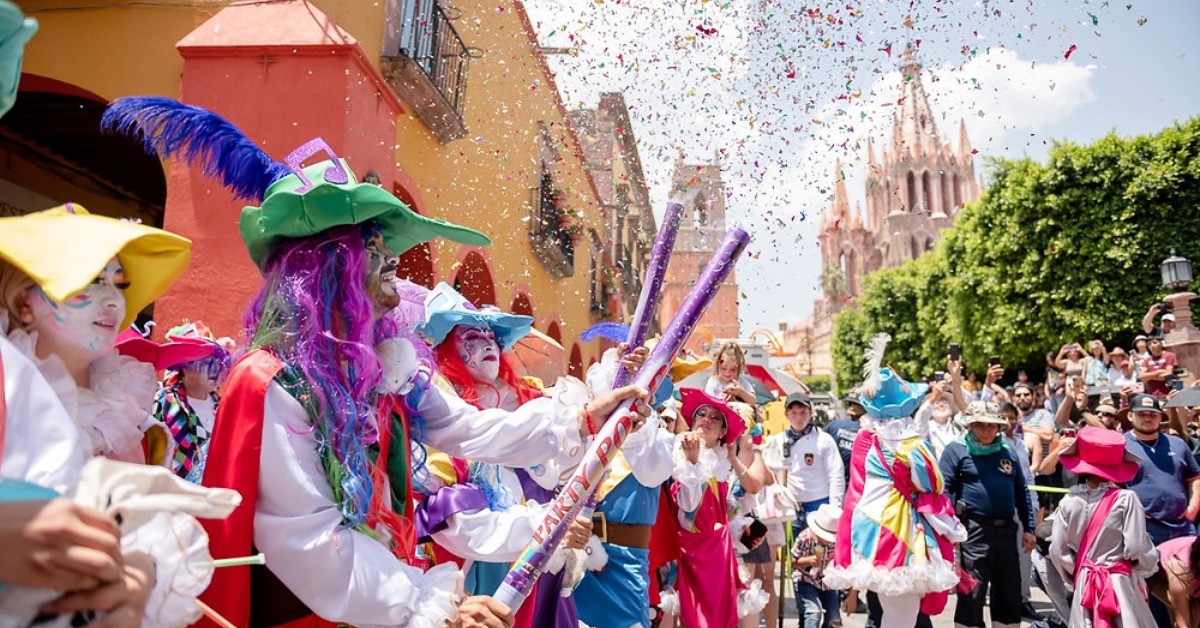
Before San Miguel’s streets fill again with masks, music, and flying candy, a small museum exhibition is pulling the city’s wildest parade back toward its orchard roots. The new show at Museo La Esquina gathers pieces that explain how the Convite de Locos grew from hortelano dances into one of the city’s most recognizable public traditions. One object in particular reaches back further than most, and it gives the whole fiesta a different texture before the crowds arrive.
San Miguel Exhibition Traces Convite de Locos Roots
San Miguel de Allende has put a museum label on one of its loudest traditions.
The temporary exhibition Hortelanos, the origin of the Convite de Locos, is now at Museo La Esquina, featuring historic masks, costumes, and clothing tied to early hortelano dancers, as well as a late-19th-century torito that helps explain how the celebration moved from an orchard ritual to a citywide parade.
The show arrives in the same June calendar that usually pulls San Miguel toward the Convite de Locos, the masked procession that fills streets with music, candy, satire, and neighborhood pride. A previous Convite de Locos preview described the celebration as one of the city’s major cultural events before the parade stepped off for San Antonio de Padua.
What the old pieces show
The strongest thread in the exhibition is the word hortelanos, the orchard growers at the root of the tradition. Official tourism material traces the figure of the loco to the Danza de los Hortelanos, performed for the fairs of San Isidro Labrador and San Pascual Bailón.
That older dance had a purpose beyond costume. Participants handed out food from the orchards that once sat outside the city. The sweets thrown along the modern parade route are the bright, noisy descendant of that exchange.
By the 19th century, the loco had shifted shape. Local background describes the change as a shift toward colorful clown costumes, bombachas, and cardboard or wooden masks. The torito in the current museum show gives that transition some weight. It is not a parade idea explained from a brochure. It is an object with age on it.
The old torito also points to a part of the fiesta that can get lost behind the crush of crowds. The Convite de Locos carries more than wild costumes. It carries traces of San Miguel’s garden districts, early religious devotion, and neighborhood organization.
The cuadros behind the parade
The celebration still runs through cuadros, the traditional groups tied to barrios and families. Earlier local background lists four of them: Cuadro del Parque, Cuadro Antiguo, Cuadro Nuevo, and Cuadro del Tecolote. Each has its own history, leadership, and route responsibilities.
Cuadro Antiguo is especially close to the story now on display. It emerged around 1912 in San Juan de Dios, once an area of pear and apple orchards, and remains the only cuadro still linked to the torito dance and hortelanos.
Jorge Baeza, a longtime mayordomo with Cuadro Antiguo, has described the feeling behind the tradition in simple terms. When the music starts, he said, “You wake up.” In a separate exhibition setting, Baeza thanked earlier keepers of the fiesta and said, “The seed has been sown.”
The pieces are not presented as loose carnival props. They are evidence of how an agricultural ritual, religious observance, and barrio system kept changing without fully cutting the cord.
A living archive before the parade
The exhibition follows a broader effort to document the Convite de Locos while it is still being made in the streets. A 2025 cultural exhibition at El Nigromante also gathered traditional clothing, early masks, the torito, drum, and chirimía to explain the older form of the procession.
At that earlier opening, Laura Bustos, then director of the cultural center, called it “a living tradition that continues to be updated.” Margarita Rodríguez, a representative of Cuadro del Parque, said the aim was “informarles a las nuevas generaciones.”
San Miguel officials have also framed the Convite as something old, changing, and heavily participated in. In 2024, Culture and Traditions director Acacio Martínez called it a “fiesta antigua que ha evolucionado.” That year, the municipality said more than 7,000 people participated and more than 160,000 attended.
Inside Museo La Esquina
Museo La Esquina is a natural place for that kind of work. The museum says its permanent collection includes more than 3,500 original pieces of Mexican popular toy art gathered over six decades, with a focus on materials, craft, and social function.
That mission lines up cleanly with the Convite pieces. Masks and costumes are playful, but they also carry labor, neighborhood memory, and religious use. The torito sits near the line between toy, dance prop, and community archive.
Museo La Esquina lists its regular hours as 10 a.m. to 6 p.m. Tuesday through Saturday and 11 a.m. to 4 p.m. Sunday. The museum gives its address as Núñez 40, at the corner with San Francisco, in San Miguel de Allende’s Centro Histórico.