In less than a day, seven armed attacks across Cancún left several people dead or injured and residents fearing what comes next.
Cancún started the day with the sound of sirens instead of waves. Overnight, seven high-impact attacks were reported in different corners of the city, turning routine streets and quiet homes into active crime scenes.
From Los Corales and Paraíso Maya to Tres Reyes and Kusamil, residents woke up to patrol trucks, forensic vans and cordoned-off blocks. The attacks unfolded between late Tuesday night and the early hours of Wednesday, less than 24 hours that again exposed how quickly violence can spread through this tourist hub.
Authorities opened separate investigations into each case. So far, investigators have not said whether the incidents are connected or whether they are treating them as unrelated events that happened to overlap in time. For people who live in these neighborhoods, that distinction matters less than the simple fact that so many scenes had to be processed before sunrise.
Seven crime scenes in hours
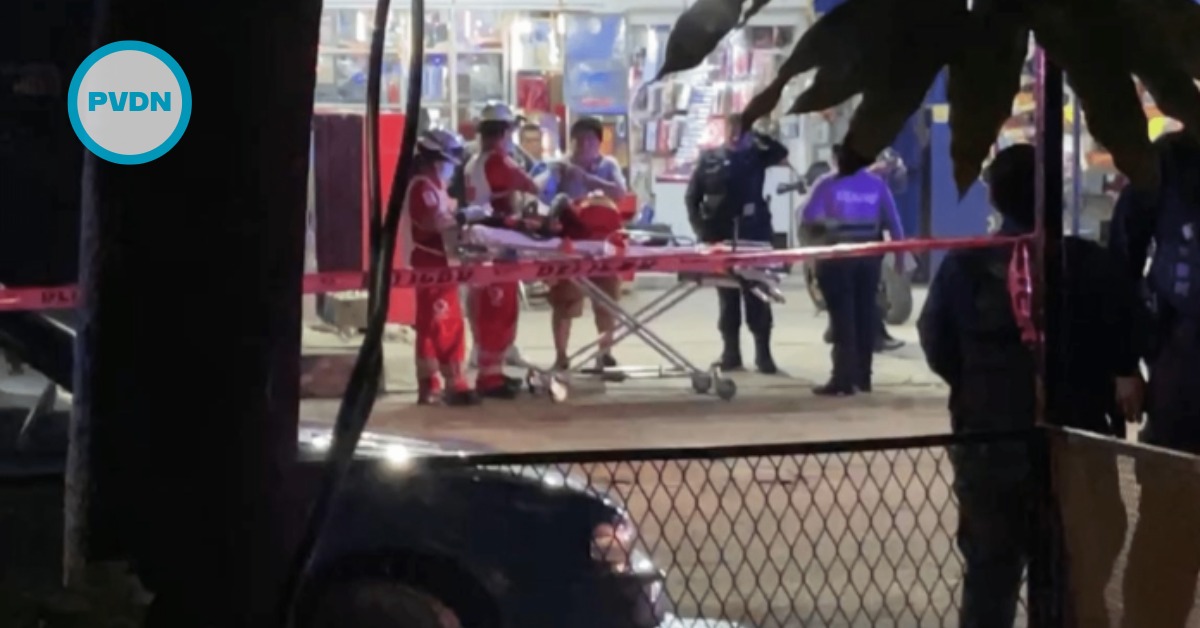
The night’s first major incident was reported in the Los Corales area, in Supermanzana 77. A man and a woman were chased by two men on a motorcycle for several dozen meters as they tried to reach a small grocery store. The attackers caught up with them inside the shop and fired at close range. Both victims died at the scene, while the motorcycle believed to have been used in the attack was later found abandoned nearby.
Not long after, another call came from a dirt road between the Kusamil and Tierra Maya areas, where neighbors reported a body on the ground. Responders found a young man with visible signs of beating and several gunshot wounds. The stretch of road, poorly lit and rarely used at night, was quickly sealed off while forensic teams documented the scene and removed the body.
Elsewhere in the city, a motorcycle rider working as a collection agent for the informal “gota a gota” loan system was attacked on a dark path in the Villas Otoch area, in Region 247. According to initial accounts, armed men intercepted him, robbed him of about ten thousand pesos and threatened him while firing shots to intimidate him. Shell casings were later found at the site, along with an abandoned motorcycle, as investigators tried to determine whether the assault was linked to wider extortion schemes in the city.
In Paraíso Maya, in Region 107, a couple was attacked inside their own home when armed men forced their way in without warning. The woman suffered a stab wound to the neck, while the man was shot. Both were taken to a public hospital; doctors reported the woman in serious condition and confirmed that the man died shortly after arrival. For neighbors, the attack underscored how violence no longer stays on distant roads but can burst through a front door.
Another case was reported late at night in Supermanzana 45, near Avenida La Luna. Co-workers went to check on a colleague who had not shown up for several days. Instead of finding an explanation for his absence, they found his body inside the home and called emergency services. Investigators have not released further details on how he died, only that the body was removed for autopsy while they reconstructed his last movements.
By morning, the focus had shifted to the outskirts. Residents in the third section of Tres Reyes reported yet another body left beside a dirt road, showing signs of violence. Despite the rain, forensic teams worked the scene and recovered the remains, which so far remain unidentified. A few hours later, another man was found dead on a different dirt road near the Kusamil housing development, lying next to a motorcycle that showed no visible damage, reinforcing the working theory that this was an execution, not an accident.
Together, the cases formed a rough circle around the city’s urban sprawl: inside homes, outside small businesses, on peripheral roads where public lighting is scarce and police patrols are sporadic. Several people are dead, others remain injured, and many more are left wondering whether anything will change after the tape comes down.
Cancun armed attacks in wider context
The Cancun armed attacks of this single night did not happen in isolation. Over recent months, residents have already seen repeated shootings, bodies abandoned on dirt roads and a string of attacks linked to local disputes and street-level drug dealing. Neighborhoods such as Paraíso Maya, Tres Reyes and parts of the northern fringe of the city have appeared again and again in crime reports as places where armed groups test how far they can act without being stopped.
At the same time, federal and state officials insist that reported homicides are trending downward nationwide compared with previous years. Security briefings highlight decreases in some categories of crime, yet the same reports also acknowledge that certain states and tourist corridors still concentrate a high number of violent incidents. For many people in Cancún, those statistical gains feel distant when a single night can produce so many crime scenes at once.
The attacks also point to patterns that have been developing over time. Informal credit schemes such as “gota a gota” have expanded in several Quintana Roo cities, and collectors have been attacked before. Residential areas that grew faster than basic services now include long stretches of unpaved, poorly lit roads, which later become convenient dumping grounds for bodies. Families in working-class districts live side by side with these risks, even as the city promotes itself globally as a carefree beach destination.
Officials have promised to keep the investigations open until those responsible are identified. Detectives are reviewing security camera footage, tracking the abandoned vehicles and taking statements from witnesses who saw the motorcycle chase in Los Corales or heard gunshots in the early hours on the city’s edge. No arrests have been confirmed in connection with this overnight sequence of attacks, and authorities have not shared a public hypothesis about motives or possible links between the cases.
For now, what is clear is the impact on daily life. People in affected neighborhoods talk about changing routes, avoiding certain roads at night and closing their businesses earlier. Parents weigh the decision to let teenagers walk home alone from school or work. Service workers who keep the tourism engine running must still cross these zones every day.
Cancún is used to living with a level of risk that does not appear in glossy promotion campaigns. This latest chain of armed attacks, spread across less than 24 hours, is another reminder that behind the hotel zone and its beaches lies a city where many residents spend the night listening for the next round of gunfire and hoping it stays far from their door.