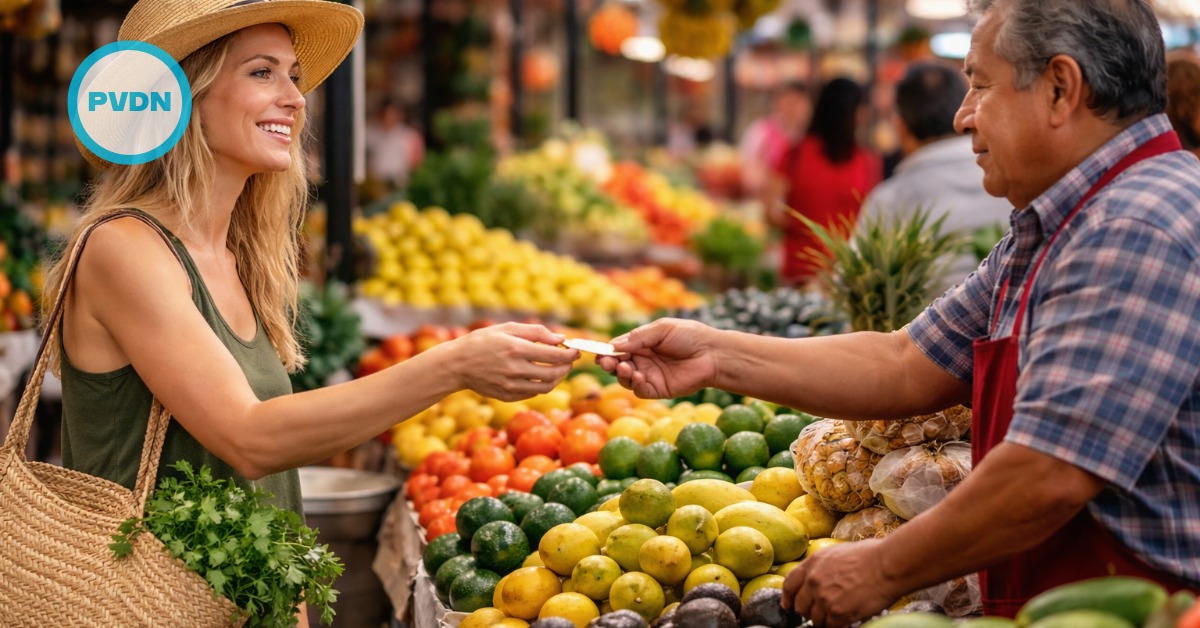
Learn the small mercado rituals—names, trust, and credit—that turn shopping in Mexico from a transaction into real belonging.
The Mercado Is Not a Store, It’s a Relationship
If you grew up with supermarkets, it’s easy to treat a Mexican market like a scenic errand. You arrive, you scan, you pay, you leave. You might even call it “shopping,” the way you would anywhere else.
But a mercado, and its cousin the tianguis, has a different center of gravity. It’s built around people, not aisles. The point isn’t just to exchange money for food. The point is to be seen, to return, to become familiar. That’s why locals don’t move through a market like they’re on a timer. They pause. They greet. They trade a few words. They let the vendor do what they’re good at.
Once you notice that, your whole approach changes. Instead of hunting for “the best deal,” you start building a small circle of trusted hands. A butcher who cuts it the way you like. A tortilla stand that knows your usual. A produce seller who won’t let you take home sad avocados. This is how people “shop like locals” without ever saying it out loud.
The Power of Names and Nicknames
Markets have their own language of belonging. Vendors often use affectionate forms of address that feel surprising if you’re new. You’ll hear calls like marchante or marchanta, the market’s way of saying “my customer,” sometimes softened into marchantita when the tone turns playful. You may also get jefe, jefa, reina, mami, or jóven, depending on the region and the personality behind the counter.
If you don’t like a nickname, you don’t have to make it a big thing. The simplest move is to offer your real name early, like you’re handing over a key. “Soy Ian.” Say it with a smile, the same way you’d introduce yourself to a neighbor. Then ask theirs. When you learn a name, use it the next time you come back. Even once. That’s enough to shift the energy.
There’s also a gentle respect-code in titles. Doña and Don can be warm when used naturally, especially with older vendors who already carry the rhythm of the market in their bodies. You don’t need to perform it. Just let it be sincere. The goal isn’t to sound “local.” The goal is to treat the person in front of you like a person you’ll see again.
Because you might.
Credit Isn’t About Money It’s About Trust
Sooner or later, you’ll hear the word fiado. It means buying on informal credit, paying later. For many Mexican households, especially outside the most banked-up neighborhoods, fiado has long been a quiet tool for smoothing life’s rough edges. In a market setting, it can show up as a casual “Pay me next time,” or a vendor waving away your apology when you’re short on cash.
For newcomers, the important thing is not to chase this. You don’t ask for fiado the way you ask for an extra lime. It’s offered, not requested, and it usually arrives after you’ve shown a pattern. You come back. You pay on time. You don’t argue over every peso. You don’t treat the vendor like an opponent. You treat them like a partner.
That’s what makes fiado feel almost invisible when it appears. It’s not a loan product. It’s a handshake that lives in memory.
If you ever do accept it, keep it small and make repayment quick. Not because anyone is counting coins, but because everyone is counting character. And if you’d rather avoid it entirely, that’s fine too. Trust has other forms. Sometimes it looks like the vendor setting aside the ripest fruit because they know you’ll be back on Thursday. Sometimes it looks like them telling you, kindly, “Not those today.”
Small Rituals to Shop Like Locals
The mercado has dozens of tiny customs that locals learn without lessons. You can learn them the same way: by watching, copying, and staying humble.
Start with the hello. A simple buenos días changes the whole exchange, even if your Spanish is still shaky. Then comes the pace. In many stalls, the line is real, but it’s also fluid. People step aside to ask a question, someone pays while another chooses, a vendor juggles three conversations without dropping one. If you look annoyed, you mark yourself as an outsider. If you settle in, you look like someone who understands that this is a shared space.
Then there’s the art of choosing. In some places, customers point and vendors select. In others, you’re expected to pick your own produce. If you’re unsure, ask with a simple, respectful question and follow their lead. Vendors notice when you trust their hands. They also notice when you handle everything like it’s a suspicious object.
And yes, there’s the little moment people love to talk about: the pilón. In Mexico, pilón is the “something extra,” a small add-on given as a gift or a friendly flourish. It might be one more chili, a handful of herbs, an extra slice of fruit tucked into the bag. You can’t demand it without killing the magic. But you can create the conditions where it happens naturally. You return. You’re pleasant. You’re fair. You don’t squeeze every interaction until it’s dry.
Even the way you carry your things can become part of the ritual. Bringing your own bag, reusing a container, or simply having cash that doesn’t force a vendor to break a large bill at 8 a.m. is a form of respect. It tells the market you plan to keep showing up.
How Expats Stop Touring and Start Participating
If you want one mindset shift, make it this: a market is a relationship you practice, not a hack you master.
Pick one or two stalls and keep them. Not forever, not exclusively, but long enough for familiarity to form. Let your face become part of the morning. Let your preferences become easy for someone else to remember. Accept that you’ll pay “normal” prices sometimes, and that the real value is what you can’t measure: better recommendations, better timing, better care.
You’ll also start to feel something unexpected. The market becomes a soft social safety net. You hear about neighborhood news. You learn which fruit is truly in season. You pick up local slang without studying. You get teased in a way that means you’ve been accepted. And on days when life feels heavy, being greeted like you belong can steady you more than you’d think.
That’s the genius of the mercado. It turns necessity into community, without making a speech about it. The only entry fee is consistency, respect, and a willingness to be known.