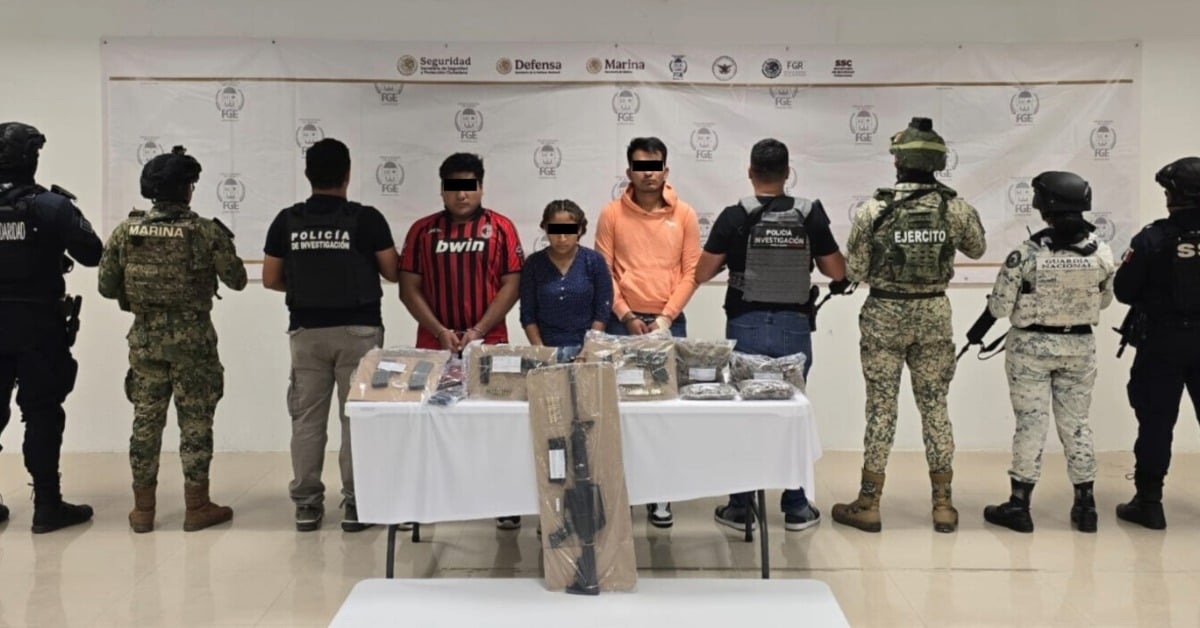
Six people—four men and two women—were bound over for trial on Friday in Playa del Carmen after state prosecutors accused them of drug retail offenses. Control judges granted vinculación a proceso and ordered justified pretrial detention while the cases move forward. The Quintana Roo Attorney General’s Office said the actions are part of a push against street-level sales in Solidaridad.
According to case filings summarized by authorities, the defendants were detained in coordinated operations across the city by an interagency team. Noticaribe reported their identities as Marco Antonio “N”, Jorge Ezequiel “N”, Guadalupe “N”, Sara Yazmín “N”, José Cruz “N”, and Felipe “N”. Prosecutors allege simple possession in some cases and possession with intent to supply in others.
Three arrests, three streets, one pattern
Court summaries describe three separate detentions. The first involved Marco Antonio “N”, Jorge Ezequiel “N”, and Guadalupe “N”, picked up on Avenida Los Gansos between Azulejos and Semilleros. They face proceedings for possession of cannabis. A second action in Fraccionamiento Marsella 3, on Paseos del Mayab, led to charges against Sara Yazmín “N” and José Cruz “N” for possession with intent to supply cannabis, cocaine, and methamphetamine. The third arrest, on 95 Avenida Sur in Colonia Ejido, targeted Felipe “N” for possession with intent to supply cannabis. Judges imposed justified preventive detention on all six.
The Attorney General’s Office said the operations were carried out with the Grupo Interinstitucional, the state’s multi-agency deployment used to confront retail drug markets and related violence in tourist corridors. The use of joint teams—state and municipal police with federal forces—has become standard when prosecutors anticipate firearms or organized backup at addresses tied to local sales.
A case built on August raids
The binding orders follow a string of earlier arrests this month in Playa del Carmen. On August 13, an interagency sweep led to eight detentions and the seizure of a cache of weapons—reports vary between 16 and 17 firearms—along with multiple drug packages. Outlets including La Jornada and El Sureste detailed that those arrests also occurred on Paseos del Mayab in Marsella 3 and along Los Gansos, echoing the locations now cited in the six vinculations. That earlier case framed the suspects as part of a group attempting to control sales in parts of the city.
Friday’s court decisions do not resolve whether all six people are linked to the August 13 operation. However, the overlap in streets and the sequence of actions—first arrests and seizures, then vinculación a proceso—suggest a standard investigative line. The state’s communiqué emphasizes that evidence collected in those operations is now before judges in separate criminal cases.
What the law says—and what comes next
Under Mexico’s General Health Law, “narcomenudeo” covers conduct such as possession, commerce, and supply of narcotics in quantities below federal trafficking thresholds. State prosecutors handle these cases, and Quintana Roo maintains a specialized anti-narcomenudeo unit. For defendants, a binding order triggers deadlines for additional investigation, defense motions, and upcoming hearings on evidence and, potentially, alternative resolutions if the law allows.
The legal threshold at this stage is not proof beyond a reasonable doubt. Judges decide whether there are sufficient data to presume an offense and probable participation. The National Code of Criminal Procedure and judicial commentary are explicit: vinculación a proceso is a procedural gate, not a final verdict. It can be challenged, and diligent investigation by both sides must follow it.
Why this matters in a tourist city
Retail drug markets rarely stay hidden in destinations like Playa del Carmen, where nightlife, short-term rentals, and transient populations create steady demand. The state’s decision to keep all six in justified pretrial detention signals a risk assessment by judges around flight, public safety or interference with the investigation. For residents and the hospitality sector, the near-weekly pace of operations this month—followed by quick court hearings—suggests sustained pressure on micro-markets rather than a single sweep.
Families of the accused, defense attorneys, and civil-rights observers will watch whether prosecutors can translate seizures and location-based arrests into trial-ready cases that prove intent to supply, not just possession. For now, the instances advance under court oversight, with the defendants presumed innocent and the state obligated to present testable evidence.