You’ve heard the line a thousand times: “Where do the locals go?” It’s usually asked while locals are literally going to work—buying breakfast at a corner stand, hustling a kid to school, carrying a ladder, clocking in.
The question sounds respectful. It’s often meant that way. But it usually carries a quiet premise: Help me consume a version of this place that feels real—but without the parts that make it complicated.
That’s why the “authentic Mexico” chase is a dead end. And why there’s a better thing to pursue instead.
The trap in one sentence
Authenticity is a useful word that got weaponized.
In tourism research, “authenticity” has been argued over for decades—partly because it keeps slipping between meanings: a property of a thing, a vibe of an experience, a story we tell ourselves afterward. In other words, it’s an unstable word that people use with high confidence.
And when a word is fuzzy, it’s easy to use it as a moral badge: “I’m not like those tourists. I’m here for the real thing.” That move doesn’t just describe a trip. It sorts people into “good” and “bad,” and it quietly turns a living country into a test you want to pass.
What tourism research says about authenticity
When people say they want something “authentic,” they often mean they want backstage: the unfiltered life behind the scenes.
That’s basically the starting point of Dean MacCannell’s classic argument about “staged authenticity” in tourist settings. He describes how tourists are pulled by the desire to see “life as it is really lived,” to feel “in with the natives,” and how the “front/back” distinction gets treated as if “back” automatically equals “more real.”
But researchers after MacCannell complicate the story in a way that matters here:
Erik Cohen argues authenticity isn’t a pure essence that tourism automatically destroys. It’s negotiated—and even new cultural forms can become accepted as authentic over time (“emergent authenticity”).
Ning Wang lays out multiple ways “authenticity” gets used (objective, constructive, postmodern) and pushes an alternative: “existential authenticity,” where the felt “realness” comes from what you do and how you relate, not whether the object you’re looking at is “pure.”
John Urry shows how tourism is shaped by a socially constructed “gaze”—what we expect to see, what counts as “worth seeing,” and how photography and visual consumption get braided into modern tourism itself.
Put those together and you get an uncomfortable conclusion: “authenticity” is less like a map and more like a mirror. It reflects the seeker’s expectations as much as it describes the place.
Why the “authentic Mexico” chase is a dead end
The argument against the “authentic Mexico” hunt isn’t that visitors are bad for wanting depth. It’s that the hunt is structured in ways that predictably flatten people—and then call the flattening “respect.”
Here are three theses that show why.
Authenticity as consumption.
A lot of “authentic Mexico” talk treats culture like a product you can source—like finding the perfect taco if you just avoid the wrong streets. But the very idea of “backstage” can turn real life into something you feel entitled to access and evaluate. If you’re disappointed that daily life isn’t arranged for your understanding, that’s not a travel problem; it’s a relationship problem.
Authenticity as a moving target.
If you freeze Mexico at the moment that best fits your fantasy—pre-development, pre-English menus, pre-price increases—you’ve left authenticity behind and walked straight into nostalgia. UNESCO’s framing of living heritage is blunt about this: intangible cultural heritage is “traditional, contemporary and living at the same time,” and it is “constantly changing and evolving.” The risk isn’t only “loss.” The risk is also that practices get “frozen” as if they belong only to the past.
The self-insert critique.
A lot of authenticity talk is code for wanting Mexico without Mexicans who complicate the story: no crowds, no negotiation, no bureaucracy, no visible inequality, no modern tastes, no housing politics, no economic pressure. Just a controlled set where you get to feel like the exception—the traveler who “gets it.” The postcolonial critique of tourism marketing has long shown how destinations can be represented through myths that emphasize “timeless” places and “unchanged” people, while pushing modernity and complexity out of frame.
That framing doesn’t just misread Mexico; it demands that Mexico perform.
And once a place is expected to perform, everyone loses—including the visitor, who ends up with a curated experience and calls it “real.”
How the fantasy gets enforced in real places
The “authentic” chase doesn’t stay at the level of vibes. It shows up in economics, housing, policy, and the small humiliations of daily interaction.
Consider Mexico City, where “authenticity” talk now runs into something much harder than taste: rent.
In late 2022, Reuters reported that then-mayor Claudia Sheinbaum signed an agreement with Airbnb meant to boost the number of digital nomads, even as concerns grew about rental affordability. The report also cited AirDNA data showing average daily rates for short-term rentals across the city rising in 2022 compared with 2019.
By mid-2025, the backlash spilled into the streets. Associated Press documented protests over gentrification and mass tourism—alongside debate over xenophobia—while also noting the government’s role in promoting remote work tourism, and a proposed policy response from Mayor Clara Brugada that included limiting rent increases above inflation.
This matters for the “authenticity” conversation because it reveals what the fantasy tries to hide: you are not just “visiting a vibe.” You are entering a housing market, a labor market, a language hierarchy, and a political moment.
Then there’s the influencer loop: the “hidden gem” that becomes a line around the block, followed by the complaint that it’s “ruined.”
Research on social media–induced tourism describes this pattern directly: platforms can rapidly boost previously obscure destinations, followed by impacts tied to visitor behavior, and “increasing deterioration in quality of life” in places struggling with overdevelopment due to viral popularity.
And finally, there’s the official version of commodified authenticity: state branding.
Mexico’s Pueblos Mágicos program is explicitly a tourism strategy built around promoting “magic” in selected towns. A University of Texas planning research essay describes how the program (launched in 2001) focuses on preservation and promotion to boost tourism—while also documenting critiques: that investments can prioritize tourist-pleasing appearance, even “modifying” structures to look older, and that preservation narratives can shift toward profitability.
None of this is to say “don’t go.” It’s to say: the “authentic” hunt isn’t neutral. It creates incentives, rewards performances, and punishes complexity—especially when the visitor wants the benefits of modernity (ease, service, access) without acknowledging the costs.
What to pursue instead
Drop “authentic.” Try reciprocal, informed, and rooted.
“Reciprocal” means you’re not treating people as scenery—or culture as a service. UNESCO’s guidance on living heritage emphasizes that safeguarding must involve the communities who practice it, and warns that tourism can damage living heritage if it becomes an extractive income strategy rather than a community-centered one.
“Informed” means you’re willing to carry some weight: history, context, basic language competence, and the humility of not being the main character. In postcolonial critiques of tourism marketing, a central issue is representation—who controls the image, what gets emphasized, what gets suppressed, and how that reproduces power. Being “informed” is partly about learning to notice when your desire is shaping what you’re calling “real.”
“Rooted” means you stop optimizing for the perfect story and start practicing continuity: return visits, repeat relationships, and ordinary days. This aligns with sustainable tourism principles that emphasize respect for host communities’ socio-cultural authenticity and living heritage, rather than treating culture as a consumable asset.
If you want a vivid model of what “living, changing, community-rooted” looks like, consider how UNESCO describes traditional Mexican cuisine: not as a museum piece, but as an ongoing cultural system—farming methods, techniques, community customs, collective participation, and identity that spans regions, with particular emphasis on Michoacán as a paradigm. The point isn’t “food.” The point is that “real” is a web of relationships and practices, not a photo-op.
Practical behaviors that don’t turn people into props
Learn enough Spanish to stop outsourcing your life. Not fluency. Competence: greetings, basic questions, numbers, polite exits. The goal is less “impress locals,” more “reduce the expectation that someone else must bridge every gap for you.”
Pay fair prices without narrating yourself as a victim. Some bargaining is part of commerce; some “bargaining” is just exporting your purchasing power into someone else’s rent. If your definition of “authentic” collapses the moment you pay what locals need to survive, it wasn’t authenticity—you were shopping for cheapness.
Build repeat relationships. The same market stall. The same panadería. The same neighbor greetings. Show up when it’s not optimized for your fun. This is how you stop consuming “backstage” and start participating in ordinary life without demanding access to private life.
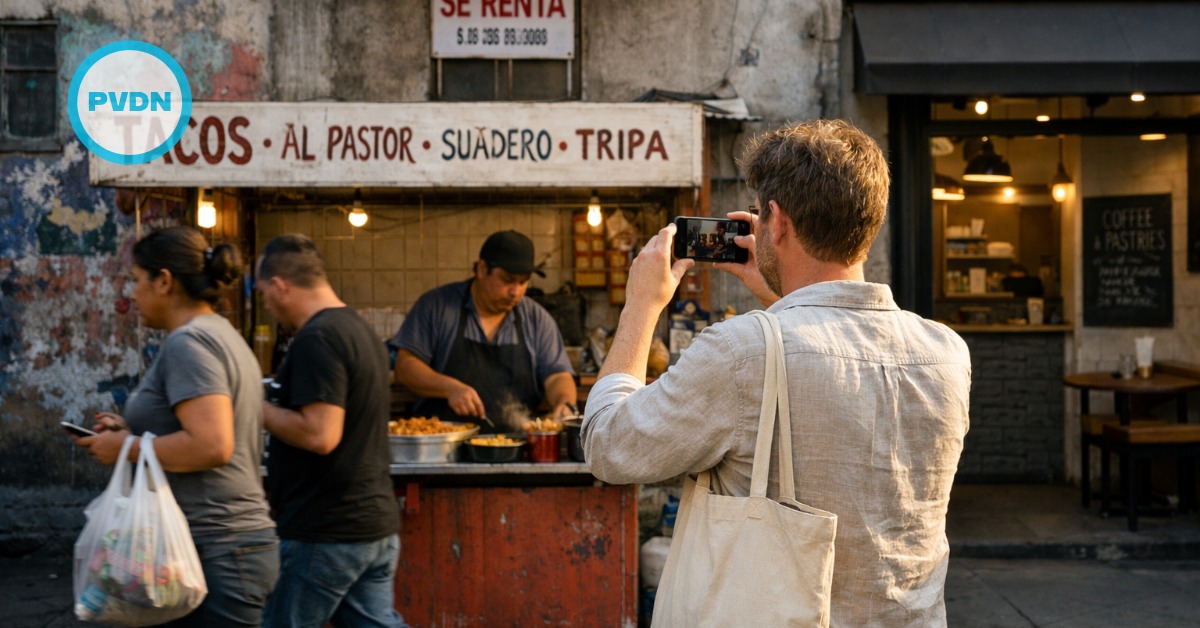
Respect “no” and boundaries—especially around photos, ceremonies, homes, and private spaces. Tourism is saturated with cameras; Urry’s account of the tourist gaze makes clear how visual capture is woven into modern tourism. But not everything you can photograph is yours to publish, tag, or turn into content.
Be curious about history and local politics—not just food and beaches. Because the reality you’re walking through includes policy (housing, development, regulation), not just aesthetics. In Mexico City, the public debate over tourism, short-term rentals, and displacement is not theoretical; it has been openly contested, protested, and politicized.
Now, the quick “replace this with that” toolkit—small phrasing shifts that change the posture underneath:
Replace “Where do the locals go?” with “What’s a respectful way to enjoy this place?”
Replace “I want authentic” with “I want to understand what I’m looking at.”
Replace “hidden gem” with “someone’s neighborhood.”
Replace “cheap” with “fair.”
And here’s the core insight that makes the whole thing click:
“‘Authentic Mexico’ is often just Mexico without friction—without paperwork, without language barriers, without poverty you can’t ignore, without development you didn’t approve, without locals who have their own priorities. That isn’t authenticity. That’s control.”
If you want “real Mexico,” stop hunting and start participating—quietly, consistently, without needing a story out of it.