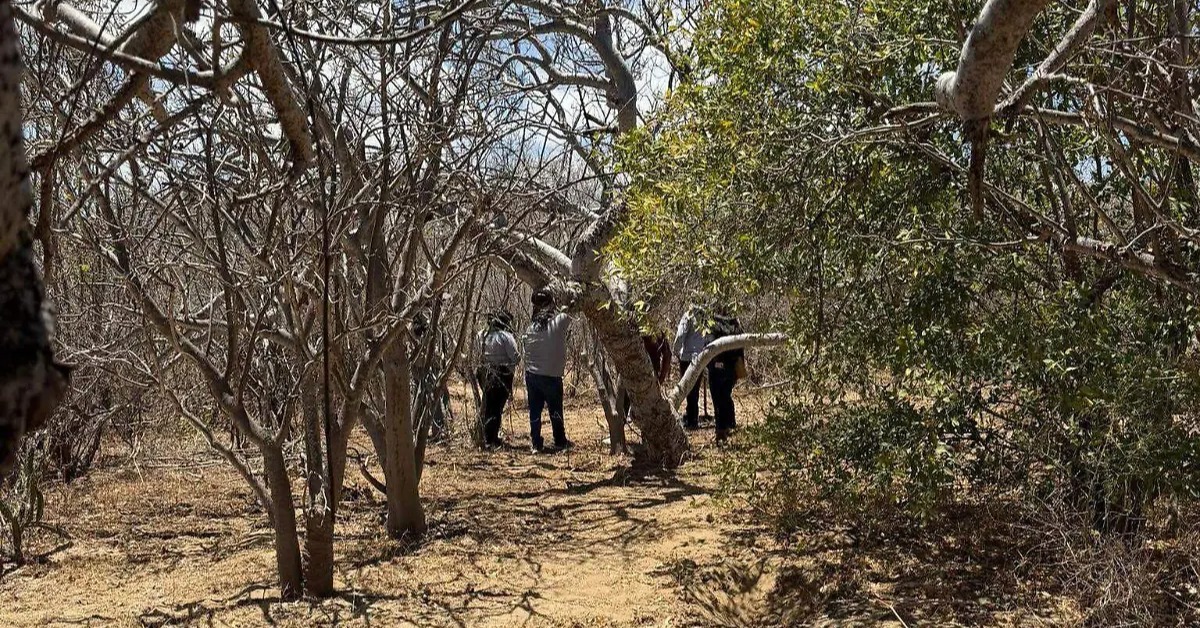
Three clandestine graves were found in less than a week in San José del Cabo, according to reports from local search groups and media in Baja California Sur. The discoveries were made between April 26 and May 1 by Madres Buscadoras de Los Cabos. Authorities are still working to identify the remains, while families of missing people are being urged to provide DNA samples.
Three graves found in less than a week
The search for missing people in Los Cabos has taken another difficult turn after the discovery of three clandestine graves in San José del Cabo in less than a week.
The findings were reported between April 26 and May 1 by Madres Buscadoras de Los Cabos, a local search collective largely composed of relatives of missing people. Searchers reported at least four bodies, all presumed to be male.
The first discovery was made on April 26 in a despoblado area near the San Lázaro dam, outside San José del Cabo. Searchers reported finding the skeletal remains of one man.
Five days later, on May 1, the same collective reported another positive search in San José del Cabo. Two additional clandestine graves were found. In one, searchers reported two possible male bodies. In the second, they reported another presumed male victim.
The identities of the bodies had not been confirmed publicly. Formal identification depends on forensic work, including DNA testing and comparison with samples from relatives of missing people.
Seven clandestine graves in Baja California Sur in one week
Human remains found in a clandestine grave in Santa Anita
Mexico May Need 150 Years to Identify Unclaimed Bodies
What searchers say they found
The May 1 search was described as the result of days and months of field work by the collective. Searchers said the first of the two graves contained what appeared to be two male victims. The second grave reportedly contained another person, also presumed male.
Some details shared by the collective included clothing and physical characteristics that could help families recognize a possible match. Those details are important, but they do not replace forensic identification.
In disappearance cases, families are often asked to provide DNA samples. Those samples can later be compared with remains recovered from graves, open fields, ravines, construction zones, or other search areas.
That process can take time. For families, each delay can mean another week or month without certainty.
A tourist destination with a deeper local crisis
Los Cabos is known internationally as a resort destination. For many visitors and foreign residents, the area’s image is tied to beaches, hotels, restaurants, golf courses, and real estate growth.
But Los Cabos is also a working municipality with ordinary neighborhoods, rural edges, arroyos, and isolated areas. Those are often the places where search collectives carry out field work.
The latest findings do not mean tourist zones are suddenly unsafe. They do show that the area is not separate from Mexico’s wider missing persons crisis.
For residents, including foreigners who live in the region, the discoveries are a reminder that public safety is not only measured by policing along tourist corridors. It is also measured by whether families can find answers when a loved one disappears.
Why clandestine graves are so hard to process
A clandestine grave is an illegal burial site used to hide bodies or human remains. These sites can be difficult to identify, protect, and process.
Search collectives often rely on anonymous tips, local knowledge, soil changes, odors, vegetation patterns, and experience from previous searches. Some searches take place in remote areas. Others happen near populated zones.
Once a site is found, authorities must secure the area, recover the remains, document evidence, and send material for forensic analysis. If several bodies are found in one place, the work becomes more complicated.
Time also matters. Heat, soil, water, animals, and human disturbance can damage evidence. In some cases, remains from different people may be mixed, making identification harder.
This is why search groups continue to ask families of missing people to provide DNA samples. Without a matching family profile, recovered remains may stay unidentified.
Families have become searchers
Across Mexico, relatives of missing people have formed search collectives because many families believe official searches move too slowly or stop too soon.
These groups are often led by mothers, wives, sisters, and daughters. Their work is usually described as humanitarian. They say they are not searching for suspects. They are searching for their loved ones.
That distinction matters. Families often say they are not trying to do prosecutors’ jobs. They are trying to end the uncertainty of not knowing whether someone is alive, dead, detained, hidden, or buried.
In Baja California Sur, search collectives have reported repeated discoveries in La Paz, Comondú, and Los Cabos. Several recent searches have involved coordination with search commissions, forensic teams, prosecutors, the Navy, or the National Guard.
Even with official support, families remain central to the process. They are often the ones pushing for searches, sharing missing-person flyers, collecting tips, and keeping cases visible.
Baja California Sur has seen growing concern
The discoveries in San José del Cabo come as Baja California Sur faces renewed concern over disappearances.
Recent registry-based analysis has placed the state among the highest in the country for missing and non-located persons by population rate during the first months of 2026. Local reporting has also pointed to La Paz and Los Cabos as two of the municipalities with the heaviest concentration of recent cases.
The numbers should be read with care. Missing-person data in Mexico can change as people are found, records are corrected, and reports are updated. Some people are alive. Others are found dead. Some remain missing for years.
Still, the direction of the concern is clear. Families and search groups say the problem has not gone away. The discovery of more graves adds weight to that concern.
What happens next
The next step is forensic processing. Authorities must determine how many victims were recovered, their biological profiles, possible causes of death, and whether they match any missing-person reports.
For families, the most urgent issue is identification. A body found in a grave does not automatically become an answer. It must be named.
That requires DNA testing, careful handling of remains, and communication with families. It also requires enough forensic staff and resources to avoid long delays.
In Mexico, the backlog of unidentified bodies and remains is one of the main barriers to closure. Each new discovery can bring hope to some families, but it also adds pressure to a system already carrying thousands of unresolved cases.
For now, the San José del Cabo findings remain part of that larger search for truth. Three graves were found. At least four bodies were reported. The names are still pending.