

At five in the morning, a small drama plays out above the streetlights. Somewhere on your block, a pump clicks on, a float valve lifts, and a rooftop tank starts to swallow the night’s pressure before the city wakes up. A neighbor hears the faint rattle through the ceiling, rolls over, and goes back to sleep. For that household, the day begins with certainty: there will be water to boil, water to shower, water to rinse the school uniforms. That certainty does not come from a government guarantee. It comes from plastic, gravity, and the money they have already spent to make the system work for them, even though it cannot.
Rooftop water tanks—tinacos—are not architectural quirks or an aesthetic of “Latin America from above.” They are the quiet hardware of a national compromise with intermittent service, uneven pressure, and pipes older than most of the buildings they feed. Look down from any pedestrian bridge and you can read a neighborhood in black and beige drums: who can stockpile, who must stretch, who pairs a tank with a ground-level cistern and a booster pump, who tapes a cracked lid because the next cleaning is already overdue. Seen this way, tinacos are not accessories. They are the country’s real water policy—implemented, funded, and maintained one household at a time.
The schedule nobody votes on
Ask a utility engineer to describe a city’s water day, and they will talk about sources, pumps, pressure zones, and the ballet of valves that move limited supply where it is needed most. Ask your neighbors and they will tell you a simpler story: the water “sube” at night, or only on weekends, or “cuando quiere.” Utilities call it tandeo—delivery by schedule or rotation—because supply cannot meet demand at constant pressure. Whatever name you use, the effect is the same. The grid breathes in pulses rather than a steady flow. Buildings at the end of a line or the top of a hill feel the low points first. The block learns, adjusts, and invests.
This is why the rooftop tank exists. It is a pressure buffer, a time machine that converts two hours of nighttime flow into twelve hours of daytime taps. The tank lifts risk off the public system and lays it gently on the household. Gravity, unlike a municipal pump station, does not call in sick, and so the city’s most reliable distribution technology becomes a drum on the roof.
How a household builds a miniature utility
Once you see a tinaco as infrastructure rather than furniture, the rest of the picture comes into focus. A working rooftop system has the same elements as the public network—storage, pressure, valves, and maintenance—only scaled to the size of a family. Many homes start with a cistern under the driveway or in a service patio to catch whatever arrives from the street main. A small electric pump pushes that water up to the tank when the city’s pressure is too weak to climb the building on its own. The tank feeds the apartment or house by gravity. A float valve decides when to stop; an overflow pipe keeps the slab from flooding if the valve sticks. The entire system relies on one more variable most people never consider until it fails: electricity. When the meter is off or the breaker trips, pressure stops at the kitchen sink, no matter how full the tank might be.
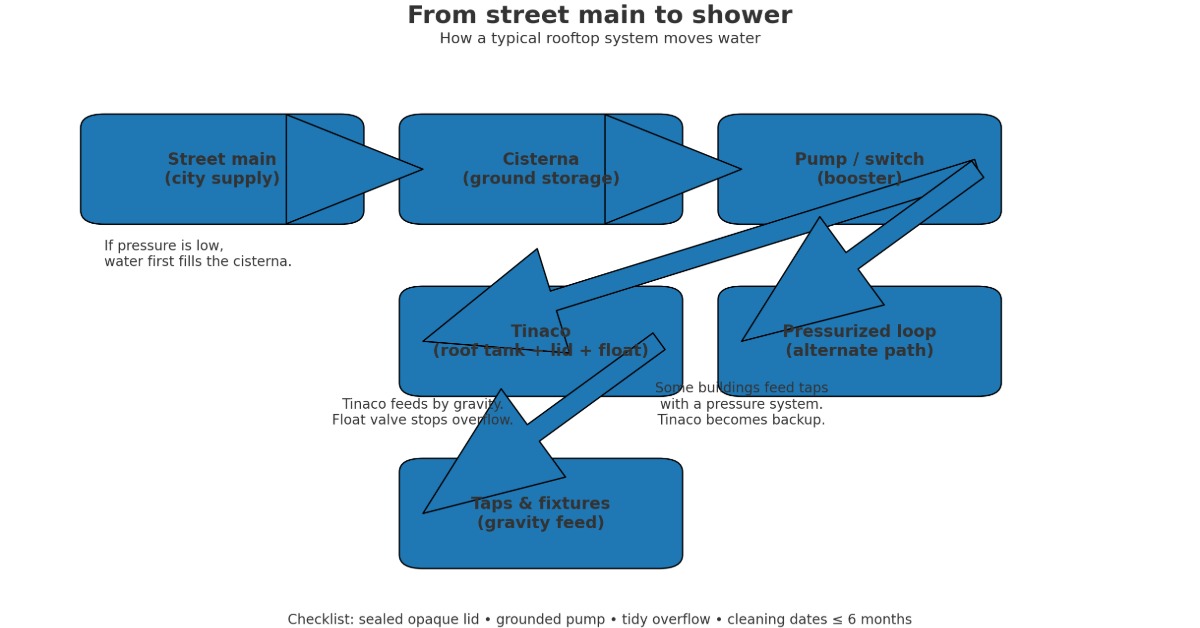
From the street main to the shower
None of this is free. A tank is a purchase and an ongoing bill. Families pay to install it and route the plumbing. They wired a pump and added a monthly draw to their electricity load. They hire someone to clean the tank and the cistern at least twice a year if they can afford to, because sunlight and warm water grow algae and biofilm on every interior surface. They replace the float valves and seals that fatigue. They buy a new lid when the old one cracks and lets in dust and insects. In bad weeks, they call a pipa—a water truck—to top up what the city did not send. Add those lines together, and you arrive at a second water budget that never shows up on a utility bill.
Quality is a calendar, not a promise
If you keep the lid sealed, clean on schedule, and your pipes are not shedding rust, stored water can meet standards. But a tank is unforgiving of neglect. A loose lid lets sunlight in, and sunlight makes algae bloom. A cracked overflow is an open invitation to roaches. Sediment from the street main drops to the bottom, where it sits until a refill stirs it, and the first second of your shower runs brown. The most significant risk is the most invisible: residual chlorine, which protects against microbial growth, fades as water sits. Households respond in predictable ways—filters under the sink, jugged water for cooking, and a mental clock that starts ticking the minute the cleaning crew leaves the roof.
For renters, the problem is compounded by distance from the decision. Landlords view maintenance as a cost center; tenants live with the consequences. A simple pair of questions—when was the tank last cleaned, and who services the pump—tells you more about a building than any brochure. A good answer usually arrives with a date and a name. A shrug tells its own story.
The quiet rooftop economy
Every gap in a public service becomes someone’s job. Tinacos have built an entire micro-economy that most city plans never count. There are the prominent players—tank manufacturers, pump brands, and plumbing supply stores—but the essential actors are local. Installers know which streets never see nighttime pressure and recommend larger tanks there. Small cleaning crews organize their weeks around schools and heat waves. Pump technicians carry a mental registry of buildings whose breakers trip when the night refill coincides with elevator traffic. Pipa drivers run priority routes like air-traffic controllers in summer, answering phones first from the addresses that always pay quickly.
There is also the industry of reassurance. Purification kiosks sell “peace of mind” by the liter to families who do not trust what comes out of their taps, even if their storage is clean. Landlords promote “pressurized water” in listings because it sounds like luxury, and for many tenants it is: a promise that showers will not sputter when the pump grid stumbles. What looks like a free market in rooftop hardware is a highly coordinated response to municipal fragility.
Risk lives in the shortcuts
On a healthy roof, a tank is unremarkable. On a lazy roof, it is a hazard. The difference is almost always in the shortcuts. An opaque lid that fits tightly keeps light and insects out; a taped garbage bag cannot. A properly grounded pump with protected splices is dull to look at and safe to stand near; a tangle of electrical tape and exposed copper is neither. Overflow pipes should discharge into drains rather than onto slabs, because water that dribbles for days destroys the concrete it is meant to protect. A float valve is not a forever part; when it leaks, the household pays twice, once on the water bill and again when the roof begins to stain.
These are not moral failings. They are the predictable outcomes of systems that ask households to become operators. A city that relies on millions of tiny utilities relies, by definition, on millions of tiny maintenance calendars. Some people keep them. Some people try. Some people cannot.
What it costs to outsource reliability
It is tempting to reduce the tinaco to a number—a one-time purchase amortized over a decade, a pump replacement every few years, two cleanings a year, the occasional emergency delivery. Tally it carefully, and you find that households spend real money to insure themselves against an unpredictable public service. The costs are not catastrophic for most families. They are relentless. They show up as minor hits scattered across the year: a Sunday spent waiting for the cleaning crew; a weekday lunch ruined by the smell of a pump about to fail; a water truck called on the third day of a school outage because everyone has run out of patience and plastic jugs.
This is the part of the policy debate that usually disappears into averages. A city’s coverage rate can be high, its per-capita supply respectable, its leak-reduction targets on track. None of those metrics asks how much households spend to turn that macro water into water at the shower head at 7:00 a.m. Tinacos make that conversion possible. They also make the actual cost of reliability private.
What it would take to shrink the rooftop role
Not every city is doomed to a skyline of tanks, and even where they persist, their job can change. The playbook is not magic. Utilities that shrink the rooftop role tend to do three things well. First, they attack leaks until nighttime pressure returns to streets that have learned to expect silence. Second, they divide the network into zones sized for the real topography, then keep those zones honest with instrumentation rather than hope. Third, they align pricing and enforcement so it is cheaper to maintain a building’s internal system than to waste water through neglect.
None of this flips a switch. Tanks do not vanish because a mayor says they should. They fade into the background as backups rather than lifelines. They become part of resilience rather than the definition of service. The sign that a city is moving in the right direction is not a press conference. It is a household that forgets to check the pump breaker for a month without noticing.
Reading a city from the roofline
If you are lucky enough—or permitted—to see a neighborhood from above, try reading it as infrastructure rather than scenery. New towers with pressurized systems and hidden cisterns tell one story: consolidated wealth, predictable maintenance, a service economy that can be outsourced to building management. Walk-ups with a different brand of tank on each roof tell another: families solving problems unit by unit, with whatever the hardware store carries and the installer recommends. A block with fresh lids and neat overflows suggests a collective decision to keep things in order; a block with green halos around every tank and water stains under every parapet suggests a slow-motion failure no dashboard will capture.
Seen this way, the city’s water policy is not an ordinance or a five-year plan. It is the pattern of investments households make to manage risk. It is a drone photograph that doubles as a budget. It is the sound of a pump at five in the morning and the relief in a parent’s face when it doesn’t trip the breaker.
The most honest measure of progress may be the least dramatic: the day a neighbor forgets they own a tinaco because the tank is clean, the lid fits, the pump hums, and the taps run without anyone ever texting “ya subió el agua.” Until then, look up. The roofline is telling you how the city works—one drum at a time.