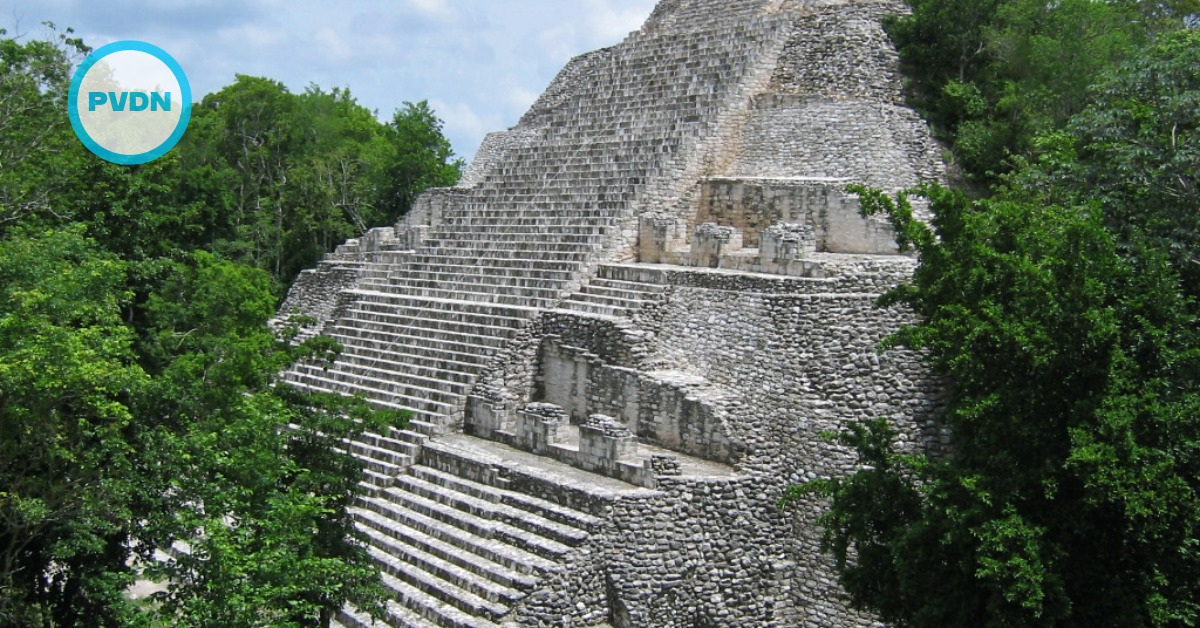
Mexico has reopened Cobá’s 42-meter Nohoch Mul pyramid after six years, with a new wooden staircase to protect the stone steps.
After six years of silence on its upper terraces, the Nohoch Mul pyramid in Cobá is climbable again. The 42-meter structure, the tallest pre-Hispanic building in the northern Maya area, has reopened its staircase to the public with a new wooden system designed to protect the ancient stone beneath.
The change was marked this Sunday in the jungle of Tulum municipality, where Mexico’s federal culture authorities cut the ribbon on the new ascent route and a refurbished visitor services building. The investment, close to five million pesos, forms part of the Program for the Improvement of Archaeological Zones, or Promeza, which is tied to the broader Tren Maya rail project running across the peninsula.
For Cobá’s ejido authorities and residents, the day marked the closure of a long chapter that began in 2019, when the original stone steps were closed to protect the monument after years of heavy foot traffic. Pandemic restrictions later kept the structure off-limits to climbers, even as the rest of the site reopened, turning the pyramid into a look-but-not-touch attraction for an entire generation of visitors.
New staircase and restored access
The new stairway is made of regional hardwoods and runs over the face of Nohoch Mul, allowing people to ascend and descend without stepping directly on the ancient blocks. Engineers and archaeologists first carried out a detailed topographic survey of each step, building a precise model of the pyramid’s surface before inserting anchors and supports. The result is a two-lane structure with built-in rest points that is meant to feel more like a controlled climb than the scramble many visitors remember from past decades.
Specialists from the National Institute of Anthropology and History describe the intervention as preventive conservation more than construction. Before the wooden structure went in, workers reinforced weakened sections, re-leveled eroded steps and conducted subsoil tests to avoid concentrating weight on vulnerable areas. The aim is straightforward: keep people enjoying the view from the top while slowing the wear that once threatened the monument itself.
The staircase was built not by an outside contractor but by carpenters from Noh Bec, a Quintana Roo community with long experience working regional woods such as tzalam, mahogany, parota and chicozapote. For Cobá’s ejidatarios, who had been asking since 2019 for a solution that would both protect the site and restore the climb, that decision matters. It keeps part of the project’s budget in local hands and underscores that the pyramid’s future depends as much on surrounding communities as on national heritage policy.
Alongside the new stairway, the site now has an upgraded services unit near the entrance. The building concentrates basic visitor attention in one space and is intended to make it easier to manage larger crowds, a likely scenario as the Tren Maya line brings more people into the region. Officials frame these changes as a way to offer better conditions for tourism while reinforcing the message that Cobá is a living landscape, not just a backdrop for selfies.
The reopening also comes amid an ongoing debate in the heritage world about whether such large structures should remain climbable at all. Some specialists have criticized wooden staircases installed on pyramids, arguing that they can still stress the underlying stone and alter the monument’s appearance. Others counter that controlled, supervised access on a secondary structure is safer for both people and ruins than letting visitors wear down the original steps. Cobá is now one of the clearest test cases for that compromise in the Maya area.
Nohoch Mul pyramid
Even before this latest chapter, Nohoch Mul occupied a special place on the map of Maya tourism. Rising above the low jungle of northeastern Quintana Roo, the pyramid crowns one of Cobá’s main architectural groups and once anchored a city that stretched across roughly 70 square kilometers. Archaeological research suggests that at its peak, between the third and seventh centuries, Cobá housed tens of thousands of people and maintained far-reaching trade ties with other major centers such as Chichén Itzá and Tikal.
The structure’s name, often translated as “great mound” in Yucatec Maya, reflects both its size and its role as a focus of ceremonial life. Today, visitors who make the climb face nearly 120 narrow steps before reaching the small temple at the top. From there, the view opens over the forest and nearby lagoons, with only a few modern constructions visible on the horizon. It is that mix of physical effort, vertigo and quiet at the summit that has made the pyramid one of the most talked-about climbs in the region.
Recent work at Cobá under the Promeza program has gone beyond the staircase itself. Archaeologists have been updating epigraphic readings of the city’s stelae, refining its chronology and highlighting the role of women in its ancient political life. Conservation teams have also been improving paths and signage across the site to better distribute visitors among its ball courts, observatories and lesser-known groups, easing pressure on Nohoch Mul while giving people more reasons to linger.
For local residents, the reopening of the pyramid’s ascent is not just about ticket sales or social media visibility. It represents a new agreement about how the site should be used, who benefits from the flow of visitors and how the community’s voice is heard when decisions are made about their heritage. As Cobá prepares for the additional attention that the Tren Maya corridor will bring, the wooden staircase on Nohoch Mul stands as both a literal and symbolic bridge between past and present, inviting people up while reminding them that every step has a cost.