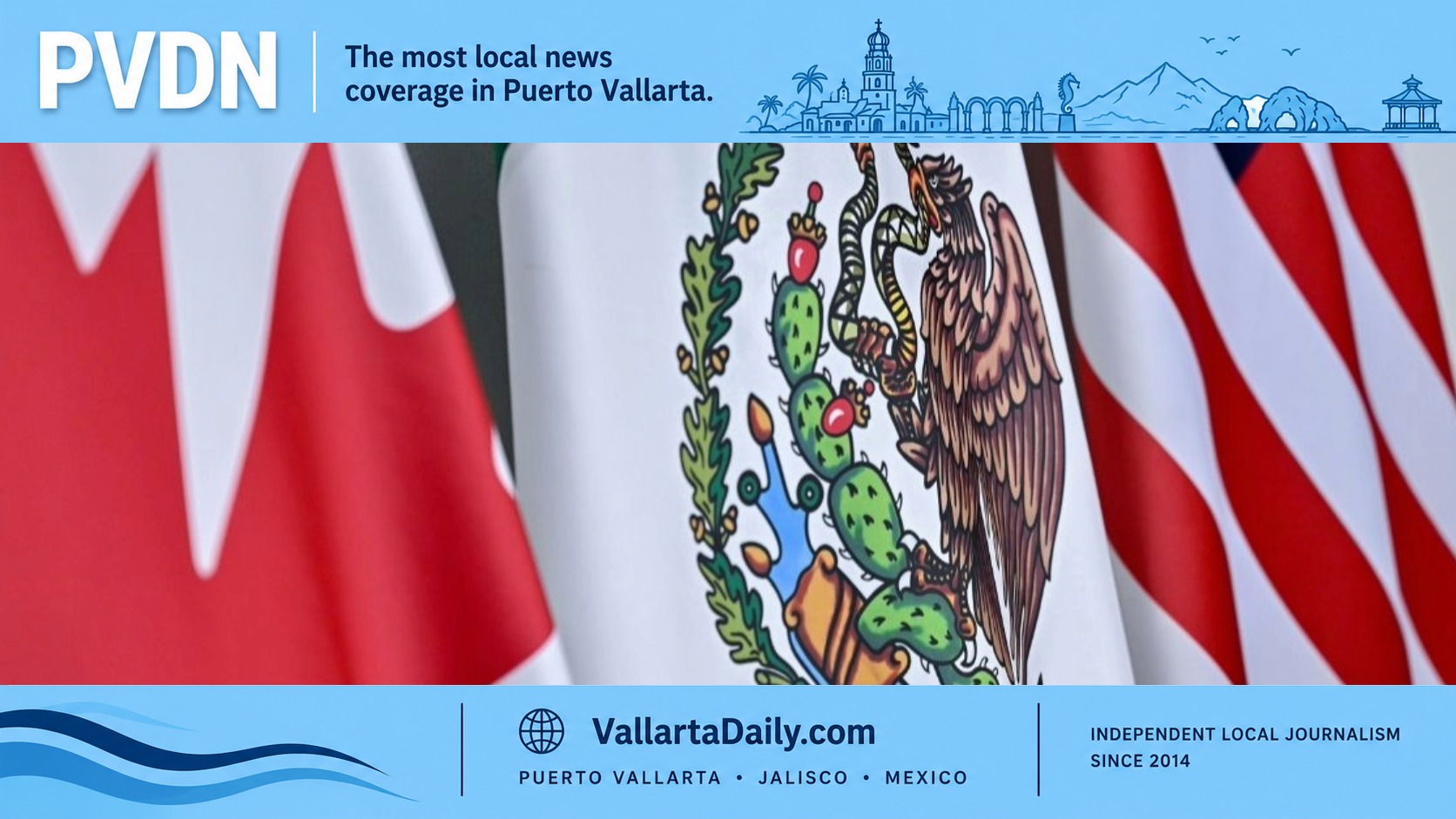
Puerto Vallarta, Jalisco, June 30, 2026 – The United States is expected to refuse a 16-year extension of the U.S.-Mexico-Canada Agreement this week, a move that would not end the trade pact immediately but would place North America’s largest commercial framework under recurring review through 2036.
Reuters reported Tuesday that the Trump administration is preparing to formally declare that it will not extend the agreement, known in Mexico as T-MEC and in the United States as USMCA. The report was also carried by Aristegui Noticias, which said the expected U.S. position would trigger the review process built into the treaty’s sunset clause.
A refusal to extend the pact this week would not cancel USMCA on July 1. Under Article 34.7 of the agreement, the three countries must conduct a joint review six years after the pact entered into force. If all three governments confirm that they want to continue the agreement, it is extended for another 16 years. If one country does not confirm, the Free Trade Commission must meet every year for the rest of the treaty’s term, which runs to July 1, 2036.
That leaves the agreement in a period of prolonged uncertainty rather than an immediate collapse. The risk for Mexico is not a sudden break in trade rules this week, but a prolonged negotiation cycle that could affect investment decisions, factory planning, automotive supply chains, and financial markets.
President Claudia Sheinbaum said Tuesday that Mexico had signed a letter supporting a 16-year extension of the pact. Reuters reported that Mexico’s position is to preserve the agreement, while Canada has also signaled support for maintaining the North American framework.
Washington’s expected refusal is tied to broader U.S. demands for changes, especially in autos, regional content rules, steel, aluminum, and protections against Chinese goods moving through North American supply chains. Reuters reported that U.S. Trade Representative Jamieson Greer has already scheduled another round of talks with Mexico for the week of July 20, suggesting that Washington’s expected position is also a negotiating tactic rather than the end of discussions.
The economic stakes are unusually high in Mexico. The U.S. Trade Representative’s Mexico trade summary says goods trade between the United States and Mexico totaled an estimated $872.8 billion in 2025, with U.S. imports from Mexico reaching $534.9 billion. The same USTR summary says USMCA supports nearly $2 trillion in U.S. goods and services trade across North America.
Mexican government data also shows how concentrated the relationship remains. Data México reported that in April 2026 alone, Mexico exported $59.177 billion in goods to the United States and imported $22.342 billion, resulting in a $36.835 billion monthly surplus.
The most immediate effect for Puerto Vallarta readers is likely to be financial rather than regulatory. USMCA does not govern tourist entry, residency permits, or the right of Americans and Canadians to live in Mexico. But trade uncertainty can move the peso, influence inflation expectations, and affect the prices of imported goods, construction materials, vehicles, electronics, and other products that filter into household and business costs.
PVDN has been tracking the review for months, including the U.S.-Mexico trade talks that moved into new rounds in June and the formal July 1 review date.
North America may keep trading under USMCA rules for now, but investors and exporters may have to price in annual political risk unless the three governments reach a later agreement.
A formal statement is expected after the July 1 review meeting. Economy Secretary Marcelo Ebrard is expected to provide Mexico’s next update after the review process begins.