
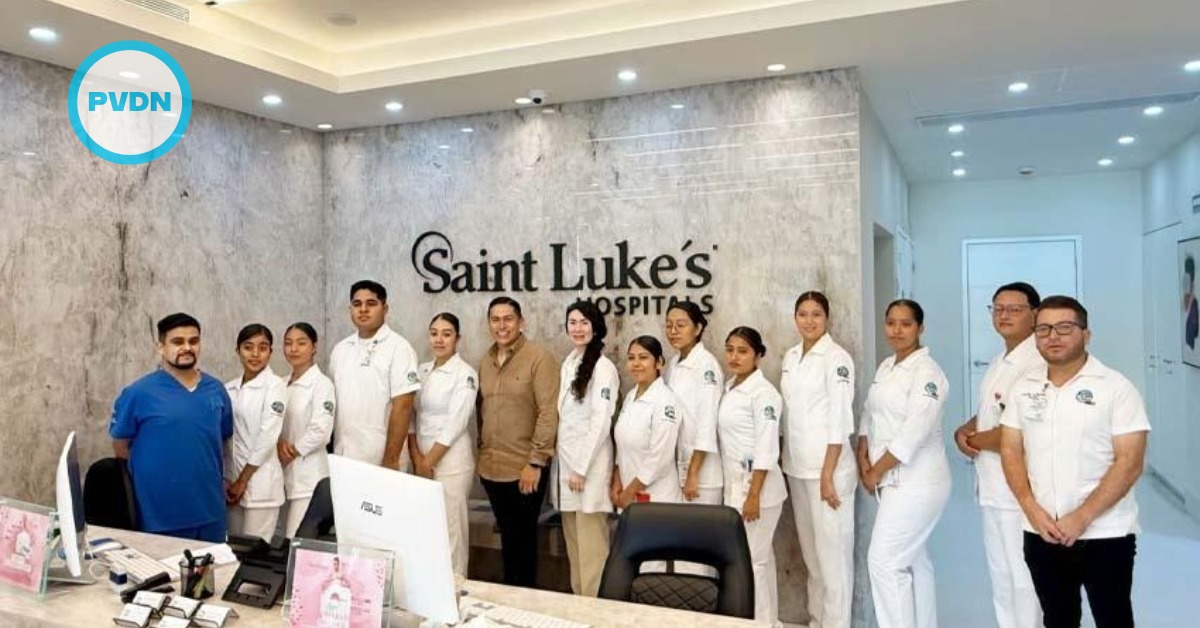
Cabo San Lucas is getting a new generation of nurses from its own backyard. The first cohort of the UABCS Los Cabos nursing degree has left the classroom and stepped into real hospital corridors, beginning clinical rotations at Saint Luke’s Hospitals and the General Hospital of Cabo San Lucas. For the students, it is the first time they are responsible for real patients, under supervision. For the young degree program, it is a milestone that turns planning on paper into daily work at the bedside.
The group arrived at the two hospitals, accompanied by the program coordinator, Sandra Lilia Martínez Alcaraz, and the faculty member, Jesús Alberto Reyes Tordecillas. At Saint Luke’s they were welcomed by hospital directors Mario Trejo and Anel Cuevas, along with chief nursing officer Óscar Castillo. At the General Hospital of Cabo San Lucas, director Ayvlis Cárdenas and head of nursing Brenda García received the university team and the students who will now rotate through different services.
Under the university’s academic plan, this first stage of clinical training begins in the third semester of the degree. From this point onward, students start combining theoretical courses with supervised practice inside health institutions. It is a demanding step, because clinical work exposes them to real schedules, real patients, and real team dynamics long before they graduate.
UABCS Los Cabos nursing
The nursing degree at the Universidad Autónoma de Baja California Sur is one of the institution’s first programs in the health sciences area. In June 2025, when a state inter-institutional health committee evaluated the study plan, the program was barely a year old and already treated as a pillar in the university’s expansion into health fields. That visit reviewed documents and facilities as part of a broader effort to align local training with national standards for health professionals.
The university’s official description of the program emphasizes community service, empathy, and respect for patients’ dignity. The curriculum combines basic sciences, public health, clinical skills, and mental health, and requires students to complete 960 hours of clinical practice between the third and eighth semesters. Those hours, spread across different specialties and care settings, are where students are expected to apply what they have seen in lectures to situations that unfold in real time on hospital floors.
Demand for the new health careers has been strong. Earlier this year, university figures showed more than 500 applicants competing for 140 places in nursing and psychology across the La Paz and Los Cabos campuses. At the same time, UABCS has announced new infrastructure for health studies, including dedicated spaces for classrooms and laboratories. For local families, the chance to study a health profession without leaving the state offers both a new academic route and access to a labour market where the university itself describes nursing graduate job opportunities as high.
Hospitals open doors to first cohort
In Los Cabos, the demand for trained nurses is visible inside the hospitals now receiving the UABCS students. Saint Luke’s, which actively recruits specialized nursing staff in Cabo San Lucas, describes its work environment as demanding and focused on complex patients, teamwork, and continuous improvement in patient care. The General Hospital of Cabo San Lucas, as part of the public health network, attends a wide range of medical, surgical, and emergency cases for the local population. In both settings, clinical rotations turn hospitals into teaching spaces and give staff a direct role in educating future professionals.
For UABCS Los Cabos, this step is also about consolidating ties with the local health system. The extension’s leadership has highlighted that clinical practice from the third semester onward is written into the study plan and forms part of the professionalization phase for students. University officials have also underlined the role of the nursing coordination, led by Martínez Alcaraz, in securing agreements with different health institutions in the municipality so that students can complete each stage of their training.
The academic program for nursing at UABCS states that clinical practice will continue, in different forms, until the eighth semester. In that sense, this first cohort is opening a route that the generations behind them are expected to follow. As the committee evaluations progress and new facilities come online, the Los Cabos extension is positioning its nursing students not only as future graduates but also as part of the current response to local health needs, always under supervision and within the framework set by the hospitals.
For now, the first generation is taking its initial steps in that environment. Their presence in the wards marks a visible change for patients and staff, who will now share their daily routines with uniformed trainees from the local public university. For students, the experience will help define their professional identity and test the values embedded in their curriculum, from a commitment to community service to respect for each patient’s dignity. For Los Cabos, it signals that the region is beginning to train more of its own nurses, inside the same hospitals where many residents receive care.