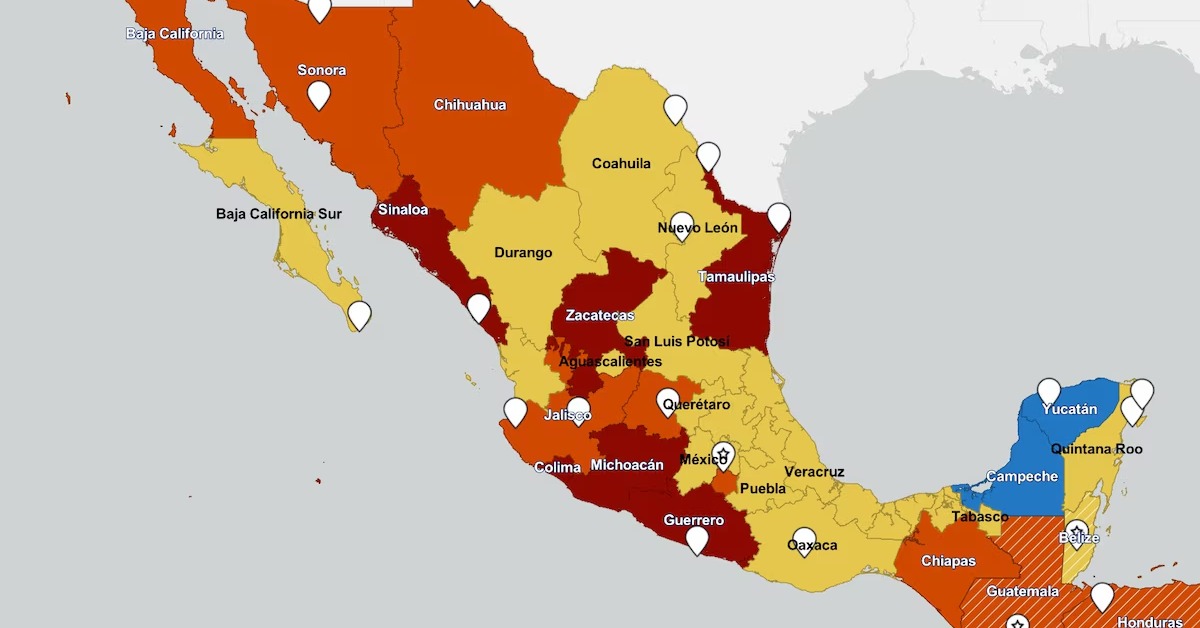
A U.S. State Department travel map is drawing attention after showing six Mexican states in the same top warning category used for some of the world’s riskiest destinations. The headline sounds sweeping, but the full picture is more layered. Mexico is not under a countrywide Level 4 advisory. Instead, the warning is split by state, with major tourist and expat destinations spread across lower tiers. Here is what changed, what did not, and what the map actually means for travelers.
What the map shows
A U.S. State Department travel map is drawing renewed attention because six Mexican states appear at Level 4, or do not travel, the agency’s highest warning. Those states are Colima, Guerrero, Michoacán, Sinaloa, Tamaulipas, and Zacatecas. That places them in the same advisory tier used for countries such as Iran, Russia, and Somalia. But the comparison needs context. Mexico is not under a nationwide Level 4 advisory. The country as a whole remains at Level 2, which tells U.S. travelers to exercise increased caution.
The important detail is that the U.S. system breaks Mexico down by state. That creates a mixed map rather than a single countrywide label. Some of the country’s best-known destinations fall below the highest tier. Jalisco, which includes Puerto Vallarta, is listed at Level 3. Quintana Roo, home to Cancún, Playa del Carmen, and Tulum, is at Level 2. Mexico City is also Level 2. Yucatán and Campeche sit at Level 1, the lowest advisory level.
Why the warning needs context
For international readers, the most useful way to read this story is to separate the headline from the system behind it. The advisory is a U.S. government warning framework for U.S. citizens and legal residents. It is meant to describe risk and explain how much help the U.S. government may be able to provide in an emergency. A Level 4 warning means the department sees life-threatening risks and advises Americans not to travel there.
That does not mean every place inside a Level 4 state looks the same on the ground. The advisory itself shows how uneven the map can be. In some Level 4 states, the U.S. still allows its own employees to use narrow routes or limited zones. In Sinaloa, for example, official travel is restricted to specific areas of Mazatlán, Los Mochis, and Topolobampo. In Colima, limited travel is allowed in parts of Manzanillo and on certain highways. The message is still restrictive, but it is also highly geographic.
This is why broad comparisons can flatten an important distinction. A state-based advisory inside Mexico is not the same thing as a single national warning covering an entire country. The label may be identical, but the underlying conditions, travel limits, and emergency support can differ sharply. For readers living in Mexico, or visiting often, that difference matters more than the headline does.
What it means for travelers and expats
For travelers, the practical takeaway is simple. Check the exact state, not just the country. A trip that includes an airport arrival, a road transfer, and a few inland stops can move across different advisory levels in a short distance. The U.S. guidance also places weight on highway travel, remote areas, nighttime movement, and access to emergency services. Those details matter for road trips, day excursions, and long transfers between cities.
For expats already living in Mexico, the advisory may not match daily life in their neighborhood. Even so, it can still affect how relatives plan visits, how insurers assess risk, and how employers or institutions write travel rules. It can also shape international perceptions of places that are often discussed as if they were part of one single story. The current map does the opposite. It shows a country with sharply different risk profiles, where one state can be rated Level 1 while another is marked Level 4.
The bigger point is not that all of Mexico has moved into the highest danger category. It has not. The real story is that the U.S. is again highlighting how uneven its travel assessment of the country is. For anyone planning a visit or hosting family from abroad, that state-by-state detail is what matters most.
With information from U.S. Department of State