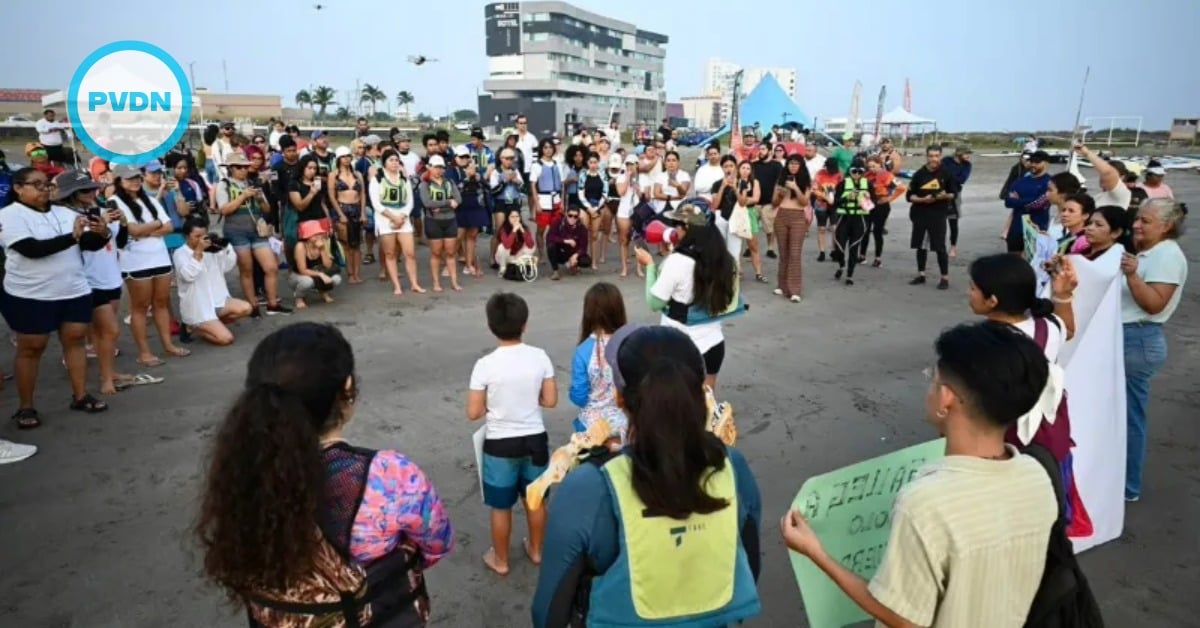
The march began in the water. Dozens of people launched kayaks and paddleboards off Playa La Bamba, while others lined the sand with hand-painted signs. Their demand was simple: stop the new south breakwater tied to the port expansion before La Gallega reef is gone for good. Veracruz reef protest organizers say the project would erase what remains of a living barrier that has already shrunk under a century of construction.
Activists argue the damage isn’t abstract. They contend La Gallega’s area has already been cut roughly in half and warn the breakwater would wipe out the rest, with knock-on effects for small-scale fishers and tour operators who rely on healthy reefs. Those are their claims; what is clear is that opposition to building directly over the reef has unified neighborhood groups and national NGOs in recent days.
La Gallega sits inside the Veracruz Reef System National Park, a federally protected area created in 1992. The park spans more than 65,000 hectares and includes dozens of reefs that help anchor local fisheries, draw tourism, and blunt storm waves before they reach the coastline.
In 2022, Mexico’s Supreme Court weighed in after residents challenged environmental approvals for the expansion. The justices found that previous authorizations evaluated the project “in a fragmented way” rather than as a whole and ordered a new, integrated environmental assessment. That ruling put guardrails around any future work affecting reefs and coastal wetlands.
Veracruz reef protest
So why are people back in the streets and on the water now? Because, despite the 2022 ruling, federal authorities have moved to restart key pieces of the expansion. In September, the Navy said it would proceed with a south breakwater more than three kilometers long, arguing the works comply with environmental law and oversight. That position has been echoed in responses to press inquiries.
Sunday’s “mar-nifestación” mixed a beach rally with a flotilla just offshore. Organizers framed the day as a defense of a living ecosystem, not simply a line on a map. They called for transparent, comprehensive environmental studies and for authorities to halt any fragmented approvals while that review happens. The mood was peaceful but insistent; chants carried over the chop as paddlers formed a loose line facing the harbor mouth.
Local voices also stress day-to-day impacts. Guides who take visitors to snorkel the park say clouded water and fewer fish have already made their jobs harder. Fishers talk about shorter trips and smaller catches. Scientists and conservation staff note that reef frameworks—built by living corals—are slow to recover once buried or shaded, which is why opponents say some damage would be “irreversible” on a human timescale.
Legally, the fault line is “fragmentation.” Environmental lawyers argue that carving the expansion into separate permits hides cumulative impacts, which is precisely what the Court warned against. They cite continuing approvals and procedures that, in their view, sidestep the mandate for a single, holistic review of everything from dredging to rock extraction for the breakwater. Authorities, for their part, maintain that the project is proceeding with all required studies.
What losing La Gallega would mean
Beyond biodiversity, reefs are natural infrastructure. They act like submerged breakwaters that sap storm energy, reducing coastal flooding and erosion. In a port city that knows hurricanes and northerlies, that service is not theoretical; it’s protection that can be measured in fewer lost beaches and less damage to homes and businesses. Economically, healthy reefs feed local markets and keep tours running in shoulder seasons, providing a steady income when cruise traffic dips.
La Gallega is also the park’s front door, the first line of coral heads visible from Veracruz’s waterfront. Losing it would change what people see and what they can do on the water, from fishing to beginner-friendly snorkeling. Scientists caution that transplanting corals or creating artificial structures rarely replaces the complexity of a mature reef built over millennia. Once buried under millions of tons of rock, that complexity doesn’t bounce back.
The immediate flashpoint is the south breakwater, but the broader question is whether Mexico can expand critical maritime infrastructure without sacrificing the ecosystems that shield its coasts. Protesters want the government to pause, conduct the comprehensive assessment ordered by the Court, and make the underlying science and modeling public. Officials say they are already following the law and that the project is under competent supervision.
What happens next will be decided in court filings and construction yards, but also on beaches like La Bamba, where neighbors, athletes, scientists, and fishers keep showing up. For now, the waterline is the meeting point of two visions: a bigger port to capture trade, and a reef that still does quiet work every time a swell rolls in. The question Veracruz faces is whether those two can truly share the same stretch of sea.