Puerto Vallarta, Jalisco, October 20, 2026 – Mexico’s Día de Muertos observances culminate November 1 and 2, when families honor deceased relatives with offerings, cemetery visits, and community gatherings.
The holiday’s most recognizable images are everywhere: orange flowers, decorated skulls, candlelit graves, and elegantly dressed skeletons. But understanding it begins with something more personal. Someone chose the food on an altar. The photograph identifies a person whose place in the family continues after death.
What does it mean to welcome the dead home?
That question connects the holiday’s religious history with the work families do today: preparing a favorite dish, cleaning a grave, finding an old photograph and telling children about relatives they never met. Public celebrations have expanded the audience for Día de Muertos, while these household acts continue to give it meaning.
In its description of Mexico’s Indigenous festivities dedicated to the dead, UNESCO identifies the central belief as the temporary return of deceased relatives and loved ones. Families prepare to receive them, arranging offerings at home and in cemeteries.
The observance also includes regional traditions. Dates, foods, ceremonies, and religious interpretations vary by community.
A visit that takes preparation
In much of Mexico, November 1 is associated with deceased children, often called angelitos, or little angels. November 2 is generally associated with deceased adults. Those popular customs overlap with the Catholic calendar’s All Saints’ Day and All Souls’ Day.
Preparations and observances can begin earlier. The distinction between a date on the national calendar and a community’s own ritual schedule matters: families may prepare offerings before the expected arrival of particular souls, then continue their observances through cemetery visits and farewells.
The National Institute of Indigenous Peoples’ explanation of the ofrenda describes households preparing children’s offerings on October 31. That preparation anticipates the visit associated with November 1.
Other communities distinguish people by how they died. Puebla’s cultural accounts, for example, describe observances beginning October 28 for people who died in accidents.
These differences explain why a single online calendar cannot fully describe how every Mexican family observes the season.
The ofrenda makes remembrance specific
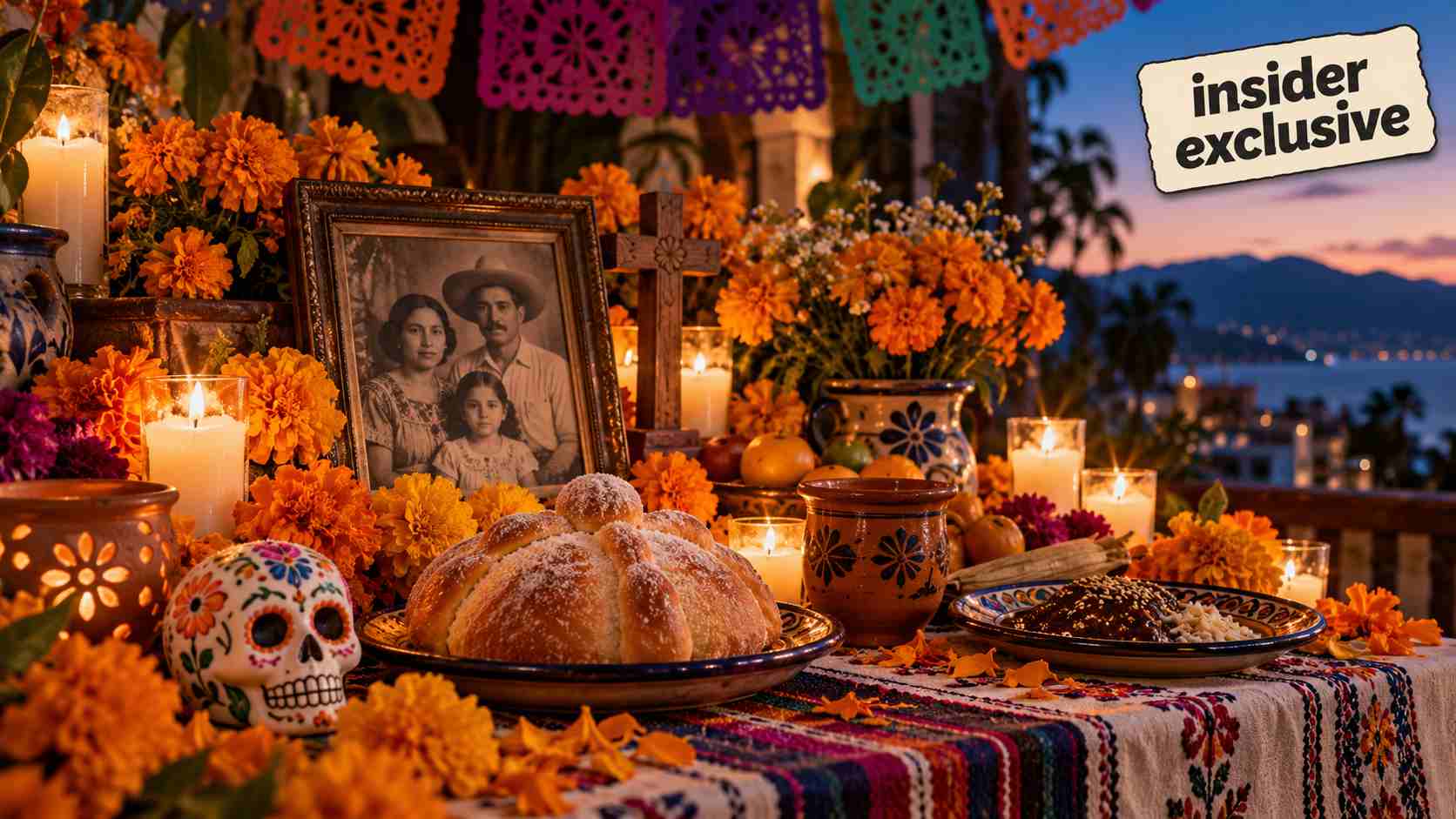
An ofrenda is an offering. The word also commonly describes the arrangement of food, photographs, flowers, and other objects placed on an altar.
Its purpose is hospitality directed toward the deceased.
The National Institute of Indigenous Peoples expresses that relationship in a phrase translated from Spanish: making an offering means “being close to our dead, to converse with their memory, with their life.”
That understanding helps explain why an altar may contain both religious objects and ordinary possessions. A photograph establishes who is being remembered. A favorite drink or dish recalls the person’s tastes. Toys and sweets may be included for a child.
The objects also carry ritual meanings. In the National Institute of Anthropology and History’s account of offerings, candles guide souls toward the altar, while food and water answer the hunger and thirst of their journey. Cempasúchil flowers can mark a path from a home’s entrance to the offering.
The orange and yellow cempasúchil is a marigold whose color and scent have become closely associated with the season. Mexico’s Agriculture Ministry describes its role as guiding returning souls, linking its physical presence to the belief that the dead need help finding their way.
Copal, an aromatic resin burned as incense, belongs to another sensory part of the welcome. Its smoke accompanies prayer and ritual purification. Salt also symbolizes purification, while cut-paper decorations, or papel picado, add color and movement.
Those explanations provide a starting point for reading an altar. Families and communities give particular objects meanings that no general guide can capture.
A useful example is the food itself. If an offering includes coffee, a soft drink, or a packaged snack, its presence may reflect the person being remembered. Researchers interviewed by UNAM have documented contemporary offerings containing foods from people’s everyday diets, including instant noodles and commercial sweets.
The offering remains personal because the person’s preferences determine what belongs there.
Indigenous roots and a Catholic calendar
Honoring the dead in Mexico long predates Spanish colonization. Indigenous societies understood death, relationships with ancestors, and ritual obligations to the deceased differently.
Among Nahua peoples, ceremonies associated with the dead also belonged to an agricultural world. Planting, harvest, abundance, and scarcity helped organize the relationship between living communities and the forces on which their survival depended.
UNAM archaeologist Diana Martínez Yrizar has linked offerings to those agricultural cycles, explaining that rituals sought help from the dead to secure good harvests. Remembering ancestors tied to the community’s ongoing needs.
The Catholic observances the Spanish brought also had a long history. All Saints’ Day and All Souls’ Day already provided occasions for prayer, remembrance, and offerings in Europe.
During colonization, Indigenous practices encountered those Christian observances within an unequal system of conquest and evangelization. Communities adapted, retained, and reinterpreted religious practices over generations.
An INAH account of the holiday’s development places the emergence of the combined celebration in colonial New Spain, bringing together Catholic feast days and Indigenous ceremonies honoring the dead.
The details of that history remain a subject of scholarly debate. Historians have challenged the familiar claim that today’s holiday is an unchanged Aztec ceremony.
In a discussion published by UNAM, historian Israel Álvarez Moctezuma describes the celebration that developed under colonial rule as “Indigenous, but colonial, not pre-Hispanic,” translated from Spanish.
His argument emphasizes the importance of European religious practices and the ways Indigenous communities made the observance their own under colonial conditions.
The modern altar carries evidence of that layered history. Maize-based foods and copal sit alongside Christian crosses and candles. Wheat bread, made from a grain introduced after the Spanish arrival, became one of the season’s best-known foods.
Over time, households added photographs, contemporary drinks and possessions belonging to the deceased. Each addition helped families recognize particular people within a shared ritual.
How remembrance became a national image
The development of Día de Muertos continued after independence.
In the 20th century, Mexican artists, intellectuals, and public institutions helped turn particular regional customs into widely recognized expressions of national identity.
Álvarez Moctezuma’s account highlights the role of postrevolutionary nationalism, especially during President Lázaro Cárdenas’ administration (1934-1940). Indigenous and rural observances became central to Mexico’s public image.
That process helps explain why a celebration with considerable local variation can now be recognized almost immediately through a common set of images.
La Catrina is one of them.
The elegant female skeleton originated in the work of printmaker José Guadalupe Posada as the Calavera Garbancera. According to the Museo Mural Diego Rivera’s history of the character, Posada used the image to criticize social pretension and people who rejected their Indigenous identity while imagining themselves European and wealthy.
Diego Rivera later gave the figure a full body and an elaborate outfit in his 1947 mural Dream of a Sunday Afternoon in the Alameda Central. His treatment helped establish the Catrina familiar today.
Her history belongs to printmaking, satire, and modern Mexican art. Her later place in Día de Muertos shows how a cultural image can acquire new uses over time.
The holiday also has a literary tradition of humor. Calaveritas literarias are short comic verses that imagine encounters with death, often involving recognizable people.
The federal Culture Ministry’s description of the form explains that these poems are traditionally written around Día de Muertos and address death through comedy. Their humor lets affection, criticism, and mortality share the same few lines.
Laughter does not dictate how anyone is expected to grieve. The holiday allows different moods to coexist, from a teasing poem to a quiet night beside a grave.
One season, different ways of receiving the dead
Regional celebrations make the limits of a single national explanation clear. The relationship with the deceased can be expressed through a night-long vigil, a masked dance, a particular meal, or an altar whose construction involves an entire household.
Michoacán’s cemetery vigils
In the Purépecha communities around Lake Pátzcuaro, Noche de Muertos places particular emphasis on keeping company with the deceased in cemeteries.
Michoacán’s Culture Department documents offerings in Pátzcuaro, Janitzio, Pacanda and neighboring communities that include flowers, candles, food wrapped in embroidered cloths and drinks prepared for deceased relatives and friends.
The department also describes prayer, music, and food shared beside graves. In parts of the Cañada de los Once Pueblos, families maintain vigils until dawn on November 2.
Even within Michoacán, the balance between public participation and private observance varies. Some communities have deliberately maintained intimate ceremonies away from tourism. The widely circulated photograph of a candlelit cemetery represents one part of a much larger religious and social life.
Xantolo in the Huasteca
In the Huasteca, Xantolo includes offerings and visits to the dead alongside distinctive traditions of masked performance.
A UNESCO account illustrated by photographer Jorge Cervera Méndez documents substantial differences among communities in the Huasteca Potosina.
Characters can include elders, devils, death, and other figures. Their costumes, masks, and responsibilities change by locality. A character assigned one role in one town may carry another meaning elsewhere.
The dances belong to community systems of belief and participation. Their meaning comes from the local relationships among performers, families, ancestors, and religious responsibilities.
Hanal Pixán in the Maya southeast
In Maya communities of the Yucatán Peninsula, Hanal Pixán is commonly translated as “food of the souls.”
Preparing food is central to the encounter. One of its best-known dishes is mucbipollo, also called pib, a substantial tamal wrapped in banana leaves.
The Agriculture Ministry’s account of Hanal Pixán describes a maize-dough preparation with chicken, traditionally cooked in an underground oven.
The dish makes remembrance a shared task. Ingredients must be gathered, the filling and dough prepared, and the food cooked for an occasion meant to receive the dead.
Huaquechula’s monumental altars
In Huaquechula, Puebla, remembrance takes a striking architectural form.
The Mexican Cultural Institute in Spain describes the community’s altars as three-level structures decorated with white satin and cut paper. Their arrangement moves through representations of earthly life, the relationship between humanity and the divine, and a highest level commonly crowned by a crucifix.
Those altars make Christian belief particularly visible within the observance. Their design also demonstrates how much knowledge, material, and collective effort can go into preparing a place for the deceased.
Taken together, these practices show why regional names and community histories deserve attention. A national symbol becomes more understandable when the people who maintain it remain in view.
Food carries a person’s memory
Pan de muerto is perhaps the most familiar seasonal purchase, including for households that do not build an elaborate altar.
The round loaf decorated with strips of dough resembling bones is widely recognized. It is one form among many.
The federal Culture Ministry’s account of regional bread traditions describes Oaxaca’s pan de yema, sometimes decorated with a small figure representing the soul, and human-shaped breads in Puebla’s Mixteca region.
Food also preserves distinctions that a photograph of an altar cannot communicate: a family recipe, a preferred drink, the way a dish was served.
That specificity helps explain why the holiday still accommodates new products. A person’s favorite food may be a regional mole or a commercially packaged snack. Both can make sense within an offering directed toward that individual.
Preparation also brings the living together. Mexico City’s account of building an ofrenda describes relatives and friends talking, praying, and recounting events from the deceased person’s life as they arrange the offering.
Remembrance happens during the work. The altar is the visible result of conversations already taking place around it.
Public celebrations add another layer
Large public celebrations have given Día de Muertos forms that earlier generations would not necessarily recognize.
Mexico City’s institutional Day of the Dead parade offers a clear example. Its first edition in 2016 followed the fictional parade shown in the 2015 James Bond film Spectre.
At the announcement, then-Mayor Miguel Ángel Mancera acknowledged the film’s influence, saying, in translation: “It came from the James Bond movie, and now we have the Day of the Dead parade.”
The example shows how quickly a new public event can become associated with a much older observance.
Pixar’s 2017 film Coco brought another screen interpretation of Mexican family remembrance. The studio describes research trips to Mexico that informed the film’s people, places, and cultural details.
These adaptations expand the settings in which audiences encounter Día de Muertos. They also raise questions about which parts receive attention. A parade readily communicates scale, movement and spectacle. A family’s reasons for choosing a particular photograph or meal require a different kind of attention.
Vallarta Daily has previously examined the tension between tourism and the holiday’s intimate purpose. That tension becomes clearest when a ceremony serving a family or community is also presented as an experience for visitors.
Halloween belongs to a wider cultural exchange
Halloween falls immediately before the principal Día de Muertos observances, and costumes, candy, and skull imagery can bring the celebrations into the same commercial spaces.
Its presence in Mexico belongs to a broader relationship with the United States involving migration, popular culture and commerce. Foreign residents may participate in that exchange, but the history reaches well beyond expatriate communities.
In the UNAM discussion of offerings and cultural change, anthropologist Ana Bella Pérez Castro explains that traditions travel in both directions.
“With migration, cultures are dynamic,” she said in remarks translated from Spanish, pointing to Mexican migrants taking Día de Muertos practices to the United States.
The celebrations have different purposes even when their imagery overlaps. Contemporary Halloween commonly centers on costumes, play, and entertainment. Día de Muertos organizes remembrance around identifiable deceased people and the relationships that survive them.
A family can participate in both. The cultural distinction is clearer in what people do than in whether a skeleton appears in the decoration.
For Día de Muertos, the photograph, the offering and the person being received remain central.
Puerto Vallarta’s place in the celebration
Puerto Vallarta offers a local example of the holiday’s growing public expression.
Jalisco’s official 2026 Festival de las Almas program for Puerto Vallarta lists October 31 through November 2 as the city’s principal festival dates, with the Malecón and El Centro forming a public corridor for installations, music and offerings.
The announced program includes flower-covered pangas honoring fishermen, a monumental Catrina and activities around Los Muertos Pier and Cuale Island. These are planned public presentations; the state notes that programming can change.
They follow earlier local celebrations, including the Festival Recuérdame reported by Vallarta Daily in 2025, which brought performances and installations into the city center and waterfront.
The maritime imagery gives Vallarta’s public program a local reference point. It connects a national season of remembrance with the boats, fishermen, and coastal landscape familiar to people living here.
For English-speaking residents encountering the holiday through the Malecón displays, those installations can provide an introduction. Understanding an individual offering still begins with the person it honors.
After the candles have burned
The holiday’s continuity depends on people doing the work again: preparing food, tending a grave, preserving a photograph and explaining a name to someone younger.
Public festivals give those practices a larger audience. Families give them their particular content.
That relationship continues after an offering has served its ritual purpose. In Michoacán’s documented account of regional observances, a final moment belongs especially to the children: they eat the fruit and sweets that spent the night beneath the embroidered altar cloths.