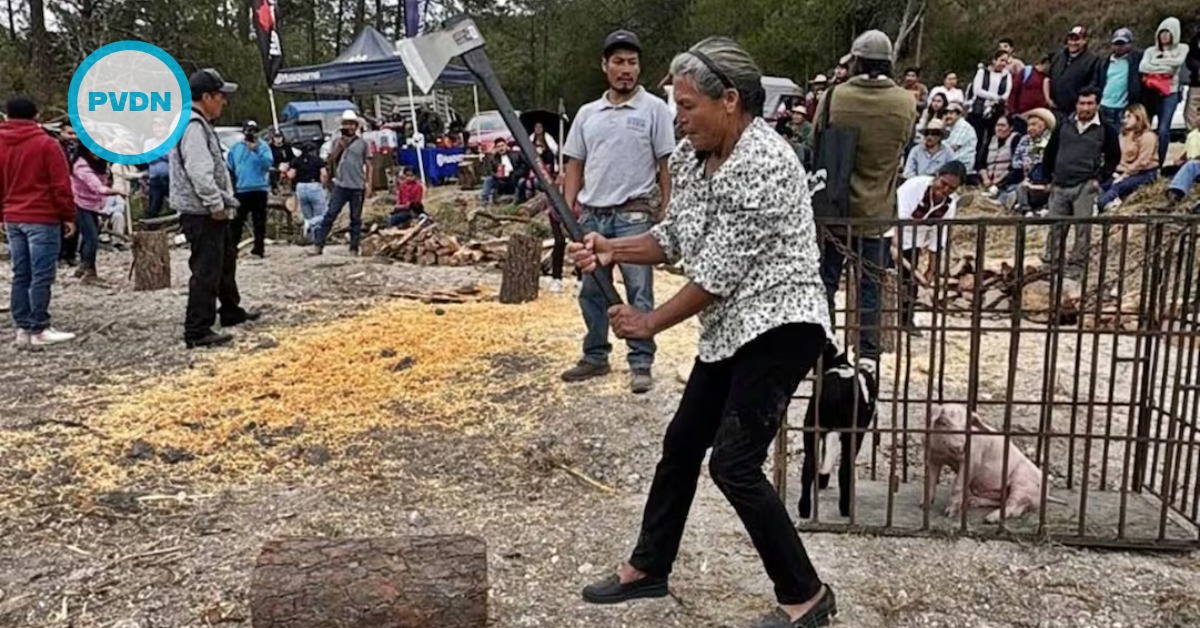
In the Mixtec village of Ojo de Agua, Oaxaca, men and even an 84-year-old grandmother take turns slinging axes at tree trunks. The spectacle isn’t an ordinary lumberjack sport, but part of a local fiesta dedicated to reviving a nearly forgotten communal tradition — with bragging rights and even livestock prizes at stake. In a community with no patron saint to celebrate, neighbors have found another reason to come together — one rooted in the collective work that sustained their ancestors.
Under a bright winter sun in Ojo de Agua’s highlands, the ring of axe blades biting into wood echoes across the fields. A line of contestants — men and women, young and old — takes turns at the chopping block. Each competitor cleaves logs with impressive strength and precision. Among them is 84-year-old Felicitas González Velasco, swinging her axe with the confidence of someone who’s been splitting firewood her whole life.
This lively wood-chopping contest is the centerpiece of Ojo de Agua’s annual community festival. The rural Mixtec community notably has no patron saint’s day to honor. Instead, it has turned to sports and old-fashioned fun to celebrate itself. Each year, on the first weekend of February, residents organize days filled with races, sports tournaments, and even a pulque fair. But the axe-and-wood competition has become the crowd favorite. For locals, the chopping competition isn’t just about trophies. “It’s an activity that reminds us how things were done in the traditional village fiestas,” explains Paulino Cruz González, a local schoolteacher who helped organize the event.
Reviving a Communal Tradition
In earlier times, when Oaxacan villages prepared for a big celebration, gathering firewood was a crucial communal task. It often took place in the run-up to a patron saint’s feast or another major event. Neighbors would head into the surrounding forests together to chop and collect leña (firewood), ensuring there was enough fuel to cook enormous pots of food—mole, beans, tortillas, coffee—for all the guests. This form of collective work, known in Oaxaca as tequio (unpaid community labor), turned a chore into a shared responsibility and a social occasion. In many communities, the task was even accompanied by ritual: before felling a tree, elders might say a prayer or sprinkle mezcal on the earth, as if asking the forest for permission. People recall that even during somber times, such as a funeral, villagers would unite to cut wood and support the bereaved family with essentials.
Though such scenes were once common across the Mixteca region, they are now rare. “People would gather to split the firewood — it was the fuel for cooking everything — but in many communities this activity is no longer carried out,” says Cruz González. With modernization and the shift to gas stoves, the old firewood gatherings have faded in many villages. Still, a few communities have held onto the practice or reinvented it in new forms. In the nearby Mixteca town of Santiago Huajolotitlán, for instance, villagers still perform the bajada de la leña (“bringing down the wood”) each year. At dawn before the July feast of their patron saint, volunteers trek into the hills to fell trees and load up burros with logs, hauling the wood back to town. The whole pueblo pitches in: devotees donate sheep or goats to make a hearty breakfast for the wood-cutters, women grind chilies and prepare huge pots of mole, and everyone shares in the labor and the meal. By midday, the towering stacks of firewood stand as proof of the village’s unity – and as fuel for cooking the feast that will feed hundreds.
Even the idea of turning this labor into a friendly contest isn’t unique to Ojo de Agua. In Ixtlán de Juárez, a Zapotec town in Oaxaca’s Sierra Norte, locals also compete in wood-splitting every year during their patron saint celebrations in December. These scattered examples show that the old custom of communal wood-cutting can survive in various guises, from solemn duty to sport, wherever people are determined to keep it alive.
A Fiesta of Community Spirit
Back in Ojo de Agua, the annual festival has become a celebration of community pride and heritage as much as athleticism. The wood-cutting contest welcomes both men and women to participate, echoing how everyone pitched in with chores in traditional village life. This year, the sight of Doña Felicitas – the 84-year-old contender – hefting an axe to split timber drew some of the loudest applause. Her presence underlined that this tradition belongs to every generation, from grandparents to the young kids cheering at the sidelines.
Organizers made sure to invite women to compete, highlighting a truth often overlooked: in many rural households, especially when husbands or sons are away, it’s the women who must chop their own firewood. “We want people to realize that often it’s the women who provide the leña,” Cruz González notes. By giving female participants equal footing, the contest honors their unsung efforts and ensures the whole community sees itself reflected in the celebration.
The atmosphere around the chopping arena is part friendly rivalry, part cultural showcase. Winners don’t just earn bragging rights — they go home with very real prizes. This year, the top axemen (and axewomen) received a live sheep and a small piglet for their victory. It’s a fitting reward in a farming village, and a nod to tradition as well; decades ago, livestock were common gifts during town fiestas. But beyond the prize animals, everyone shares the satisfaction of watching an old-fashioned skill in action. Younger spectators marvel as elders like Doña Felicitas swing with practiced technique, learning that what might seem like simple manual labor actually carries the weight of history and identity.
As the chopped logs pile up, so do feelings of pride. By transforming a once-obligatory village task into a festive competition, Ojo de Agua has strengthened the bonds among its people. The communal spirit that sustained their ancestors is not only remembered — it’s lived anew each year. With every swing of the axe and every splintered log, an old way of life lives on, not as a relic of the past but as a source of unity and joy in the present.