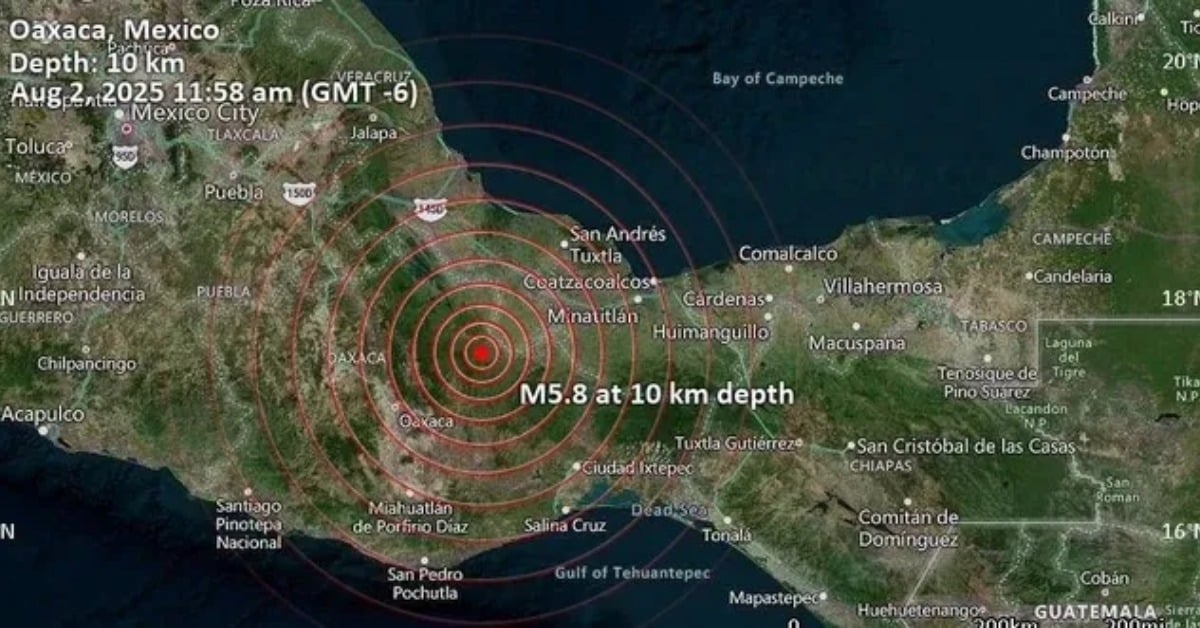
Tlacolula, Oaxaca – The southern Mexican state of Oaxaca experienced a magnitude 5.9 earthquake on Saturday around midday. There were no immediate reports of fatalities or major damage, authorities said. The temblor was felt across multiple states and even into neighboring Guatemala. This underscores the reach of seismic activity in the region.
The National Seismological Service (SSN) reported that the epicenter was located 13 kilometers east of Tlacolula, Oaxaca. The quake occurred at latitude 16.97° north and longitude 96.36° west, at a depth of 74 kilometers. This data comes from the National Autonomous University of Mexico (UNAM).
Strong shaking felt beyond Oaxaca, but no damage confirmed
Civil Protection officials confirmed that the earthquake was felt strongly in Puebla, Morelos, Veracruz, and Mexico City. Despite the intensity reported by residents in those areas, authorities said there were no confirmed reports of structural damage or injuries. The tremor was also perceptible in parts of Guatemala. This illustrates how even moderate earthquakes in southern Mexico can register across borders when conditions align.
Local emergency response teams and municipal authorities activated standard protocols. They checked critical infrastructure and communicated with residents to assess any localized effects. Early public messaging emphasized calm. It reminded citizens that the absence of immediate damage reports did not preclude localized issues that might surface after more systematic inspections.
Oaxaca’s seismic backdrop: why earthquakes are frequent
Mexico sits atop a complex junction of tectonic plates, making it one of the most seismically active countries in the world. The interaction among five major plates—the North American, Cocos, Pacific, Rivera, and Caribbean—creates frequent tremors. These range from minor jostles to major, destructive earthquakes. Oaxaca, in particular, is vulnerable due to its proximity to the subduction zone where the Cocos Plate dives beneath the North American Plate, generating stress release in the form of earthquakes.
The 5.9 magnitude event, while noticeable, occurred at a depth that typically reduces the likelihood of catastrophic surface effects. This is compared to shallower quakes. Still, the broad footprint of felt shaking demonstrates how even moderate seismic events can be widely perceived when energy transmits through geological structures.
Residents and officials review preparedness ahead of aftershocks
In the hours following the quake, residents in affected areas shared accounts of the shaking on social media and through local communication channels. Officials used those reports to triangulate felt intensity patterns and guide follow-up inspections. Civil Protection urged people to review their emergency plans, check for minor cracks in buildings, and report any unusual post-quake conditions.
Seismologists routinely monitor for aftershocks after a main event of this size. They can persist for hours to days. While most aftershocks are smaller and pose limited additional risk, public advisories emphasized vigilance. This is especially in older structures or buildings that might have preexisting vulnerabilities.
Institutional response and historical context
Mexico’s federal and state disaster agencies maintain continuous seismic monitoring through a network of sensors. They coordinate with academic institutions like UNAM to validate and disseminate data quickly after events occur. The timely reporting of the epicenter and depth reflects that collaborative system.
Historically, Oaxaca has experienced both moderate and severe earthquakes, shaping local emergency response culture. Community preparedness campaigns, routine drills in schools and public offices, and reinforced building codes in recent decades aim to reduce harm when quakes strike. The lack of significant damage in this latest event is a reminder of both the risk inherent to the region and the benefits of sustained awareness and institutional readiness.
What comes next for the region
Authorities will continue to monitor seismic activity and conduct targeted inspections where shaking was strongest. While no casualties or major structural impacts have been reported, follow-up assessments—especially in rural and hard-to-reach zones—are important. These ensure any latent damage is caught early.
Residents in Oaxaca and the broader affected corridor have been reminded to keep emergency kits accessible and avoid standing near weakened structures. They should stay informed through official channels in case of recurrences or updates. The event also offers a natural prompt for households and small businesses to revisit their earthquake safety measures. These include securing heavy furniture and confirming evacuation routes.