
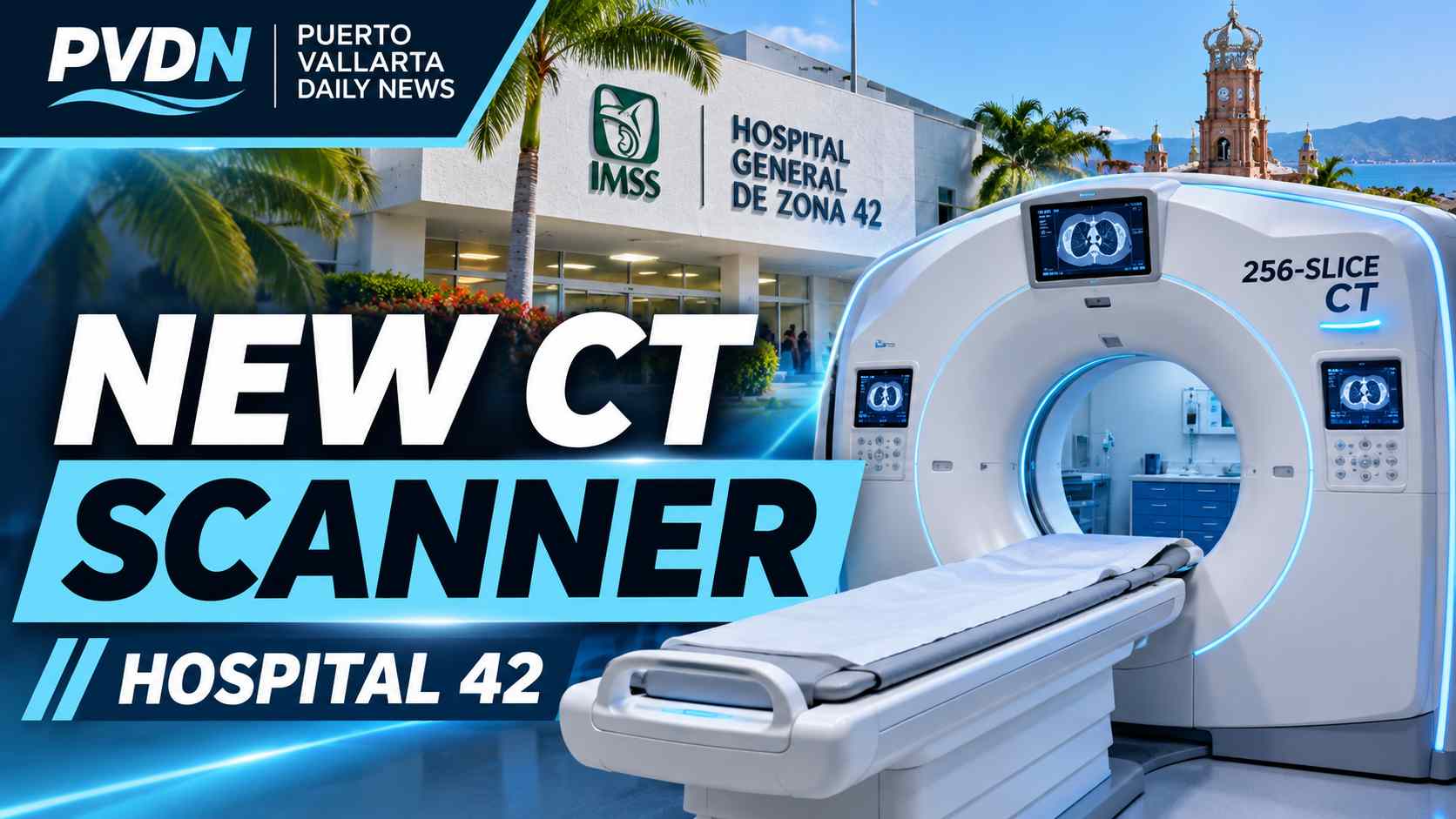
IMSS says Hospital 42’s new 256-slice CT scanner will begin seeing patients Tuesday. Here’s what the upgrade could mean in Puerto Vallarta.
Puerto Vallarta, Jalisco, November 17, 2026 – Patients at Puerto Vallarta’s Hospital General de Zona No. 42 are expected to begin receiving diagnostic scans Tuesday using a new 256-slice CT scanner, an equipment upgrade that could help doctors detect serious medical conditions faster and reduce the need to send some patients elsewhere for testing.
Zoé Robledo Aburto, director general of the Instituto Mexicano del Seguro Social (IMSS), announced the start of service during Tuesday morning’s federal government news conference. The scanner was scheduled to receive its first patient Tuesday morning.
Hospital 42, located on Boulevard Francisco Medina Ascencio in Colonia Díaz Ordaz, is one of Puerto Vallarta’s main public hospitals serving IMSS beneficiaries.
The new equipment gives doctors a faster way to examine internal injuries, blood vessels, organs and other conditions that cannot always be diagnosed through a physical examination or standard X-ray.
Robledo identified cardiology, traumatology and orthopedics among the medical areas expected to benefit from the upgrade.
The announcement marks a scheduled start of patient service, although a separate confirmation that the first examination took place was not available at publication time.
What makes a 256-slice CT scanner different?
A CT scanner uses X-rays taken from multiple angles to create detailed images of structures inside the body. Doctors use those images to identify injuries, internal bleeding, tumors, circulation problems and other medical conditions.
The term 256-slice refers to the scanner’s imaging technology, which allows it to collect a large amount of information during a single rotation. That can shorten examinations and provide detailed images of areas that may be difficult to study with older equipment.
The difference becomes especially useful when doctors need to examine a moving organ, such as the heart, or assess internal injuries after an accident.
A faster scan can also help in emergencies. For certain patients with suspected strokes, internal bleeding or serious trauma, CT imaging helps doctors decide which treatment or intervention is needed.
Modern scanners can produce detailed images with lower radiation exposure than older systems under appropriate scanning protocols. The actual dose and examination time still depend on the type of study and the patient’s medical condition.
IMSS has already reported improvements at hospitals using its newer equipment.
In a June 2026 announcement about its national CT scanner modernization program, the institute said newer machines had reduced the imaging portion of some examinations from approximately five or six minutes to about 15 seconds.
Robledo also reported that participating hospitals had increased their daily scanning capacity from roughly 20 to 25 studies to around 50.
Those are figures reported across the modernization program, not confirmed operating numbers for Hospital 42. IMSS has not released a local estimate of how many additional Puerto Vallarta patients could be examined each day.
Hospital 42 already had a CT scanner, but its earlier equipment needed maintenance
The new machine is not Puerto Vallarta’s first CT scanner within the IMSS system.
Federal procurement records show that Hospital 42 already had a GE Healthcare BrightSpeed 16 Lite scanner, a considerably older 16-slice system.
In May 2026, IMSS awarded a contract worth approximately 2.06 million pesos, including tax, for corrective maintenance of that machine.
The federal procurement record for the maintenance contract identifies the existing scanner, the hospital where it was installed and the work contracted through the end of 2026.
The record confirms that the institute sought corrective maintenance. It does not establish how long the equipment may have been unavailable, whether repairs were completed or how many patients were affected.
There is another part of Hospital 42’s imaging history worth examining.
In February 2026, IMSS published a federal procurement notice for outsourced diagnostic services at the Puerto Vallarta hospital.
The contract covered CT scans, magnetic resonance imaging and ultrasound examinations, with an estimated 1,090 studies across the services listed.
That figure was not exclusively for CT scans.
Such arrangements allow hospitals to send patients to outside diagnostic providers when examinations are handled through contracted services.
The arrival of a newer scanner could allow Hospital 42 to perform more of its own CT examinations, potentially reducing referrals to outside facilities.
Whether that happens will depend on the hospital’s operating schedule, staffing, demand and the types of studies it can perform with the new equipment.
IMSS has not announced whether the new scanner will replace the older machine entirely or whether both will remain available.
The upgrade is part of a larger IMSS modernization effort
The Puerto Vallarta announcement comes during a broader effort to replace aging medical equipment throughout Mexico’s public healthcare system.
In June, IMSS reported that 42 modern CT scanners had been installed at 40 hospitals across 19 states. Of those machines, 41 were 256-slice systems.
Installation, however, is not the same as beginning regular patient service.
New medical equipment generally requires testing, adjustments to hospital facilities and staff training before patients can undergo examinations.
During Tuesday’s national presentation, Robledo reported that IMSS had installed 81 pieces of high-technology medical equipment under its current modernization reporting, with 64 already providing patient services.
Those figures cover several types of medical equipment, not CT scanners alone.
Robledo identified Hospital 42 and Hospital General Regional No. 1 in Charo, Michoacán, as the two facilities scheduled to begin examining patients with new 256-slice scanners Tuesday morning.
The government is also pursuing another round of equipment purchases through its recently announced 12 Acciones en 120 Días program, which includes plans to acquire 26 additional 256-slice CT scanners.
The larger investment comes as IMSS faces pressure to improve access to specialist appointments, diagnostic examinations and hospital procedures.
What changes for patients in Puerto Vallarta?
For IMSS beneficiaries, the clearest potential benefit is access to more advanced diagnostic imaging at a hospital they already use.
Someone undergoing treatment for a suspected cardiovascular condition, for example, may benefit from more detailed imaging when a doctor determines that a CT examination is appropriate.
Patients with fractures, internal injuries or suspected tumors could also benefit from the scanner’s capabilities.
But having the equipment inside the hospital doesn’t automatically mean every examination will be available immediately.
A CT scan still requires a medical order and must be scheduled or prioritized according to the patient’s condition. Some examinations also require contrast material, additional preparation or specialists trained to interpret particular types of images.
The number of patients the machine can serve will depend on more than its technical specifications.
Hospital 42 has not publicly detailed the scanner’s daily operating hours, the number of technicians assigned to it or whether it will provide examinations during overnight emergency shifts.
There is also no confirmed figure showing how long patients have been waiting for CT examinations at the facility, making it impossible to calculate how much those waits might improve.
For Americans and Canadians living in Puerto Vallarta, the distinction between healthcare systems also matters. The scanner is part of the IMSS hospital network and does not create a new walk-in diagnostic service for residents who receive their care through private hospitals or other public health systems.
PVDN has previously explained those differences in its subscriber guide to how healthcare works in Puerto Vallarta for foreigners, including how medical coverage and access vary between public and private providers.
For foreign residents who are registered IMSS beneficiaries, however, the new scanner could become part of their regular hospital care when a physician orders an eligible examination.
The next measure will be how many patients receive care
The new equipment represents a substantial improvement over the older 16-slice technology previously documented at Hospital 42.
Yet the hospital’s actual results will depend on how consistently the machine operates and whether the additional capacity makes its way into daily patient care.
IMSS has pointed to fewer transfers, shorter examination times and increased scanning capacity as benefits of its national modernization effort.
At the Puerto Vallarta hospital, those outcomes still need to be measured.
The institute has not released Hospital 42’s current CT backlog, expected daily patient volume or a timeline for reducing reliance on outside imaging providers.
For patients who already have an IMSS order for a CT scan, the immediate question is whether their examination can now be scheduled at Hospital 42, rather than through an outside provider.
The hospital’s new scanner was scheduled to see its first patient on November 17. Its daily examination schedule and the number of patients it will accommodate have not yet been announced.