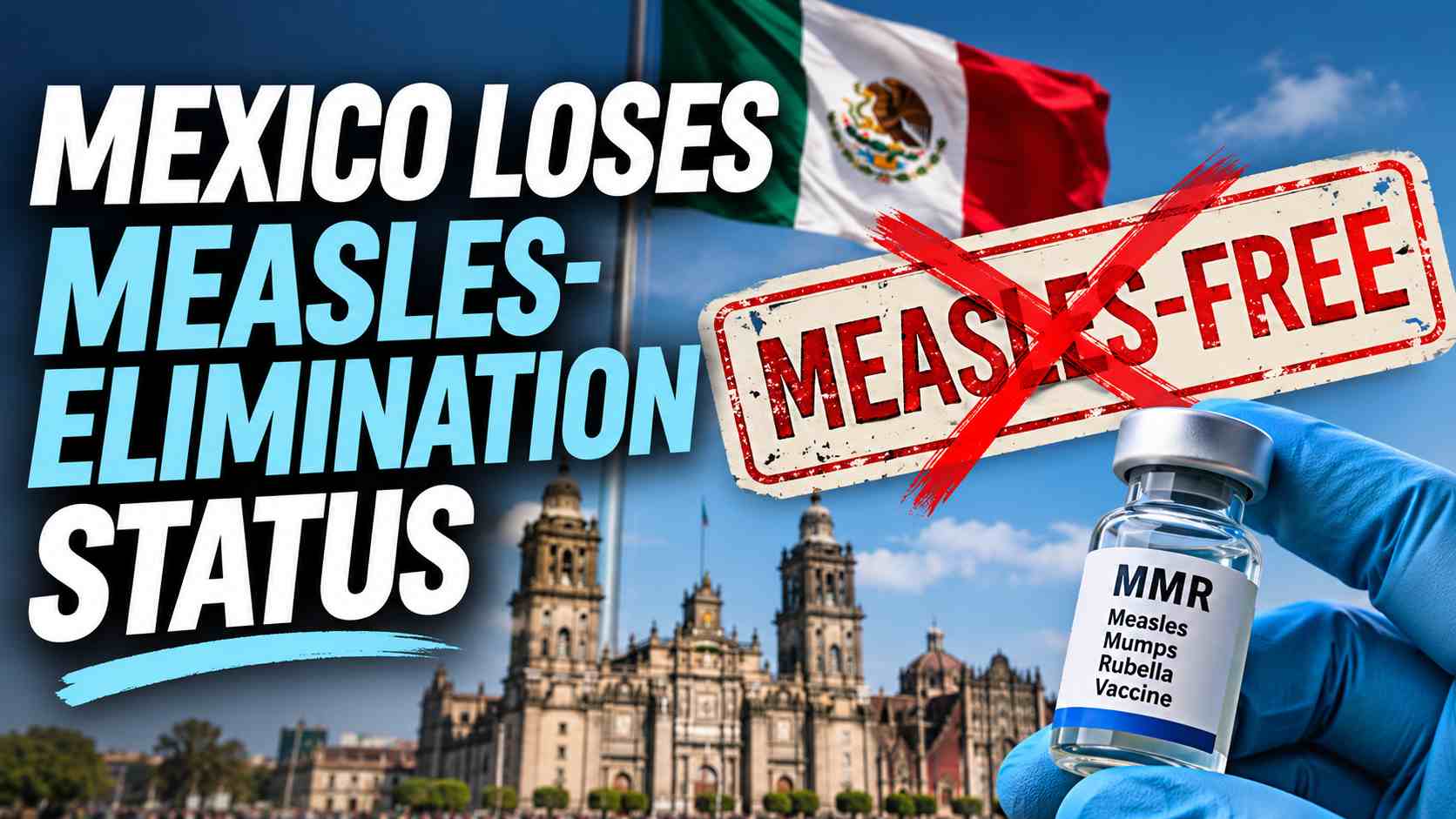
Mexico loses its measles-elimination status after sustained transmission, even as officials report fewer cases and new vaccine efforts.
Mexico City, Mexico, November 17, 2026 – Mexico has officially lost its status as a country that eliminated measles, following an international health review that found the virus had spread continuously within the country for more than a year. The decision marks a reversal of decades of progress against one of the world’s most contagious diseases.
The Pan American Health Organization (PAHO) announced the decision Tuesday, confirming that Mexico, the United States, and Bolivia no longer qualify as countries free of endemic measles transmission. Canada lost the same designation in November 2025.
The announcement comes at an unusual moment. Mexico’s federal health officials reported Tuesday morning that measles infections have fallen dramatically since their peak earlier this year, with just 14 active cases currently identified nationwide.
Both statements are true. Mexico is making progress against the outbreak, but that progress cannot erase the prolonged transmission that led to the international decision.
Why Mexico lost its measles-free designation
The decision followed a November 10–13 review by PAHO’s independent Measles and Rubella Elimination Regional Monitoring and Re-Verification Commission.
Under international health standards, a country can experience individual measles cases, including infections brought in from abroad, without losing its elimination status. The critical difference is whether the virus continues spreading locally for 12 consecutive months.
According to PAHO’s explanation of the decision, Mexico’s outbreak began February 1, 2025, and reached the 12-month threshold on February 1, 2026.
That distinction matters. Tuesday’s announcement doesn’t mean measles has suddenly returned to Mexico. It confirms that the country failed to interrupt an established chain of transmission during the period examined by international health authorities.
The commission reviewed laboratory findings and epidemiological evidence, including the genetic characteristics of the virus, before reaching its conclusion. PAHO Director Jarbas Barbosa accepted its recommendations and communicated the change to the affected countries.
The designation itself doesn’t mean every Mexican state or city is experiencing an active outbreak. It reflects the country’s ability to stop sustained transmission.
More than 20,000 infections and 50 deaths
The scale of Mexico’s outbreak helps explain why the decision was made.
According to figures from Mexico’s Secretaría de Salud reported November 17, the country recorded 20,701 confirmed measles cases between January 1, 2025, and November 12, 2026.
Health authorities also confirmed 50 deaths associated with the outbreak.
The figures cover infections across all 32 Mexican states and 531 municipalities. Children have been particularly affected, although measles can cause serious illness in adults who lack immunity.
Jalisco has recorded the largest number of confirmed cases during the outbreak, with 8,272. Chihuahua follows with 4,606, while Chiapas has reported 1,335 and Mexico City 1,083.
Those cumulative numbers don’t represent people who are currently sick. They show how widely the disease spread during the outbreak and why sustained transmission became a concern.
Mexico’s latest numbers tell a different story
Earlier Tuesday, Rafael Ricardo Valdez Vázquez, subsecretary of Políticas de Salud y Bienestar Poblacional, presented a considerably more encouraging picture of the current outbreak.
During the federal government’s morning news conference, he said Mexico had 14 active measles cases, compared with a peak of 1,314 cases in a single week during February 2026.
Of those 14 active infections, 12 were in Chiapas and two in Quintana Roo.
According to the government’s November 17 update, 12 states have gone at least 12 weeks without reporting a new case. Four others have gone six to 11 weeks without infections.
Still, 16 states, including Jalisco and neighboring Nayarit, have recorded cases within the previous five weeks.
The government says its vaccination campaign has administered approximately 40.9 million doses against measles during 2025 and 2026. Officials have also reported reaching 90% of the campaign’s vaccination target.
These are substantial gains, especially considering the number of infections recorded earlier this year.
But there’s a difference between bringing an outbreak under control and proving that transmission has been completely interrupted.
Mexico may be approaching the first goal. The second will take considerably longer to establish.
What this means for Puerto Vallarta and Jalisco
For residents of Puerto Vallarta, the national decision follows months of local vaccination campaigns and efforts to contain infections.
The city confirmed its first measles cases in February 2026, prompting health authorities to expand vaccination efforts.
Those efforts included temporary vaccination stations, additional public health services, and campaigns aimed at reaching people who had missed recommended doses.
By February 16, Puerto Vallarta had administered approximately 40,000 measles vaccinations in one week, reflecting the scale of the local response.
Jalisco’s cumulative case total remains particularly significant because the state recorded more infections than any other Mexican state during the outbreak.
However, the latest national active-case count does not establish that Puerto Vallarta currently has an active outbreak. Nor does the loss of Mexico’s elimination status establish a new outbreak in the city.
For residents, including Americans and Canadians living in the area, the immediate guidance remains centered on vaccination and recognizing symptoms early.
Measles spreads through the air and is exceptionally contagious. PAHO estimates that one infected person can transmit the virus to between 12 and 18 susceptible people under typical conditions.
The virus can remain infectious in the air for up to two hours after an infected person leaves an enclosed space. Someone with measles can also spread the disease before developing the characteristic rash.
That makes vaccination especially important, even in communities where recent infections have been uncommon.
How Mexico reached this point
Mexico’s struggle with measles comes after a long period in which the disease was largely controlled through routine childhood vaccination.
The country interrupted endemic measles transmission in 1996, and in 2016, the Americas became the first World Health Organization region to achieve measles elimination.
That regional accomplishment was the result of decades of vaccination campaigns and disease surveillance.
There were setbacks along the way.
Venezuela experienced renewed endemic transmission in 2018, followed by Brazil in 2019. Both countries eventually interrupted those transmission chains, allowing the Americas to regain regional elimination status in 2024.
The achievement didn’t last.
Canada lost its national elimination designation in November 2025 after measles spread continuously for more than a year. That also caused the Americas to lose its regional verification.
Now Mexico, the United States, and Bolivia have joined Canada on the list of countries that must work to regain their elimination status.
The broader regional figures show the extent of the resurgence.
PAHO reported 58,213 confirmed measles cases across the Americas as of November 13, 2026, compared with 12,806 during the corresponding period in 2025.
Health officials have linked the resurgence to gaps in vaccination coverage, missed childhood vaccinations, barriers to medical care, and declining confidence in vaccines in some communities.
One of the biggest problems is that national vaccination averages can hide significant differences between neighborhoods, municipalities, and individual populations.
A country might have relatively strong overall vaccine coverage while still leaving enough unprotected people in particular communities for an outbreak to continue.
What health authorities want residents to do
PAHO recommends that communities maintain at least 95% coverage with two doses of a measles-containing vaccine.
That benchmark is important because measles spreads considerably more easily than many other infectious diseases.
Mexico’s reported progress toward its vaccination campaign target shouldn’t be confused with the percentage of people who have completed both recommended doses in every community.
For adults who received routine vaccinations during childhood, the first step is to check their records. People with uncertain vaccination histories should speak with a healthcare professional about whether they need additional protection.
Parents should also review their children’s vaccination records and complete any missing doses.
The Secretaría de Salud maintains a national vaccination-location service where residents can look for available vaccination centers. Federal officials said Tuesday that approximately 10.8 million vaccine doses remain available through more than 21,000 vaccination locations nationwide.
Symptoms commonly begin with fever, cough, a runny nose, and red eyes, followed by a rash that usually starts on the face and spreads.
Anyone who suspects measles should contact a healthcare provider before arriving at a clinic or hospital. Calling ahead allows medical personnel to arrange an evaluation while reducing the risk of exposing other patients.
When could Mexico regain its measles-free status?
Mexico won’t regain its international elimination designation simply because the number of active cases falls to zero.
PAHO requires evidence that endemic transmission has stopped for at least 12 consecutive months. Countries must also show that their vaccination programs, outbreak investigations, and disease-monitoring systems can prevent another prolonged chain of infections.
According to the federal government’s plan discussed Tuesday, Mexican health officials are working toward ending the outbreak in 2027 and pursuing renewed elimination certification in 2028.
Those are government targets, not guaranteed dates.
PAHO will need to review the evidence before the country can regain its designation.
The organization has also called for continued vaccination campaigns and closer surveillance, even where infection numbers are declining.
For Mexico, the immediate task is to interrupt the remaining transmission chains. The longer test will be documenting 12 consecutive months without endemic measles transmission, something the country has not been able to demonstrate since the outbreak that began in February 2025.