Mexico’s President Claudia Sheinbaum flew economy to China’s APEC summit, sparking online praise and reviving debate over presidential travel.
Shenzhen, China, November 19, 2026 – Mexican President Claudia Sheinbaum has become an unexpected social media favorite in China after flying economy class to an international summit, sharing an ordinary passenger flight while other world leaders arrived aboard presidential aircraft and private or chartered jets.
Her decision to travel commercially to the Asia-Pacific Economic Cooperation (APEC) summit in Shenzhen attracted millions of views on Chinese social media, where users praised what they saw as an unusually modest approach to presidential travel.
According to reporting by Bloomberg, a hashtag about Sheinbaum’s arrival had generated roughly 10 million views on Weibo, one of China’s largest social media platforms.
The attention wasn’t focused on a speech or a diplomatic agreement. It was the way she got there.
Sheinbaum left Mexico City early Sunday, November 15, aboard a commercial flight that stopped in Tijuana before continuing across the Pacific on China Southern Airlines flight CZ8032.
The international leg took approximately 15 hours. Including the first flight and the stop in Tijuana, her journey lasted about 21 hours.
She arrived at Shenzhen Bao’an International Airport around 11:30 a.m. local time Monday, November 16.
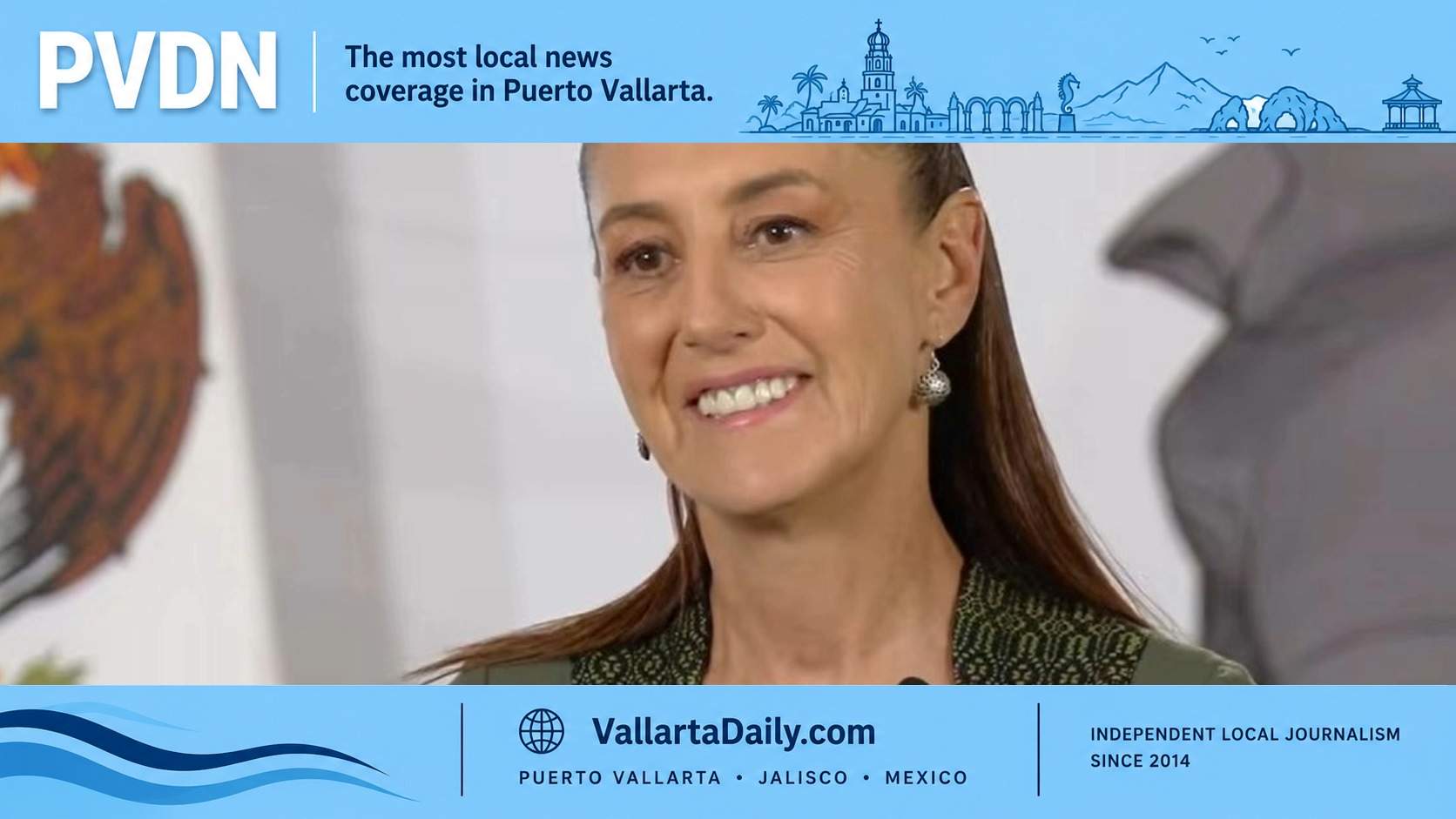
Videos shared on Chinese social media showed passengers taking turns posing for photographs with the Mexican president before departure. Sheinbaum smiled for pictures as travelers approached her at the boarding gate in Mexico City.
Another detail drew attention online. A Weibo user claimed that fellow passengers had confirmed Sheinbaum was sitting in seat 33B, an ordinary economy-class seat toward the rear of the aircraft. Bloomberg reported the claim, although the seat assignment has not been independently established.
For Chinese social media users accustomed to images of foreign presidents arriving aboard government aircraft, the photographs offered a different picture.
Comments circulating online praised the decision as a way to avoid spending public money on luxury travel. Some described Sheinbaum as down-to-earth and considerate of ordinary people.
The reaction spread beyond Weibo, with videos of the president’s departure and arrival also circulating on Chinese social media.
An airport bus before the red carpet
The contrast continued after Sheinbaum landed in China.
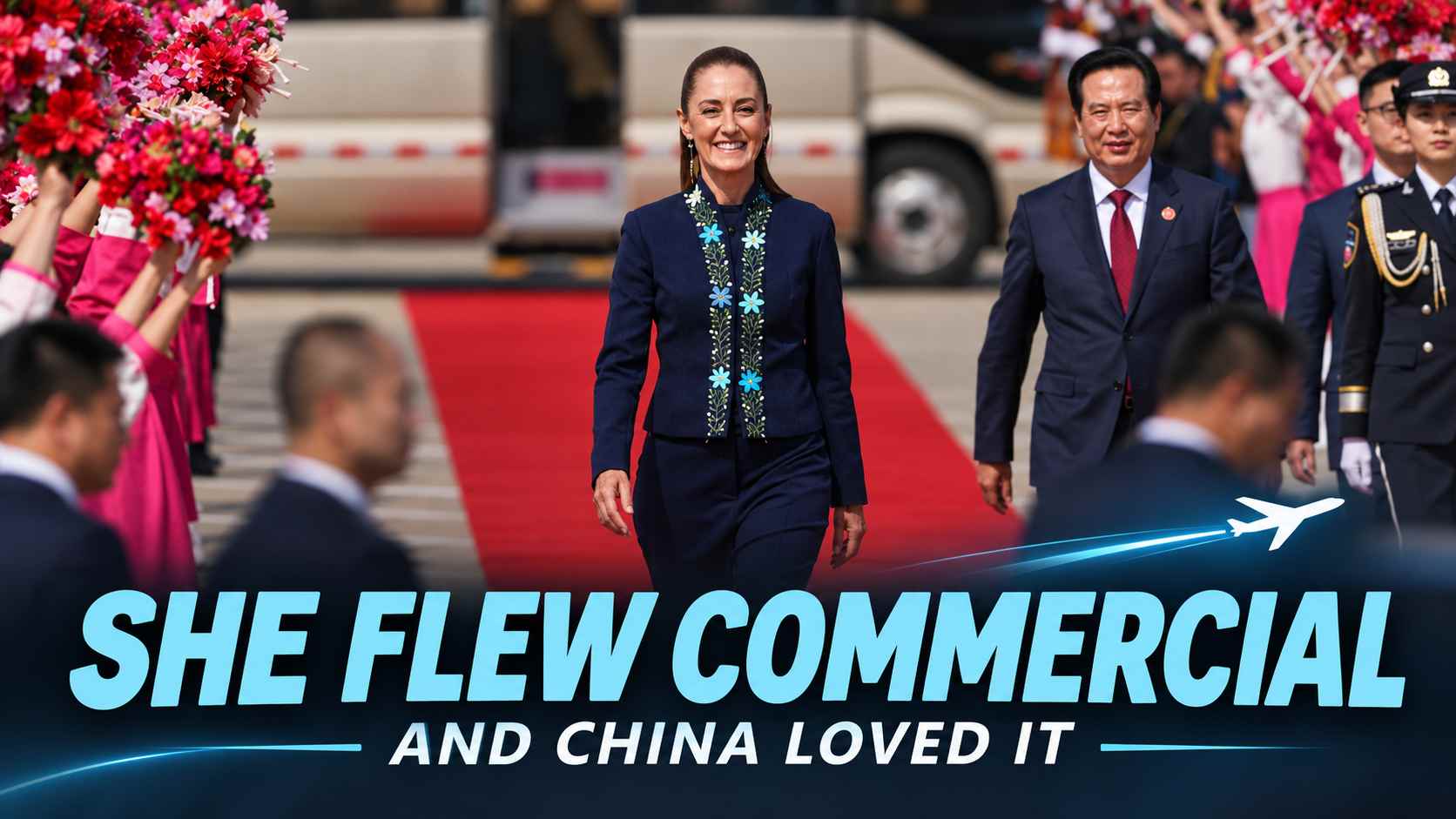
Rather than stepping directly from a presidential aircraft onto a red carpet, she left the commercial plane and traveled by airport shuttle bus to another area of the airport, where Chinese officials had arranged her formal reception.
A video shared by Sheinbaum showed a military honor guard, officials and performers dressed in pink taking part in the welcome ceremony.
Other leaders attending the summit arrived aboard dedicated government aircraft or specially chartered flights, with some receiving their official greetings directly on the airport apron.
Sheinbaum still received the diplomatic treatment expected for a visiting head of state. The difference was the transportation that brought her to the ceremony.
Her commercial flight also wasn’t a spur-of-the-moment decision. It followed a policy established by her predecessor, Andrés Manuel López Obrador, who made flying on regular passenger airlines a visible part of his administration’s government austerity program.
Mexico’s presidential airplane became a political symbol
When López Obrador took office in December 2018, he refused to use Mexico’s Boeing 787 Dreamliner presidential aircraft, arguing that its luxury features and operating costs were inappropriate for a country with widespread poverty.
The airplane had been purchased in 2012, toward the end of Felipe Calderón’s presidency, and was used by his successor, Enrique Peña Nieto.
According to the Mexican government’s account of the aircraft’s sale, its original acquisition, equipment and associated costs totaled approximately $217 million.
Inside were luxury seating areas, a private presidential bedroom, a meeting room and other accommodations designed for official travel.
López Obrador spent years trying to sell it.
The sale was finally completed in April 2023, when the government of Tajikistan purchased the aircraft for $92.1 million, or approximately 1.66 billion pesos at the time.
López Obrador said proceeds from the sale would help pay for hospitals in Tlapa, Guerrero, and Tuxtepec, Oaxaca.
The decision helped establish commercial air travel as part of the public image of the Morena-led federal government.
Sheinbaum has continued that approach since taking office in October 2024, including on international trips.
There is a distinction worth keeping in mind. A president flying commercially doesn’t mean an official visit is inexpensive. Security, government personnel, diplomatic arrangements and other expenses remain part of the trip. The choice of airline alone doesn’t establish how much the government saves.
Still, the public reaction in China shows how strongly the image of a president sitting among regular airline passengers can resonate.
A warm reception despite trade tensions
The positive reaction comes at an interesting moment in Mexico’s relationship with China.
Sheinbaum’s administration has pursued higher tariffs on a range of Chinese imports, seeking to protect domestic industries while Mexico faces continuing trade pressure from the United States.
China has criticized the restrictions, placing Mexico in a difficult position between its largest export market, the United States, and one of the world’s biggest manufacturing economies.
That tension formed part of the background to Sheinbaum’s visit to Shenzhen.
APEC brings together 21 Pacific Rim economies, including Mexico, China, the United States, Canada and Japan. The organization focuses on trade, investment and regional economic cooperation.
On Tuesday, November 17, Sheinbaum met Chinese President Xi Jinping, with discussions covering economic cooperation and opportunities in science, technology and other industries.
She also presented Plan México, her administration’s effort to attract investment and strengthen domestic manufacturing. The government is trying to expand international business ties while retaining greater control over strategic industries, an issue examined in Vallarta Daily’s earlier reporting on Plan México.
The following day, November 18, Sheinbaum met U.S. President Donald Trump on the sidelines of the summit.
She later described their meeting as positive and said the two governments were making progress in negotiations over trade barriers. According to Reuters, Mexico is seeking relief from U.S. tariffs affecting industries including automobiles, steel and aluminum.
The Chinese online response to Sheinbaum’s flight hasn’t changed those economic disagreements. It has, however, given the Mexican president favorable attention in a country where her government is trying to build closer diplomatic and commercial relationships.
A return to Mexico after a busy week
The trip is also significant because Mexico is preparing to host the APEC leaders’ summit in 2028, giving Sheinbaum’s administration another opportunity to shape the country’s relationships with major Pacific economies.
Her first visit to China as president included meetings with business leaders, discussions with foreign heads of government and an encounter with Mexican residents living in Shenzhen.
The government’s original travel schedule called for Sheinbaum to return to Mexico on Friday, November 20, in time for the country’s Revolution Day commemorations.
She left Mexico aboard a regular passenger flight, made a two-hour stop in Tijuana and continued to China in economy class. By the time she arrived at the summit, that travel decision had already become one of the most widely discussed details of her visit.