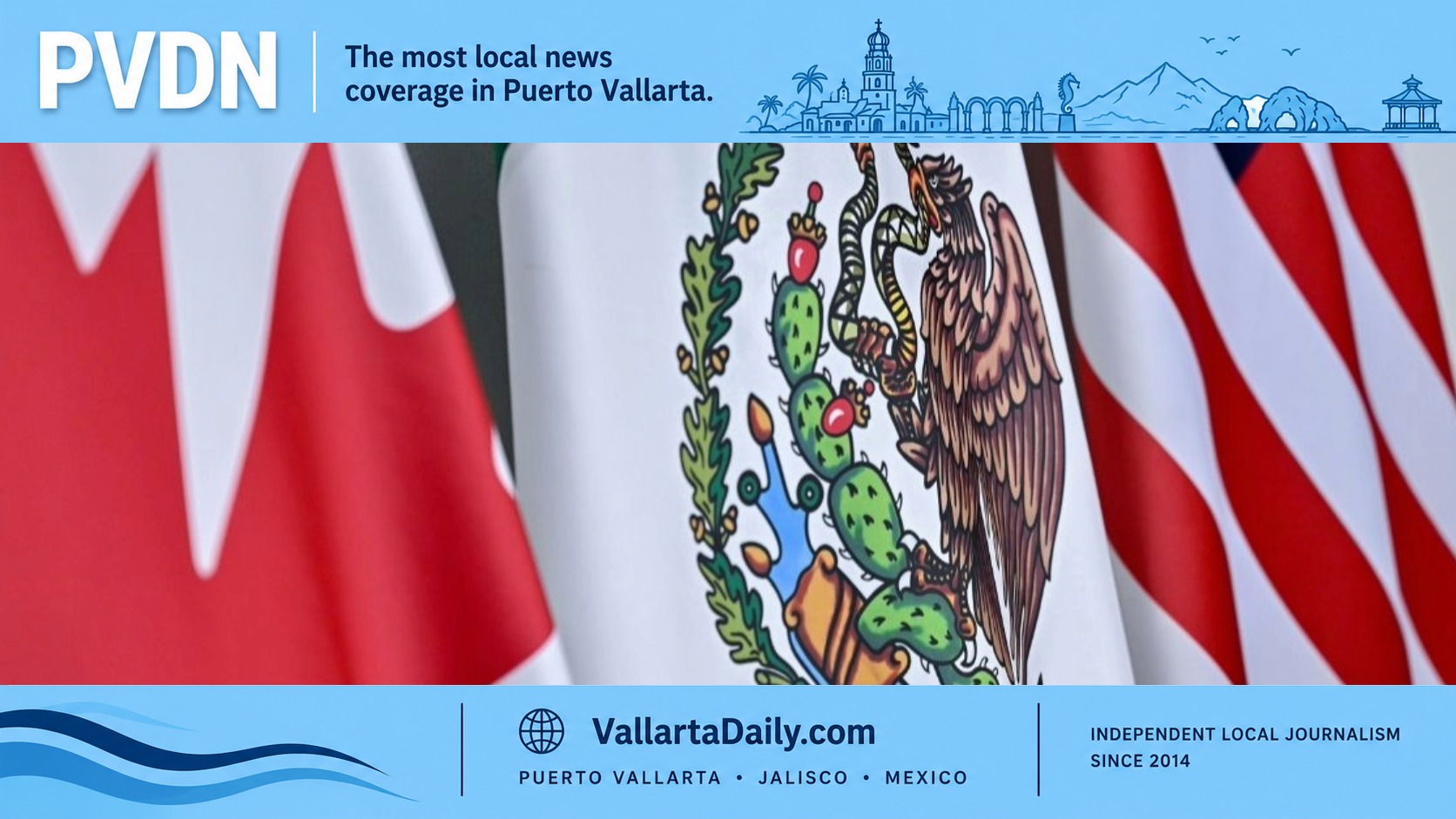

Puerto Vallarta, Jalisco, Oct. 12, 2026 — President Claudia Sheinbaum said Monday that U.S. trade talks remain unfinished, following reports that Donald Trump pressed Mexico for energy deals.
An Oct. 9 report, citing people familiar with a September call, said Trump sought energy partnerships and more U.S. natural gas purchases. A U.S. official linked the discussions to reducing Mexico’s trade surplus. The account described requests made during negotiations.
“There is progress. We still don’t have a final agreement, but we continue talking,” Sheinbaum said Monday. She also said the existing North American trade treaty remains in force.
USMCA remains in force during negotiations
The United States-Mexico-Canada Agreement, known in Mexico as T-MEC, has entered annual reviews after Washington declined an extension.
In its July 1 statement, the Office of the U.S. Trade Representative said the United States would not renew the agreement in its current form. United States Trade Representative The same statement confirmed that the treaty remained in force while the governments addressed their differences.
An Oct. 5 federal notice explains the resulting timetable. Annual reviews continue until all three countries approve another 16-year term or the existing term expires.
The notice identifies July 1, 2036, as the expiration date under the current term. A separate provision, Article 34.6, allows a country to withdraw after giving six months’ written notice.
On Monday, Sheinbaum said Mexico’s immediate priorities include reducing U.S. tariffs and preventing additional tariffs during the review. Her remarks at the morning briefing placed those concerns alongside negotiations over the treaty’s duration.
Energy requests therefore sit within a wider negotiation covering market access, tariffs and the agreement’s future term.
Washington’s objections concern access to the market
The Trump administration has already identified Mexico’s energy policies as a trade concern.
In its 2026 trade policy agenda, USTR argues that Mexico favors national companies in oil, gas and electricity at U.S. investors’ expense. That is Washington’s stated position in the negotiations.
The dispute predates Trump’s current administration. In July 2022, USTR requested dispute consultations, alleging that Mexican measures favored CFE and state oil company Petróleos Mexicanos, or Pemex.
The complaint also challenged a policy requiring users of Mexico’s gas transportation network to demonstrate that they sourced gas from Pemex or CFE. That allegation concerned which companies could supply customers within Mexico.
Read together, those filings show that Washington’s concerns extend beyond the volume of energy Mexico imports. They also concern how companies operate in the Mexican market.
Mexican ownership and private participation have separate rules
USMCA itself recognizes Mexico’s ownership of underground oil and gas.
Under Chapter 8, the United States and Canada recognize Mexico’s ownership of hydrocarbons beneath its territory. The chapter also recognizes Mexico’s sovereign right to change its Constitution and domestic laws.
The same text preserves the other countries’ rights and remedies under the agreement. The treaty therefore recognizes Mexican ownership while retaining a framework for disputes over other trade obligations.
Mexico’s domestic law already provides a route for partnerships. The Hydrocarbon Sector Law enacted in March 2025 allows Pemex to undertake mixed-development projects when it needs additional technical, financial, or operating capacity.
Article 24 permits participating companies to operate such projects. It also requires Pemex to retain the exclusive rights granted through the state assignment, which authorizes field development.
Article 31 requires Pemex to hold at least a 40% participation interest in mixed contracts. That percentage concerns participation in the contract; Pemex retains the exclusive rights under the state assignment.
These provisions allow private companies to contribute investment and expertise within Mexico’s legal framework. They also distinguish commercial participation from ownership of the country’s underground resources.
Electricity follows different requirements. Under the Electricity Sector Law, the state must retain at least 54% of the average electricity injected into the grid over a calendar year.
For mixed-generation projects, Article 40 separately requires the public enterprise to hold at least a 54% direct or indirect stake. One threshold concerns national electricity output; the other concerns participation in an individual mixed project.
Those distinctions help explain Mexico’s position. Its laws permit investment partnerships while reserving specific rights and levels of participation for public companies.
Mexico already buys substantial amounts of U.S. gas
The Mexican government’s April 8 gas strategy put imports at approximately 75% of national natural gas consumption. The strategy seeks to reduce that dependence through domestic production and renewable electricity.
U.S. Energy Information Administration figures published in October 2025 show the scale of the existing relationship. Pipeline exports to Mexico averaged 6.4 billion cubic feet daily in 2024, up 25% from 2019.
The agency attributed much of Mexico’s gas-demand growth to electricity generation. It also identified Mexican pipeline constraints and limited storage capacity as factors restricting additional deliveries.
Those findings show that a larger purchase commitment would involve infrastructure as well as negotiations. The agency’s analysis identifies bottlenecks within Mexico’s system, even where cross-border pipelines have unused capacity.
Mexico’s published plan combines investment with lower import dependence
Mexico’s gas strategy includes several approaches. An Aug. 6 government statement lists renewable generation, energy efficiency, conventional gas production and reduced gas flaring among the recommended measures.
The government also commissioned specialists to examine unconventional gas resources. Its stated objective is to reduce imports while assessing technologies and their environmental effects.
Sheinbaum acknowledged in an Aug. 7 briefing that U.S. supplies would remain part of the energy mix.
“We will continue importing some of the gas,” she said. She also said Mexico wanted to prevent its dependence from continuing to grow.
That stated objective differs from the reported U.S. request for increased purchases. At the same time, Mexico’s investment rules provide existing channels for companies from both countries to work together.
In an Oct. 7 energy update, Energy Secretary Luz Elena González reported 55 renewable projects underway: 42 solar plants and 13 wind plants. The government’s stated target is to raise renewable electricity generation from 24% to 38%.