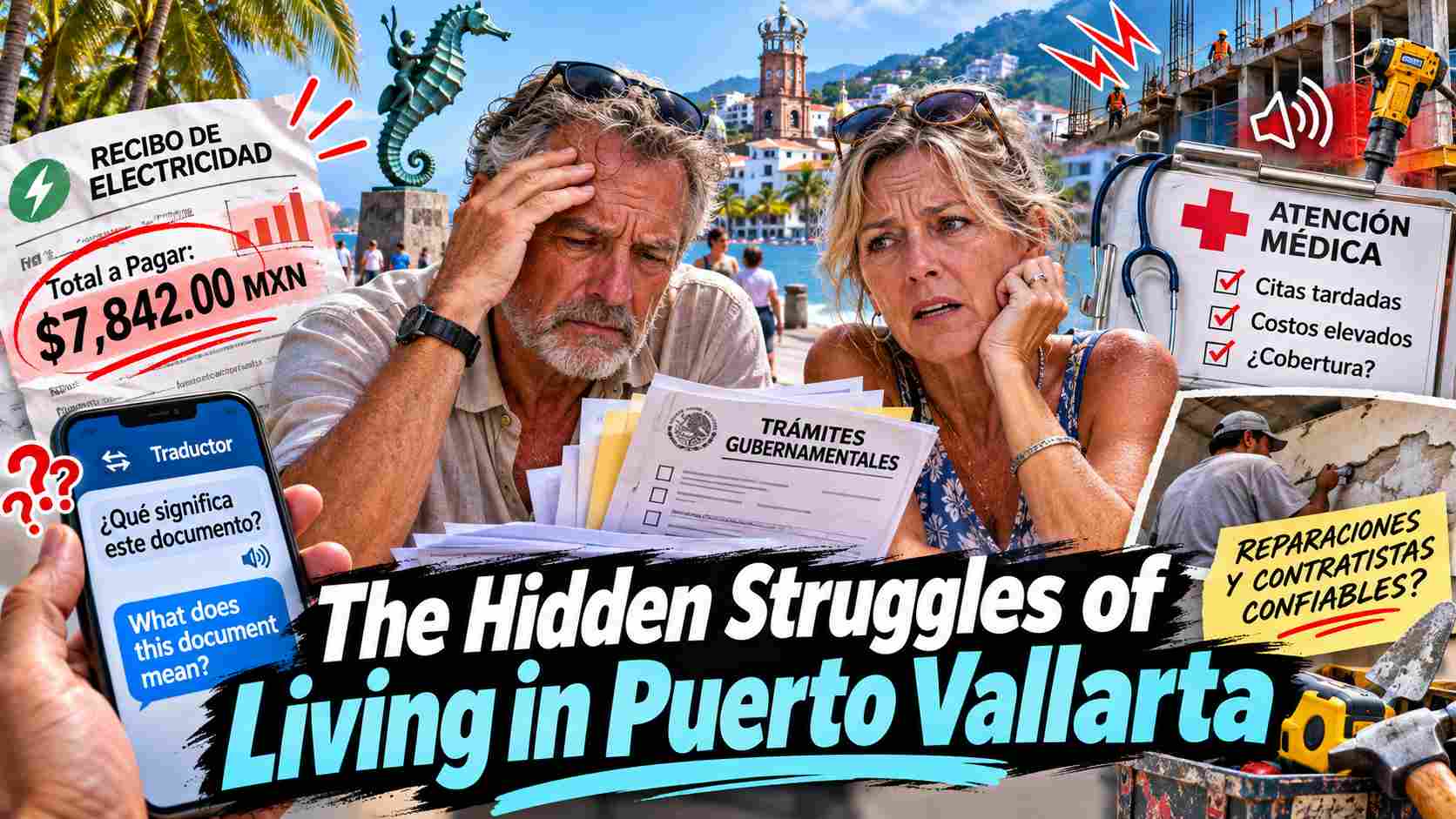
A Vallarta Daily subscriber survey reveals the everyday struggles foreign residents face, from language barriers and healthcare to electricity bills.
Puerto Vallarta, Jalisco, November 25, 2026 – Setting up an electricity account, finding someone reliable to repair an appliance, registering a car, or simply knowing who to call during a medical emergency can become some of the most frustrating parts of living in Puerto Vallarta as a foreigner.
A recent Vallarta Daily subscriber survey asked foreign residents about the difficulties they encounter living in Mexico, the expenses they struggle with, the mistakes they have made, and the services they wish were available.
The answers offer a look at life beyond the beaches, restaurants, and retirement brochures that sell Puerto Vallarta as a place to spend the next chapter of your life.
Language barriers, government paperwork, unreliable contractors, electricity costs, neighborhood noise, and concerns about growing older in Mexico emerged throughout the responses.
The survey received 20 submissions, with participants able to skip individual questions. While the small, voluntary survey is not representative of Puerto Vallarta’s entire foreign population, the personal experiences shared by subscribers provide insight into the everyday difficulties some residents face.
When a simple task becomes a complicated one
One of the recurring frustrations among respondents was having to depend on someone else to accomplish relatively ordinary tasks.
Asked about the last problem they needed a Spanish-speaking person to help resolve, subscribers mentioned setting up internet service, arranging air conditioning installation, dealing with electricians, communicating with appliance repair technicians, resolving electricity billing problems, and navigating government agencies.
One household described trying to transfer a water service account from the previous homeowner into their own name. According to the respondent, completing the process required the assistance of two native Spanish speakers.
Another subscriber struggled to arrange payments with the Federal Electricity Commission, known as CFE, without having a Mexican mobile phone number for verification.
Even finding out where to donate an unwanted mattress presented a language challenge for one resident.
Several respondents said they had hired professionals to help obtain residency documents, driver’s licenses, vehicle registrations, and an RFC, Mexico’s federal taxpayer identification number.
One permanent resident described obtaining their RFC as “an incomprehensible task.”
Mexico’s tax authority, SAT, provides official information about registering for an RFC, but knowing where to find the information and understanding the procedure are two different things for residents unfamiliar with Mexican administrative systems.
Subscribers who had Spanish-speaking spouses or partners appeared to have fewer difficulties navigating these situations. Others relied on property managers, lawyers, and paid service providers.
For residents without that support, the language barrier can carry an additional financial cost.
Electricity bills stand out among household expenses
Among the 16 subscribers who answered a question about which recurring household expenses they would most like to reduce, seven identified electricity or air conditioning costs.
An eighth respondent said electricity would have been their answer had they not installed solar panels after moving into their home.
One resident in La Cruz de Huanacaxtle described their electricity expenses as particularly high. Other respondents simply identified their CFE bill as the household expense they would most like to bring under control.
Three respondents identified groceries or food costs.
However, the responses also showed that experiences with the cost of living in Puerto Vallarta vary considerably.
Some subscribers said their household expenses remained minimal. One resident who relocated from Chicago said Mexico was still considerably cheaper than their former home.
Housing choices, air conditioning use, personal spending habits, and investments such as solar panels can make a considerable difference in what households spend each month.
One respondent offered an observation that prospective homeowners might find particularly useful. While a home filled with natural light was desirable where they previously lived, they realized after moving to Mexico that a home with more shade might have been a better choice.
It is the kind of consideration that can easily be overlooked when viewing properties during Puerto Vallarta’s cooler winter months.
Finding businesses and contractors you can trust
Several subscribers shared experiences involving unreliable businesses, disappointing workmanship, lost deposits, and difficulties getting companies to honor their commitments.
One resident reported paying a carpenter an advance several years ago and never seeing him again. Another described a bathroom renovation that went badly despite hiring what they considered a well-known service provider.
A subscriber said they had placed a deposit on a new vehicle that was never delivered and that the business refused to return the money.
Another reported purchasing window blinds that needed repairs but receiving no response to emails or WhatsApp messages requesting assistance.
Rental fraud was also mentioned, an issue Vallarta Daily has previously covered in reporting on vacation rental scams in Puerto Vallarta.
These experiences were reported by survey participants and have not been independently investigated.
Several respondents indicated that they had never lost money through an unreliable transaction. Nevertheless, finding trustworthy, reasonably priced professionals remained a concern.
When asked what difficulty they would pay someone to permanently remove from their lives, some residents described wanting access to dependable handymen, repair technicians, and people who could recommend qualified service providers.
For consumers experiencing problems with a business, Mexico’s federal consumer protection agency, Profeco, provides information about filing a consumer complaint and seeking a resolution.
What happens if you get sick while living alone?
Some of the more personal answers came when subscribers were asked what would worry them most if they became ill or injured while alone in Mexico.
Their concerns went beyond finding a good doctor.
They worried about communicating with medical staff, paying for emergency treatment, understanding insurance coverage, arranging care at home, and having someone available to advocate for them during a hospitalization.
One respondent identified the need for a medical advocate as their greatest concern.
Another worried that their Spanish abilities would not be sufficient to communicate effectively with healthcare workers during an emergency.
One household had purchased emergency medical evacuation coverage to address what they considered their greatest vulnerability. Others expressed uncertainty about international insurance reimbursement or whether their existing coverage would adequately protect them in Mexico.
One respondent’s answer was particularly straightforward: “Being alone period.”
The same subscriber, however, said their experiences with local people willing to help had been entirely positive.
Not everyone expressed dissatisfaction with medical care. Some respondents were comfortable with their insurance arrangements, and one spoke positively about routine medical services while expressing reservations about emergency care.
The distinction is important. Being satisfied with your regular doctor does not necessarily mean you are prepared for hospitalization, limited mobility, or an extended recovery without family nearby.
For foreign residents, understanding how healthcare works in Puerto Vallarta is only part of preparing for those possibilities.
Having someone who can accompany you to a hospital, communicate with doctors, collect prescriptions, or help you return home may become just as important as having insurance.
What residents wish they had known before choosing a neighborhood
Noise was a recurring complaint when subscribers were asked what they wished they had known before choosing their home or neighborhood.
One respondent regretted living near a restaurant that plays loud music. Others identified neighborhood noise as one of the difficulties they would most like to eliminate.
Another resident described losing their ocean view to the construction of a condominium building, raising concerns about development and the enforcement of building regulations.
Dusty roads, neighboring residents’ behavior, traffic, and unreliable public services also appeared in the responses.
One subscriber reported deteriorating mobile phone coverage in Alta Vista and Emiliano Zapata, saying a previously reliable service had become increasingly difficult to use.
Garbage collection was another source of frustration, reflecting problems documented throughout the year in Vallarta Daily’s coverage of missed garbage pickups and waste accumulation.
These frustrations are not exclusive to foreigners. Previous reporting on neighborhood conflicts in Puerto Vallarta has also highlighted noise, garbage, and parking as sources of tension among the wider population.
For someone considering purchasing or renting a home in Puerto Vallarta, visiting a neighborhood at different times of the day, investigating nearby development projects, testing mobile phone reception, and speaking with existing residents could help prevent some unpleasant surprises.
The paperwork that never seems to end
Residency renewals, vehicle registrations, license plate payments, bank trust renewals, and other administrative responsibilities were among the deadlines subscribers said they worried about forgetting.
Some residents had developed systems to manage these obligations. One created a schedule of recurring fees and responsibilities, while another relied on a property manager.
Others expressed little concern, saying they simply used calendar reminders.
What emerged from the survey was not necessarily that residents were overwhelmed by paperwork every day, but that managing unfamiliar responsibilities requires time and organization.
For residents who spend part of the year outside Mexico, keeping track of these obligations can become another consideration when planning their annual travel.
Loneliness and finding a sense of belonging
One of the less obvious challenges revealed by the survey was building lasting social connections.
A respondent explained that many of their neighbors were Canadians who returned home during the summer. Friendships developed during the winter months were interrupted annually, leaving the household looking for more consistent social connections through volunteering, work, or creative activities.
Another subscriber described occasionally feeling unwelcome as a foreign resident, despite making an effort to support local restaurants, bars, and shops.
That individual experience should not be interpreted as a measure of how Mexican residents generally feel about foreigners. It does, however, illustrate that questions about belonging can affect people who have chosen to make Puerto Vallarta their home.
Building friendships beyond seasonal foreign communities, participating in local activities, learning Spanish, and finding meaningful ways to contribute can be important parts of making Puerto Vallarta home.
For some residents, finding a community may be more challenging than finding a condominium.
The everyday conveniences people miss
When asked what services available in their home countries they wished existed locally, respondents offered a surprisingly ordinary collection of answers.
They mentioned prescription medication delivery, grocery delivery, prepared meals, dependable home repairs, self-storage facilities, parcel acceptance services, better telecommunications, and more efficient vehicle registration.
Others wanted cleaner streets, more reliable garbage collection, and improved sewer infrastructure.
These responses do not necessarily mean such services are unavailable in the region. Some may already exist but remain difficult for residents to discover, access, or use confidently.
Several subscribers said they could not think of any services they missed. One said the services available in Mexico were already meeting their needs.
Not everyone wants Mexico to change
Perhaps one of the most revealing answers came from a subscriber asked what difficulty they would pay someone to permanently remove from their life in Mexico.
The respondent rejected the premise of the question.
“I came here for the entire experience not to pick and choose.”
That perspective provides an important balance to the complaints raised elsewhere in the survey.
Many of the challenges described by subscribers involve learning to navigate life in another country rather than expecting that country to recreate the systems they left behind. Others, including deteriorating infrastructure, unreliable businesses, and inadequate public services, are legitimate concerns shared by residents regardless of nationality.
The survey also suggests that moving to Puerto Vallarta successfully involves considerably more than finding an affordable home near the beach.
Knowing whom to call when something breaks, understanding your medical insurance, keeping track of government paperwork, learning enough Spanish to handle daily responsibilities, and developing friendships that survive the departure of winter visitors are all part of establishing a life here.
For some foreign residents, these are occasional inconveniences. For others, they are responsibilities that become increasingly important as they grow older.
And none of them are particularly visible during a two-week vacation.