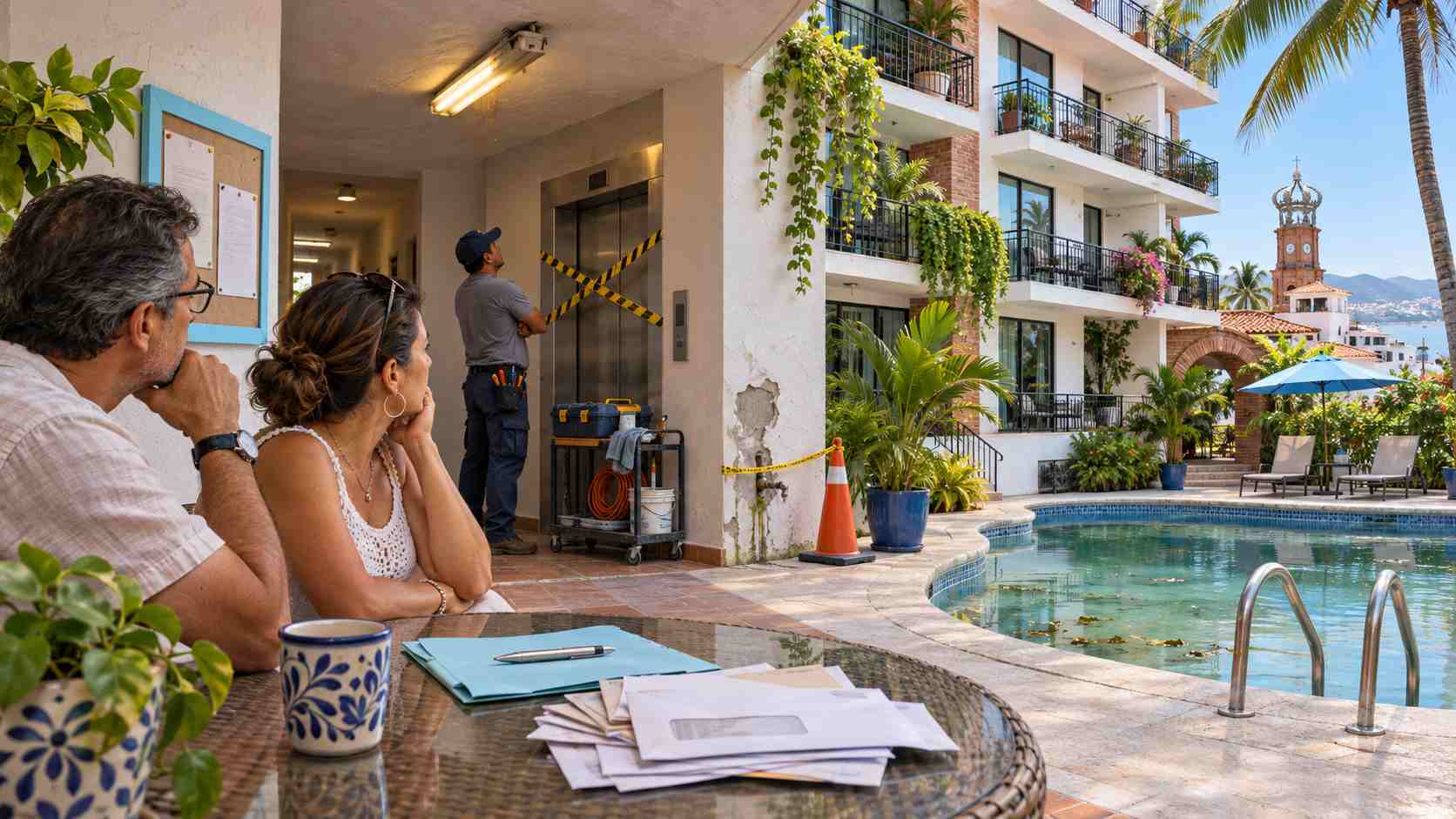

From finding the right person to agreeing on prices, communicating expectations and making sure the job is done properly.
Finding someone to fix a leaking faucet, paint a bedroom or repair a damaged door should be relatively straightforward. Yet for many foreigners living in Puerto Vallarta, getting even a small household repair completed can become a surprisingly frustrating experience.
In a recent survey of Vallarta Daily subscribers about the challenges of living in Puerto Vallarta, two issues stood out: language barriers when conducting everyday business and finding reliable people to complete household repairs.
The two problems are often connected.
You might find someone who does excellent work but speaks very little English. You might receive a recommendation from a neighbor only to discover that the person is better at plumbing than painting. Or you might agree on a price, only to find that what you thought was included in the job wasn’t what the worker understood.
None of these situations is unique to Mexico. However, navigating them in another language, with unfamiliar business practices and sometimes while managing a property from thousands of miles away, adds another layer of difficulty.
The good news is that there are ways to make the experience considerably easier. And many of them involve things you can do before anyone picks up a hammer.
1. Finding a reliable handyman in Puerto Vallarta
When something breaks at home, many foreign residents turn to Facebook groups and ask for recommendations. Within an hour, they may have a dozen names, several telephone numbers and a few warnings about people they should never hire.
That’s a starting point, but it shouldn’t be the entire hiring process.
A recommendation is only as useful as the experience behind it. Someone who did an excellent job installing curtain rods may not be the right person to repair a leaking shower.
Some of the best places to begin your search are closer to home.
Ask Mexican neighbors who they use for household repairs. People who have lived in the same neighborhood for years may already have established relationships with dependable tradespeople.
Condominium administrators and building maintenance employees are also worth approaching. They may know workers familiar with your building’s plumbing, electrical systems and construction materials.
Local hardware stores, known as ferreterías, can be another useful resource. Employees regularly interact with painters, plumbers, electricians and other tradespeople purchasing supplies.
You can also use the Vallarta Daily local services directory as a starting point, remembering that a business listing is not a guarantee of workmanship.
Ask better questions about recommendations
Instead of simply asking whether someone is a good handyman, ask the person recommending them a few more specific questions.
- What type of work did they complete?
- Did they finish within the agreed timeframe?
- Was the final price close to the original estimate?
- Did they communicate when problems arose?
- How has the repair held up since it was completed?
- Would you hire them again?
That last question can be particularly revealing.
Someone might be satisfied with the finished work but unwilling to repeat the experience because of communication problems, delays or unexpected expenses.
When interviewing a potential handyman, ask whether they have photographs of similar jobs they have completed. For more expensive work, ask whether a recent customer would be willing to provide a reference.
Know when you need a specialist
The English word handyman doesn’t necessarily translate into one particular profession in Mexico.
Someone who describes themselves as offering mantenimiento general may handle a variety of household repairs, but other workers specialize in particular trades.
| Spanish term | Type of work |
|---|---|
| Mantenimiento general | General household maintenance |
| Plomero | Plumbing |
| Electricista | Electrical work |
| Albañil | Masonry and construction |
| Carpintero | Carpentry |
| Pintor | Painting |
| Herrero | Metalwork |
| Cerrajero | Locks and security hardware |
| Impermeabilizador | Waterproofing |
| Técnico en refrigeración | Air conditioning and refrigeration |
Installing shelves, replacing cabinet handles and repairing furniture may be perfectly reasonable jobs for a general handyman.
Electrical panels, gas installations, structural cracks, major plumbing problems and extensive waterproofing require appropriately qualified and experienced professionals.
A good tradesperson should be comfortable telling you when something falls outside their area of expertise.
Be cautious when someone insists they can do absolutely everything, refuses to explain their approach, pressures you into making an immediate payment or suggests concealing work from your condominium administration.
For someone you haven’t worked with before, consider starting with a small job. It gives both of you an opportunity to establish how well you work together before committing to something more expensive.
2. Why misunderstandings begin before the work starts
Imagine asking someone to paint your bedroom.
You agree on a price, leave the worker to complete the job and return two days later to discover that the walls have been painted, but the ceiling hasn’t. There is paint on the electrical outlet covers, several cracks remain visible and the furniture hasn’t been returned to its original position.
You’re disappointed because you thought you were paying for a complete bedroom makeover.
The painter may be equally surprised by your dissatisfaction. As far as they’re concerned, you asked them to paint the walls, and that’s exactly what they did.
This is where many disagreements begin.
The problem isn’t necessarily dishonesty or poor workmanship. Sometimes the two people involved simply agreed to different versions of the same job without realizing it.
Describe the finished result
Rather than asking someone to paint a room, explain what you expect the room to look like when the work is finished.
For example:
| General instruction | Better instruction |
|---|---|
| Paint the bedroom | Prepare and paint all four walls, repair minor surface cracks, protect furniture and clean the room afterward |
| Fix the bathroom leak | Identify the source of the leak, repair it and demonstrate that it no longer leaks |
| Fix the door | Adjust the door so it opens, closes and locks without rubbing against the frame |
| Repair the terrace | Identify the cause of water penetration, explain the proposed repair and restore the affected surface |
| Install a shelf | Install the shelf at the agreed height, level and securely attached using appropriate hardware |
Try to avoid descriptions such as “make it look nice,” “fix it properly” or “do whatever is necessary.”
They leave too much room for interpretation.
Photographs can be especially helpful. If you want a particular finish, color, tile arrangement or style of installation, show the worker an example before agreeing on the price.
A photograph of what you want may accomplish more than ten minutes of struggling through a translation app.
Repairing the symptom isn’t always repairing the problem
This is particularly important in Puerto Vallarta, where humidity and seasonal rainfall can contribute to recurring household maintenance issues.
Painting over a damp wall may temporarily improve its appearance, but if water is entering through an exterior crack or leaking pipe, the discoloration will probably return.
Ask what caused the problem and how the proposed work will address it.
Sometimes paying someone to investigate a problem before attempting to repair it is money well spent.
3. Getting a quote that actually means something
The Spanish words cotización and presupuesto are commonly used when requesting an estimate for household work.
A written estimate doesn’t need to be a professionally designed document. For a small repair, a clearly written WhatsApp message identifying the work and price may be enough to establish what both parties have agreed to.
More substantial jobs deserve a more detailed written agreement.
In fact, Article 59 of Mexico’s Federal Consumer Protection Law requires service providers covered by the law to provide written estimates before performing services, including details of repair work, labor and replacement parts.
Before accepting an estimate, make sure you understand the following terms.
| Item | What should be established |
|---|---|
| Scope of work | Exactly what will be repaired or installed |
| Labor | The amount charged for the work itself |
| Materials | What is included and who will purchase it |
| Transportation | Any delivery or travel charges |
| Preparation | Furniture protection, surface preparation and removal of existing materials |
| Cleanup | Who removes debris and cleans the work area |
| Taxes | Whether applicable taxes are included in the total |
| Schedule | Expected start and completion dates |
| Additional work | How unexpected expenses will be approved |
| Warranty | What is covered and how problems will be corrected |
Make sure all amounts are expressed in Mexican pesos unless you have specifically agreed otherwise.
The difference between MXN $5,000 and USD $5,000 is not a misunderstanding you want to discover after the work has begun.
Don’t automatically choose the cheapest estimate
Suppose you receive the following three estimates for painting a bedroom.
These figures are hypothetical examples, not current Puerto Vallarta market rates.
| What’s included | Estimate A | Estimate B | Estimate C |
|---|---|---|---|
| Labor | Included | Included | Included |
| Paint | Not included | Included | Included |
| Surface preparation | Minimal | Included | Included |
| Primer where needed | Not included | Not included | Included |
| Furniture protection | Unspecified | Included | Included |
| Cleanup | Unspecified | Included | Included |
| Total | MXN $1,800 | MXN $3,200 | MXN $3,800 |
The first estimate appears considerably cheaper, but once you purchase paint and discover that additional preparation is necessary, it may no longer represent the best value.
The most expensive estimate isn’t automatically the best one either.
The objective is to compare the same job, using comparable materials and expectations.
Also remember that small jobs may carry minimum service charges. A worker who spends an hour traveling to your home, purchases a replacement part and completes a 20-minute repair has devoted considerably more than 20 minutes to your job.
A fair price should account for that time.
4. Overcoming the language barrier
You don’t need to speak fluent Spanish to manage a successful household repair in Puerto Vallarta.
However, relying entirely on verbal conversations can create unnecessary problems, particularly when discussing measurements, technical details, costs and dates.
WhatsApp can be one of your most useful tools.
Written messages allow both parties to translate conversations, refer back to previous agreements and confirm details without having to remember everything that was discussed.
Spanish phrases worth saving
The following phrases can be copied directly into WhatsApp when communicating with tradespeople.
| English | Spanish |
|---|---|
| Could you give me a written estimate? | ¿Me podría dar una cotización por escrito? |
| Does the price include materials? | ¿El precio incluye los materiales? |
| Is this the total price in Mexican pesos? | ¿Este es el precio total en pesos mexicanos? |
| Are taxes included? | ¿El precio incluye los impuestos? |
| When can you start? | ¿Cuándo puede empezar? |
| When will the work be finished? | ¿Cuándo estará terminado el trabajo? |
| What is causing the problem? | ¿Cuál es la causa del problema? |
| What materials will you use? | ¿Qué materiales va a utilizar? |
| Have you done this type of work before? | ¿Ha realizado este tipo de trabajo anteriormente? |
| Could you send me photographs of previous work? | ¿Me podría enviar fotos de trabajos anteriores? |
| How much is the deposit? | ¿De cuánto es el anticipo? |
| Could you send me the receipts for the materials? | ¿Me podría enviar los comprobantes de compra de los materiales? |
| Please let me know before doing any additional work. | Por favor, avíseme antes de realizar cualquier trabajo adicional. |
| Please wait for my approval before continuing. | Por favor, espere mi autorización antes de continuar. |
| Does the work include cleanup? | ¿El trabajo incluye la limpieza al terminar? |
| Does the work come with a warranty? | ¿El trabajo tiene garantía? |
| Can we check everything before I make the final payment? | ¿Podemos revisar todo antes de que haga el pago final? |
A message you can use when hiring someone
Here is a simple introductory message you can adapt to almost any household repair.
Spanish:
Hola, buen día. Estoy buscando a alguien que me ayude con una reparación en mi casa. Le envío unas fotos del problema. ¿Me podría dar una cotización por escrito, indicando el costo de la mano de obra, los materiales y el tiempo estimado para terminar el trabajo? Muchas gracias.
English translation:
Hello, good morning. I’m looking for someone to help me with a repair at my home. I’m sending you some photographs of the problem. Could you provide a written estimate indicating the labor costs, materials and estimated time to complete the work? Thank you very much.
Confirm that you both understood the agreement
Once you have discussed the job, send a brief summary of what was agreed.
For example:
Spanish:
Para confirmar, el precio total acordado es de $3,500 pesos, incluyendo materiales, mano de obra y limpieza. El trabajo comienza el lunes y se estima que estará terminado el miércoles. Cualquier gasto adicional deberá ser autorizado antes de realizarse. ¿Es correcto?
English translation:
To confirm, the agreed total price is 3,500 pesos, including materials, labor and cleanup. The work begins Monday and is expected to be completed Wednesday. Any additional expenses must be approved beforehand. Is that correct?
Wait for confirmation before treating the agreement as settled.
When a conversation involves technical work or a substantial amount of money, consider asking a bilingual friend, property manager or professional interpreter to review the agreement.
Translation software is helpful, but it doesn’t always understand construction terminology or the context in which particular words are being used.
5. Who should purchase the materials?
There are two common ways of handling materials for household repairs. You can purchase them yourself, or the handyman can purchase them on your behalf.
Neither arrangement is necessarily better. It depends on the job and how comfortable you are selecting the correct products.
Purchasing materials yourself
Buying materials directly allows you to control the quality, compare prices, retain receipts and know exactly what has been purchased.
It can work particularly well when selecting visible items such as paint colors, light fixtures, tiles, faucets and door handles.
However, purchasing technical materials without understanding the installation requirements can create problems.
A faucet may look beautiful in the store but be incompatible with your existing plumbing. A replacement electrical fitting may not be appropriate for your installation.
Ask the person completing the work to prepare a shopping list before making purchases.
Allowing the handyman to purchase materials
An experienced worker may know which stores carry the appropriate supplies, which brands offer better value and what additional components will be required.
That knowledge has value.
If someone spends part of their working day traveling between hardware stores and collecting materials, it is reasonable for them to charge for that service.
Agree in advance whether purchasing and transportation are included in the estimate, whether a handling charge applies and what receipts you will receive.
If you paid for an entire container of paint or a package of tiles, establish who will retain any unused materials. Keeping them can be particularly useful when future repairs are needed.
Not all materials are suitable for Puerto Vallarta
Products that perform well in a dry inland climate may deteriorate much faster in a coastal environment.
Puerto Vallarta homes are exposed to combinations of humidity, salty air, intense sunlight, heavy seasonal rainfall and insects.
| Household item | What to consider |
|---|---|
| Exterior screws and hardware | Corrosion-resistant materials appropriate for coastal exposure |
| Outdoor paint | UV resistance, moisture resistance and proper surface preparation |
| Bathroom sealants | Compatibility with surfaces and resistance to moisture and mold |
| Outdoor furniture | Materials and finishes designed for prolonged exposure |
| Wood cabinetry | Moisture protection and pest resistance |
| Roof waterproofing | Correct product, preparation, application and curing conditions |
| Exterior electrical fittings | Equipment rated for the actual exposure to moisture and weather |
A cheaper product that needs replacing every year may ultimately cost more than purchasing the appropriate material the first time.
Ask the worker to explain why they recommend a particular product. Retain the product label, model number or a photograph of the packaging so you know what was installed.
6. Establishing a fair payment arrangement
Few subjects create more anxiety when hiring someone than deciding how much money to pay before work begins.
Some homeowners have been advised never to pay anything upfront. Others have discovered that paying the entire amount before the job is completed leaves them with little practical leverage if problems arise.
A reasonable arrangement protects both parties.
Remember that independent workers may not have the financial resources to purchase thousands of pesos in materials for every customer while waiting to be reimbursed.
Requesting a deposit is not automatically a warning sign.
The important questions are how much is being requested, what the money will be used for and whether you can document the payment.
Match the payment schedule to the job
| Type of work | Suggested arrangement |
|---|---|
| Small, labor-only repair | Payment after completion |
| Small repair requiring materials | Purchase materials directly or provide an agreed material advance |
| Multi-day maintenance job | Material deposit, followed by payment for agreed progress and completion |
| Larger repair or renovation | Written agreement with clearly defined payment milestones |
| Emergency service | Confirm call-out charges and obtain approval for additional repair costs |
There is no universal deposit percentage appropriate for every project.
For example, imagine a small repair estimated at MXN $8,000, including materials.
An illustrative payment arrangement might be:
| Payment stage | Amount |
|---|---|
| Initial payment for materials | MXN $2,500 |
| Agreed work milestone completed | MXN $3,000 |
| Final inspection and completion | MXN $2,500 |
| Total | MXN $8,000 |
The amounts should reflect the actual expenses and work involved, rather than an arbitrary formula.
If a worker needs to purchase an expensive special-order part, a larger deposit may be justified. You may also be able to pay the supplier directly.
Avoid making repeated advances when the previous payment cannot be accounted for or the agreed work milestone has not been reached.
Cash or bank transfer?
Cash payments are common for small services, but they can be more difficult to document if a disagreement develops.
A bank transfer, known as a transferencia, creates a payment record. Confirm the recipient and account details before sending money.
If paying cash, request a receipt identifying the payment amount, date, purpose and remaining balance.
Under Article 62 of Mexico’s consumer protection law, covered service providers are required to issue documentation of completed work, including relevant labor and material charges and any warranty granted.
Whatever payment method you use, keep a record of every transaction.
7. Managing the work without micromanaging
There is a difference between managing a household repair and standing over someone’s shoulder while they work.
A professional should be given room to do their job. At the same time, you are entitled to understand what is happening in your home, particularly when decisions affect the cost or finished result.
Before the work begins, discuss practical details such as access to the property, working hours, bathroom use, furniture protection, cleanup and where tools and materials can be stored.
If other workers will be assisting, establish who they are and who is responsible for supervising them.
Condominium residents have additional considerations
If you live in a condominium, contact the administrator before arranging work that could affect other residents or common areas.
Your building may have restrictions governing construction hours, weekend work, contractors, elevator use, debris disposal and modifications to exterior walls or balconies.
Plumbing and electrical systems can also extend beyond the boundaries of your individual unit.
A leaking pipe inside your wall might be part of the building’s shared infrastructure rather than something you are individually responsible for repairing.
Establish responsibility before authorizing work that could affect neighboring units or communal systems.
If you rent your home, obtain the owner’s authorization when required and establish who will pay for the repair before hiring anyone.
Handling unexpected problems
Imagine hiring someone to replace a bathroom vanity. Once the old vanity is removed, the worker discovers a damaged water supply connection that needs replacing.
This may be a legitimate additional expense.
The problem arises when the worker completes the extra work without discussing it and presents you with a larger bill afterward.
Agree beforehand that unexpected work requires approval.
Ask for a photograph of the newly discovered problem, an explanation of the recommended repair, the additional cost and any effect on the completion date.
Then approve or decline the additional work in writing.
Article 10 of Mexico’s Federal Consumer Protection Law also addresses additional services and charges that have not been expressly accepted by the consumer in covered commercial transactions.
Managing repairs when you’re outside Mexico
For snowbirds and part-time residents, managing repairs from Canada or the United States introduces additional challenges.
One useful approach is to establish three stages of photographic documentation:
| Stage | What to request |
|---|---|
| Before work begins | Existing condition and visible damage |
| During the work | Preparation, materials and repairs that will later be concealed |
| After completion | Finished work and demonstrations that everything functions |
Photographs taken during the work can be more valuable than photographs taken afterward.
Once a wall is closed or tiles have been installed, it becomes much harder to determine what happened underneath.
For more substantial jobs, consider hiring an independent property manager or qualified professional to inspect the work on your behalf.
Arrange temporary property access where possible, avoid unnecessarily distributing permanent keys and access codes, and confirm that keys are returned when the work is complete.
Most importantly, designate someone locally who can make contact with the worker if you are unavailable.
A few additional pesos spent on independent oversight can be a worthwhile investment when managing an expensive repair from another country.
8. Knowing whether the job is actually finished
One of the biggest mistakes homeowners make is inspecting the appearance of a repair without checking whether it actually works.
A newly installed faucet may look beautiful while slowly leaking into the cabinet underneath. A freshly painted wall may look perfect while the underlying moisture problem remains unresolved.
Make the final inspection part of the original agreement.
It doesn’t need to be uncomfortable. Simply walk through the completed work together and compare the results with what was agreed.
Painting
Check the finished surfaces after the paint has dried, preferably in daylight.
Look for uneven coverage, visible drips, unpainted edges, paint on fixtures and damage to flooring or furniture.
Confirm that agreed preparation and repairs were completed and that remaining paint has been properly labeled and stored.
Plumbing
Ask the worker to demonstrate the repaired fixture.
Run water through faucets, check accessible connections for moisture, operate toilets and observe whether sinks and showers drain properly.
For repairs involving hidden pipes or significant leaks, ask whether appropriate testing has been performed before walls or floors are closed.
Tile replacement
Look for obvious differences in alignment, damaged tiles, uneven grout lines and loose or raised edges that could become tripping hazards.
In a shower or outdoor area, drainage and waterproofing may matter more than the appearance of the finished tile.
Allow the appropriate curing time before using the area.
Doors and windows
Open and close them several times.
Check locks, handles, alignment and whether doors or windows rub against their frames.
For exterior installations, discuss how the repair will handle wind and rain.
Waterproofing
Ask which product was used, what surface preparation was completed and whether application followed the manufacturer’s instructions.
Confirm whether there is a warranty and whether the contractor will return if water continues entering through the repaired area.
Waterproofing can be difficult to evaluate immediately. Some defects only become apparent during heavy rainfall.
That makes written warranty terms and photographs of the preparation particularly valuable.
Electrical repairs
Have a qualified electrician demonstrate that the repaired installation functions correctly and perform any necessary safety testing.
Do not remove electrical covers, handle exposed wiring or attempt technical testing yourself.
Unusual heat, burning smells, sparking or repeated circuit-breaker trips require professional attention, even if the installation appears to work.
Check the work against the original agreement
Before making the agreed final payment, confirm that the work has been completed, necessary tests have been performed, additional expenses were approved and the work area has been cleaned.
If minor corrections remain, create a short written list of those items and agree on when they will be completed.
The construction industry sometimes calls this a punch list. In Spanish, you can refer to it as a lista de pendientes.
9. What to do when something goes wrong
Even with good preparation, not every household repair will go according to plan.
A worker may miss an appointment, discover unexpected damage, install the wrong material or complete a job to a standard you find unacceptable.
How you respond can determine whether the problem is resolved or becomes a much larger disagreement.
Start with the specific problem
Instead of telling someone that their work is terrible, explain what is wrong and what you would like corrected.
For example:
Spanish:
Gracias por el trabajo. Revisé la reparación y todavía hay una fuga debajo del lavabo. Le envío una foto. ¿Podría regresar para revisar y corregir el problema, por favor?
English translation:
Thank you for the work. I checked the repair, and there is still a leak underneath the sink. I’m sending you a photograph. Could you please return to inspect and correct the problem?
Being polite doesn’t mean accepting poor workmanship.
It means giving the other person an opportunity to address a clearly identified issue before the conversation becomes confrontational.
What if the price suddenly increases?
Return to the original written estimate.
Ask which additional work was performed, why it was necessary and when you approved it.
There may have been a genuine misunderstanding or an unexpected expense that needs discussing.
Pay amounts that are undisputed according to your agreement, and document how any disputed amount will be resolved. Avoid using payment for properly completed work as leverage over unrelated complaints.
What if the handyman stops responding?
Send a clear written message requesting a response by a reasonable date.
If the work is unfinished, document its current condition before another worker changes it.
Retain payment receipts, estimates, photographs, correspondence and any information identifying the service provider.
Where the problem involves an unsafe installation or ongoing property damage, prioritize making the property safe with appropriately qualified help.
Understanding warranties in Mexico
Ask about the warranty before hiring someone rather than after a problem appears.
A warranty should explain what is covered, how long the coverage lasts, whether materials and labor are included, and how you request corrective work.
Under Articles 77 and 78 of Mexico’s Federal Consumer Protection Law, when a covered product or service is offered with a warranty, that warranty cannot be shorter than 90 days and its terms must be documented.
That doesn’t mean every type of household repair automatically comes with identical coverage, or that unrelated damage occurring later must be repaired free of charge.
Clarifying the terms beforehand is essential.
Can PROFECO help?
Mexico’s federal consumer protection agency, the Procuraduría Federal del Consumidor, commonly known as PROFECO, can assist consumers in certain disputes involving commercial service providers.
Examples may include failing to honor an agreed price, refusing to fulfill contracted services or failing to respect a warranty.
Independent tradespeople who regularly offer commercial services may fall within the law’s definition of a provider. However, employment relationships and certain other arrangements are excluded.
Whether PROFECO can intervene depends on the nature of your particular agreement.
If you intend to pursue a complaint, prepare the following information:
- Your identification and contact details.
- The service provider’s name and information about where they can be located.
- The written estimate or agreement.
- Receipts and evidence of payments.
- Photographs and relevant correspondence.
- A description of the problem and the resolution you are requesting.
PROFECO provides official guidance on filing consumer complaints.
You can also contact its consumer assistance line at 800 468 8722 from within Mexico.
Online conciliation is available through Concilianet for participating service providers, although many independent tradespeople may not be registered with that platform.
For part-time residents who have returned to their home country, PROFECO also provides procedures for consumers living outside Mexico.
A complaint does not guarantee a refund or favorable resolution. Significant property damage, suspected fraud or disputes outside PROFECO’s jurisdiction may require advice from a Mexican attorney.
10. Building a reliable network of local tradespeople
Ask someone who has lived in Puerto Vallarta for twenty years how they handle household repairs, and you may discover that they rarely need to search for a new worker.
They have a plumber they call, an electrician they trust, someone who services their air conditioners and another person who handles painting and general maintenance.
Building those relationships takes time, but it can make living in Mexico considerably easier.
When you find someone who communicates well, arrives when agreed, charges fairly and stands behind their work, retain their contact information.
Keep notes about the work they completed, the materials used and when maintenance may be needed again.
And remember that maintaining a good relationship requires effort on both sides.
Be available when appointments are scheduled. Communicate changes promptly. Pay agreed amounts on time. Avoid adding small tasks throughout the day without discussing whether additional payment is appropriate.
Don’t expect someone to drop every other customer whenever you have a non-emergency problem.
Good tradespeople are running businesses of their own, and their time deserves the same consideration you would expect someone to give yours.
Insider resource — Your bilingual handyman job sheet
Save the following worksheet and use it whenever you hire someone to complete household repairs. You can copy it into an email, a document or a WhatsApp conversation.
Home Repair Agreement — Acuerdo de Reparaciones del Hogar
| Information / Información | Agreed details / Datos acordados |
|---|---|
| Customer / Cliente | |
| Service provider / Prestador del servicio | |
| Telephone / Teléfono | |
| Property address / Domicilio del inmueble | |
| Description of work / Descripción del trabajo | |
| Work not included / Trabajos no incluidos | |
| Materials and brands / Materiales y marcas | |
| Labor cost / Costo de mano de obra | MXN $ |
| Material cost / Costo de materiales | MXN $ |
| Other expenses / Otros gastos | MXN $ |
| Total agreed price / Precio total acordado | MXN $ |
| Deposit / Anticipo | MXN $ |
| Payment schedule / Calendario de pagos | |
| Start date / Fecha de inicio | |
| Estimated completion / Fecha estimada de terminación | |
| Cleanup and debris removal / Limpieza y retiro de escombros | |
| Warranty and conditions / Garantía y condiciones | |
| Customer acceptance / Aceptación del cliente | |
| Service provider acceptance / Aceptación del prestador del servicio | |
| Date / Fecha |
Additional work agreement — Acuerdo sobre trabajos adicionales
Any additional work or expenses must be explained and approved by the customer before proceeding.
Cualquier trabajo o gasto adicional deberá ser explicado y autorizado por el cliente antes de realizarse.
Final inspection checklist
- All agreed work has been completed.
- Repairs have been tested where appropriate.
- Agreed materials have been used.
- Additional expenses have been approved.
- Furniture and surrounding surfaces have been checked.
- The work area has been cleaned.
- Material receipts have been received.
- Unused materials have been accounted for.
- Warranty information has been received.
- Remaining corrections and completion dates have been agreed upon.
- Final payment and receipt have been documented.
- Keys and property access arrangements have been resolved.
This worksheet is intended for ordinary household repairs. Larger construction projects and renovations may require more comprehensive contracts, professional oversight, insurance arrangements and permits.
The goal isn’t finding the cheapest handyman
One of the advantages of living in Puerto Vallarta is the availability of skilled tradespeople who can repair things that might simply be discarded and replaced elsewhere.
A damaged piece of furniture can often be restored. A broken cabinet can be rebuilt. A door that no longer fits its frame may be adjusted rather than replaced.
There is considerable value in that knowledge and craftsmanship.
But finding someone capable of doing the work is only half the equation. The other half is communicating what you want, establishing a fair agreement and making sure both parties understand what successful completion looks like.
Not every bad experience can be prevented. But many can be avoided by spending a little more time discussing the job before it begins.
Eventually, the most valuable telephone number in your contacts may not belong to the person who charges the least.
It may belong to the person you can call, explain a problem to, agree on a fair price with and trust to leave your home in better condition than they found it.