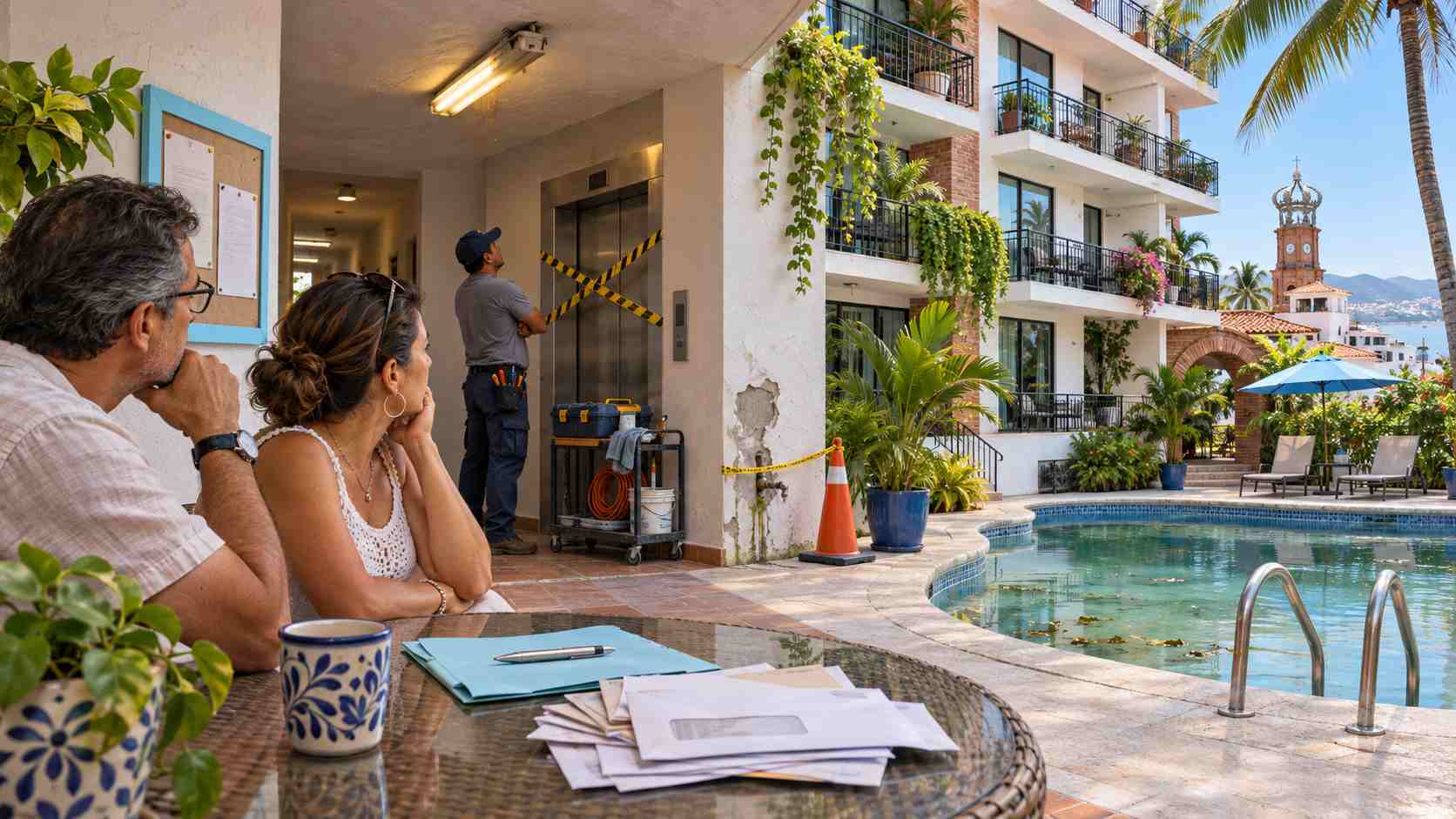
Puerto Vallarta faces falling tourism, failing public services and a financial crisis as Mayor Luis Munguía comes under mounting pressure to act.
Puerto Vallarta, Jalisco, November 25, 2026 – At a time when Puerto Vallarta needs its city government working harder than ever, getting the mayor to hold a City Council meeting has become a political battle of its own.
Garbage is going uncollected. Municipal workers have reported delayed pay. Streets need repairs. Water infrastructure continues to break down. Police officers are raising concerns about operating resources, and the tourism industry is struggling through a particularly difficult year.
Yet tomorrow evening, Puerto Vallarta will hold its first ordinary City Council meeting in more than two months.
It took two formal demands from municipal officials and mounting political pressure before Mayor Luis Ernesto Munguía González finally called a City Council meeting for November 26.
Getting the city’s government to sit around a table should be the least of Puerto Vallarta’s problems.
Instead, it has become one of the clearest examples of the leadership concerns facing a city going through an unusually difficult period.
The question this week is bigger than whether the mayor has enough political support to get his proposals approved. It is whether his administration has a credible plan to get Puerto Vallarta back on its feet.
A city government that had to be pushed into meeting
On November 13, seven council members and the municipal síndico formally requested that Munguía convene the City Council within two business days.
When that did not happen, the group submitted a second demand on November 20, giving the mayor 24 hours to issue a meeting notice.
That deadline also passed.
The mayor eventually issued the convocatoria on Tuesday, scheduling the meeting for Thursday at 7 p.m.
The officials were not asking for a meeting simply to debate political differences. They wanted answers about garbage collection, unpaid wages, municipal debt, pothole repairs and the availability of money to keep the city functioning.
Under Article 31 of Jalisco’s municipal government law, municipal governments are required to hold at least one council session per month. The law also assigns the mayor responsibility for convening meetings and directing municipal public services.
Holding a meeting is not a political favor the mayor extends to other elected officials. It is part of governing.
As we examined in last week’s City Hall Watch, the political breakdown inside the administration has increasingly coincided with problems outside City Hall.
Municipal departments have continued operating, but the absence of regular council meetings has deprived the city of an important forum for public oversight, financial scrutiny and collective decision-making.
And that is particularly concerning when so many departments appear to need help.
Tourism is struggling when Vallarta can least afford it
Puerto Vallarta’s economic problems are no longer just a matter of perception or anecdotal reports from restaurant owners and taxi drivers.
The numbers are there.
According to Grupo Aeroportuario del Pacífico’s October passenger traffic report, Puerto Vallarta International Airport continues to record substantial declines compared with 2025.
- Total October passenger traffic fell 19.8%.
- International passenger traffic fell 20.3% in October.
- Domestic passenger traffic fell 19.4% in October.
- Total passenger traffic between January and October fell 12.9%.
- International passenger traffic for the first ten months fell 19.5%.
The airport handled approximately 722,000 fewer passenger movements during the first ten months of 2026 than during the same period last year. Those figures include arrivals and departures, rather than representing a count of individual tourists.
The hotel industry is also facing a more challenging outlook for 2027, despite expectations that winter visitors will help improve business in the coming months.
Not all of this can fairly be placed at the mayor’s feet.
Security incidents earlier this year, Hurricane Simón, airline capacity, international economic conditions and travelers’ perceptions of Mexico have all complicated the tourism recovery.
City Hall cannot control the weather, international airline schedules or every security incident in Jalisco.
What it can control, however, is much of the experience people have once they arrive in Puerto Vallarta.
Clean streets. Maintained sidewalks. Reliable garbage collection. Street lighting. Municipal police patrols. Public spaces that are welcoming and accessible.
Those are not unreasonable expectations for a city whose economy depends so heavily on attracting visitors.
Puerto Vallarta does not need to give people additional reasons to reconsider their next vacation.
Puerto Vallarta is asking businesses to help maintain the city
One of the more telling developments this week came out of a meeting between Munguía and representatives of Puerto Vallarta’s hotel industry.
Local hotel operators offered to take responsibility for maintaining sections of the medians along Avenida Francisco Medina Ascencio, the city’s principal entrance from the airport.
The mayor also discussed rehabilitating the Malecón and Los Muertos Pier, improving garbage collection and expanding pothole repairs in 2027.
There is nothing inherently wrong with businesses helping maintain public spaces. Public-private cooperation can benefit communities, particularly when local government is financially constrained.
But the circumstances surrounding this proposal deserve attention.
The businesses that depend on Puerto Vallarta looking attractive are offering to help maintain the city’s appearance at a time when the municipal government is struggling to provide basic services.
On Tuesday, Francisco Gabriel Vizcaíno Rendón, president of Coparmex Puerto Vallarta, warned that garbage collection failures are damaging the destination’s tourism image.
He also pointed out something City Hall needs to recognize. Tourism is no longer concentrated exclusively in the Hotel Zone and along the beachfront.
Visitors are staying in condominiums and vacation rentals in neighborhoods throughout Puerto Vallarta. The condition of those neighborhoods is now part of the tourism experience.
Cleaning up the airport corridor while allowing residential neighborhoods to deteriorate is not a comprehensive tourism recovery strategy.
Where did the city’s money go?
Perhaps the most consequential issue facing residents is the municipality’s financial situation.
Munguía confirmed that his administration intends to request an advance on government revenue to cover municipal workers’ year-end bonuses.
A figure of approximately 100 million pesos has been discussed, although the final amount and conditions have yet to be established publicly.
Independent council member Melissa Madero has indicated that she would oppose such a request without sufficient transparency regarding the municipality’s finances.
The concern here is not whether municipal employees deserve their aguinaldos. They are legally entitled to them.
The concern is why the city finds itself potentially needing next year’s money to cover a predictable expense from this year.
An advance on future government revenue is not additional income. It brings forward money that would otherwise be available to the municipality later.
Puerto Vallarta could consequently enter 2027 with fewer financial resources available to address the same infrastructure and public service problems it is struggling to resolve today.
There are several questions that residents should expect City Hall to answer before any financial agreement is approved.
How much money does the municipality currently owe? How much revenue did it collect compared with projections? Which departments exceeded their budgets? Which expenses were postponed? How much money remains available for essential services?
The municipality publishes budget information and financial documents through its government accounting transparency portal. What residents need now is a clear explanation of how those figures translate into the city’s present financial difficulties.
A cash shortage does not automatically establish financial misconduct. But it does require an explanation, particularly when the consequences are becoming visible throughout the city.
Garbage collection has become a leadership problem
On November 19, Javier Arturo Dueñas Peña was named the new head of municipal public services, replacing Rodolfo Domínguez Monroy amid ongoing garbage collection problems.
The change in leadership comes after months of complaints about missed collections, inadequate equipment and insufficient operating resources.
Before his departure, Domínguez reported that only 26 of the municipality’s 35 garbage trucks were operational. Municipal workers subsequently told local media that the number of trucks actually circulating could be considerably lower.
The conflicting figures are another reason the city needs to publish reliable operational information.
Residents should not have to guess whether garbage will be collected on their street today, tomorrow or sometime next week.
For condominium administrators, irregular collection means finding somewhere to store accumulating waste. For restaurants, it creates sanitation concerns. For households, it means unpleasant odors, pests and garbage bags left exposed to animals.
These are not cosmetic problems.
The appointment of a new public services director may help, but changing the person responsible for a department does not automatically provide that department with money, equipment or fuel.
The new director inherits the same financial problems that reportedly complicated the work of his predecessor.
What matters now is whether he receives the resources to do the job.
Police spending is no longer just a budget discussion
On November 20, Vallarta Daily reported that municipal police officers were raising concerns about fuel restrictions affecting their ability to patrol the city.
Officers speaking anonymously alleged that financial restrictions had reduced mobile patrols.
The claims have not been independently established across the entire police department, and the reported restrictions do not necessarily mean that emergency services are unavailable or that crime has increased as a direct result.
Nevertheless, the allegations deserve a detailed public response from the administration.
Security has been one of the most sensitive issues affecting Puerto Vallarta’s international reputation this year.
A city trying to convince Canadians, Americans and other international visitors that it remains a safe destination cannot afford uncertainty over whether its municipal police have sufficient operating resources.
The police budget should be among the first items examined as council members seek explanations about municipal spending.
It is one thing to announce new police vehicles, equipment or security initiatives. It is another to ensure that the department can afford to operate them every day.
A growing city with unreliable water infrastructure
During the past week, residents in 17 neighborhoods around El Pitillal experienced water interruptions after a second break occurred in a major supply line.
On Tuesday, residents in 5 de Diciembre faced a scheduled nine-hour water interruption while crews connected new infrastructure.
Meanwhile, residents of Campestre Las Palmas have reported suspected sewage contamination in an arroyo that flows toward Estero El Salado. Residents say they have previously reported the problem without receiving a satisfactory response.
There is an important distinction between water outages caused by planned infrastructure improvements and those caused by unexpected equipment failures.
SEAPAL is undertaking repairs and investment. The utility also announced the acquisition of additional operational vehicles this week.
Those efforts deserve recognition.
But Puerto Vallarta’s recurring water and drainage problems raise a larger question about the relationship between urban development and infrastructure planning.
Last week, we reported on a proposed eight-story, 24-unit condominium development in 5 de Diciembre. The project was proposed, not confirmed as approved.
We also reported that SEAPAL is considering wastewater metering for condominium buildings in Versalles.
New development is not necessarily bad for Puerto Vallarta. It generates employment, investment and potentially additional municipal revenue.
But every additional building creates demands on water supplies, drainage systems, roads, garbage collection and emergency services.
City Hall needs to demonstrate that its infrastructure planning is keeping pace with the development taking place across the city.
Approving construction is relatively easy compared with providing decades of public services to the people who eventually occupy those buildings.
Road improvements cannot always be next year’s problem
During his meeting with hotel representatives, Munguía discussed strengthening pothole repair efforts in 2027.
For residents driving around Puerto Vallarta today, next year can feel like a long way away.
Poor road conditions have consequences beyond an uncomfortable ride. They increase vehicle maintenance costs, complicate deliveries, affect public transportation and create accessibility problems for older residents and people with disabilities.
Puerto Vallarta also continues to undergo significant infrastructure changes, including roadwork near the international airport that resulted in the removal of more than 30 palm trees.
Major transportation projects can improve the city’s future, but they do not replace the need for routine maintenance throughout its neighborhoods.
Not every road project falls under municipal jurisdiction. State and federal authorities also have responsibilities in Puerto Vallarta. Effective municipal leadership includes coordinating with those authorities and communicating clearly with residents about disruptions.
What is missing from the current discussion is a comprehensive, funded and publicly accessible road maintenance schedule.
Residents deserve to know which streets will be repaired, when those repairs will take place and how the work will be financed.
What happened to Vallarta’s promised beach improvements?
Puerto Vallarta’s beaches are central to its tourism economy, yet questions remain about the progress being made toward improving their management and international certification.
During a state government accountability hearing this week, Jalisco legislator Yussara Canales questioned Tourism Secretary Michelle Fridman about the destination’s tourism performance and its progress toward Blue Flag beach certification.
As Vallarta Daily reported Wednesday, Fridman announced that eight Blue Flag distinctions would be delivered in December, while questions remained about progress toward previously announced certification targets.
Beach certification involves more than putting a flag on the sand.
It includes water quality, environmental management, safety, accessibility and services.
For Puerto Vallarta, that means beach policy cannot be separated from sewage infrastructure, garbage collection, public access, lifeguard resources and enforcement of commercial activities along the coast.
Responsibility for these issues is shared among municipal, state and federal authorities, particularly where federal maritime concessions are involved.
There was no verified announcement this week of a comprehensive new municipal beach-access policy or an overhaul of beach concessions.
That remains an area worth watching.
Puerto Vallarta’s beaches are among its most valuable public assets. Their management should reflect the interests of residents as well as the businesses that profit from their popularity.
City Hall can still process permits
One of the more striking contrasts during the council’s prolonged absence is that other municipal decision-making bodies have continued operating.
On November 18, Puerto Vallarta approved 104 new alcohol permits, alongside other licensing changes.
Businesses have legitimate reasons to expect their applications to be processed. Keeping commercial activity moving is important, particularly during an economic downturn.
But expanding commercial activity also creates additional municipal responsibilities.
More establishments can mean greater demand for garbage collection, policing, noise enforcement, inspections, parking and public space management.
Tomorrow’s council agenda also includes neighborhood regularization and municipal market concessions, including matters involving El Mirador, Colinas del Bosque and Mercado Río Cuale.
These decisions can have important consequences for property owners, small businesses and residents seeking greater legal certainty.
They should not be overlooked amid the political and financial controversy surrounding the meeting.
The question is whether Puerto Vallarta’s ability to authorize new commercial and residential activity is being matched by its ability to manage the consequences of that growth.
When residents have to interrupt a parade to be heard
During Friday’s Revolution Day parade, a woman publicly confronted Munguía about garbage collection and deteriorating streets.
According to local reporting of the encounter, the woman said she had previously delivered a letter to the mayor on November 2 and had not received a response.
She used the public event to ask for help again.
It was a small moment in a week dominated by much bigger political stories, but perhaps one of the most revealing.
Residents are not necessarily interested in which political party controls City Hall, which council members have switched allegiances or who might eventually replace the mayor.
They want someone to answer their complaints.
They want to know when the garbage truck is coming, when the pothole outside their home will be repaired and whether somebody is investigating the sewage running down their street.
A functioning city government should have a system that makes interrupting a public ceremony unnecessary.
Puerto Vallarta’s reputation is becoming an economic risk
Last week, Vallarta Daily examined whether Puerto Vallarta is becoming more expensive while simultaneously becoming less desirable.
This week’s developments make that discussion even more relevant.
Puerto Vallarta is asking visitors to pay increasingly competitive international prices while the quality and reliability of some basic municipal services remain uncertain.
A vacationer spending thousands of dollars on flights, accommodations and restaurants has choices. So does a retired Canadian considering where to spend the winter. So does an American purchasing a retirement property in Mexico.
Puerto Vallarta is competing with destinations throughout Mexico, Central America, the Caribbean and elsewhere.
It cannot rely indefinitely on the loyalty of people who fell in love with the city ten or twenty years ago.
There are encouraging signs. Two cruise ships brought approximately 8,720 passengers to Puerto Vallarta on Tuesday. Winter reservations offer some hope for the hotel industry. Tourism businesses continue working to attract visitors.
The city has not lost everything that made it special.
But the recovery of individual tourism indicators should not be confused with the recovery of Puerto Vallarta’s broader competitiveness or the quality of life of its residents.
There is no reliable measure establishing exactly how many visitors have chosen another destination because of municipal service failures.
There is, however, a growing body of evidence that local business leaders believe those failures are hurting the city’s reputation.
That should be enough to make improving public services a central part of tourism policy.
What Insiders should watch at Thursday’s council meeting
Tomorrow’s meeting is an opportunity for Munguía and the City Council to begin restoring confidence in municipal government.
The mayor has expressed confidence that the different political groups can reach agreements despite their recent divisions.
Residents should judge the meeting by what it produces rather than how many hours it lasts or how heated the political exchanges become.
In particular, these are the issues worth following:
- Municipal finances: Whether the administration provides a detailed explanation of outstanding debts, available cash and spending.
- The proposed revenue advance: How much money the mayor requests from 2027 revenues, how it would be repaid and what conditions council members impose.
- Garbage collection: Whether a funded recovery plan is announced, including equipment repairs and reliable neighborhood collection schedules.
- Public safety: Whether officials address reports of police operating restrictions and establish whether adequate resources are available.
- Roads and infrastructure: Whether residents receive specific repair commitments rather than general promises.
- Government oversight: Whether council members establish a reliable schedule for future meetings and financial reviews.
- Development and concessions: Whether neighborhood regularization and market concession decisions are accompanied by clear explanations of their public benefits and obligations.
Residents can follow municipal proceedings and access published documents through Puerto Vallarta’s official City Council records portal.
The meeting is scheduled for Thursday, November 26, at 7 p.m. at the municipal palace on Independencia 123 in Centro.
The City Hall Watch assessment
Puerto Vallarta is experiencing a convergence of economic, political and infrastructure problems that makes effective municipal leadership especially important.
Some of these problems existed long before Luis Munguía took office in October 2024. Others have been aggravated by circumstances beyond the municipality’s control.
But the responsibility for how City Hall responds belongs to the current administration.
More than two months without an ordinary council meeting, repeated demands from elected officials for financial information, difficulties paying municipal employees and persistent public service failures are legitimate measures of government effectiveness.
The mayor does not need to personally repair every pothole, collect every garbage bag or fix every broken water pipe.
He does need to ensure that the people responsible for those jobs have the resources, direction and accountability necessary to perform them.
Puerto Vallarta needs a financial recovery plan, a public services recovery plan and a tourism recovery strategy that recognizes the connection between the condition of the city and its economic future.
Those three issues cannot continue to be treated separately.
Tomorrow evening, Puerto Vallarta’s City Council will finally meet again. By Friday morning, residents should know more about the city’s financial condition, what resources are available to restore essential services and who will be held responsible for delivering results.
After more than two months without an ordinary meeting, simply showing up is not an accomplishment.
It is the starting point.