A late-night street robbery in central Cancún has drawn unusual attention because the victims were foreign tourists and the attack was caught on camera. Authorities moved quickly and detained two suspects, but the case raises broader questions that matter to many readers in Mexico: how safe are city streets outside the hotel zone, what risks do visitors actually face, and what does this incident reveal about the gap between a destination’s tourism image and daily reality?
A robbery in central Cancún, not the hotel zone
The robbery happened early on April 14 in Supermanzana 27, near Avenida Palenque, an area in central Cancún rather than the beachside hotel zone. According to authorities and multiple local reports, four men on two motorcycles approached two foreign women walking on the street, threatened them with a gun, and took cash, bags, and high-end phones. Authorities later described the victims as foreign nationals. Several local reports identified them as Australian tourists.
One detail made the case especially visible. In the video, one of the women can be heard pleading for her passport. That moment explains why this story travels far beyond a routine police brief. For an international visitor, a stolen passport can turn a street crime into a broader disruption involving police reports, consular assistance, canceled plans, and additional travel costs. For foreign residents, it is also a reminder that crimes against visitors do not only happen in nightlife districts or on isolated roads.
Why this case matters to foreign residents and visitors
Cancún sells itself as one of Mexico’s most established international destinations. That is why the location matters. This was not a report from a remote highway or a rural stretch outside the city. It happened in an urban area where many travelers pass through on their way to rentals, downtown restaurants, bus terminals, and everyday services outside the resort corridor.
That does not mean all of Cancún is unsafe, and it does not mean every visitor faces the same risk. But the incident fits a pattern that foreign readers should understand clearly. The practical safety question in Quintana Roo is often not whether tourists should go to Cancún at all. It is whether they understand the difference between tourist-heavy, heavily patrolled zones and ordinary city streets where conditions can change quickly, especially late at night.
Current U.S. travel guidance for Quintana Roo already tells travelers to pay close attention after dark in downtown areas of Cancún, Tulum, and Playa del Carmen. That guidance can sound abstract until a case like this appears on video. Once that happens, the warning becomes easier to understand. The concern is not only major organized crime violence. It is also a risk of robbery and opportunistic crime in places many visitors assume are routine and low-risk.
What authorities say happened next
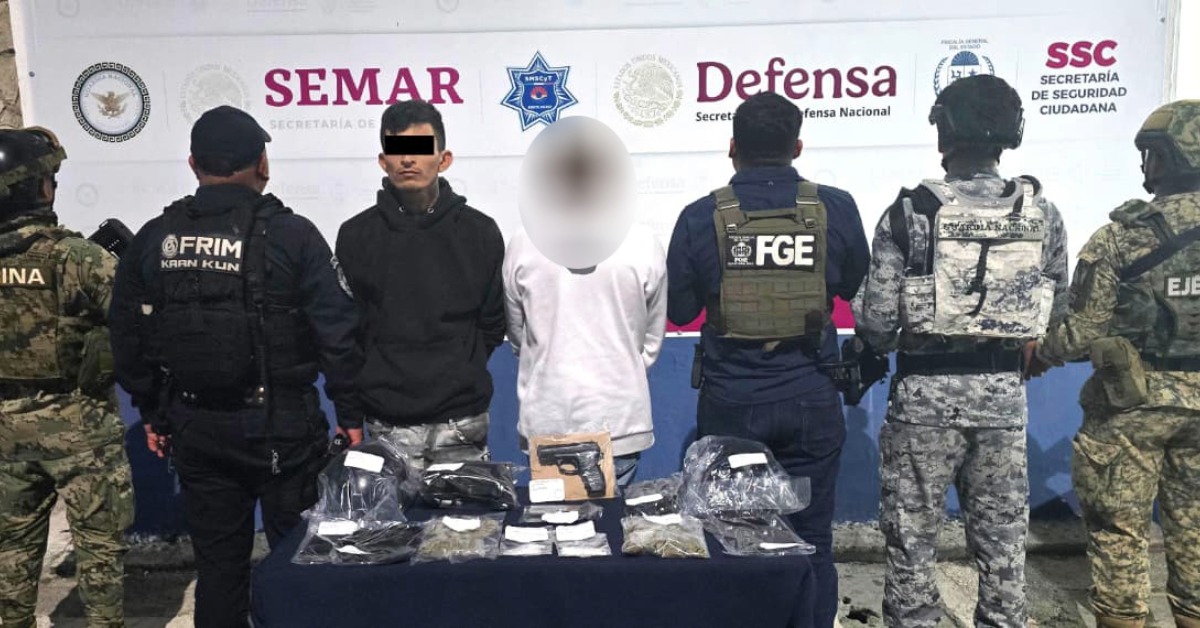
Authorities say two suspects were detained on April 15 in a coordinated operation involving state investigators, federal forces, and local police. They were identified as Carlos “N,” alias “Flaco,” and a minor. Officials said investigators seized a motorcycle, a 9 mm handgun, helmets, a balaclava, a backpack, and drugs during the operation. Prosecutors also said the detainees may be linked to a group involved in robbery and drug sales in Benito Juárez municipality.
Local authorities also said the victims received psychological support and legal guidance. Municipal reporting indicated that tourist police and a specialized victim-support unit were involved in the follow-up. At the same time, officials said police presence would be reinforced in the area, and motorcycle checks would be intensified, since motorcycles remain a common tool in street robberies and fast escapes.
Those official responses matter, but they do not fully answer the larger concern. A quick detention can reassure the public for a day or two. It does not erase the fact that the robbery happened in a city built around international tourism. For many readers, especially expats and long-stay visitors, the bigger issue is not whether police acted afterward. It is whether ordinary movement through the city feels predictable and safe before something happens.
The larger tourism problem behind the story
This case also lands at a sensitive moment for Quintana Roo. State officials recently said they expected more than 1.2 million visitors and hotel occupancy above 82 percent during the Semana Santa travel period. That means the state is asking the world to keep arriving while also trying to convince residents and visitors that security operations are strong enough to protect them.
That tension is not unique to Cancún, but Cancún feels it more than most places. The city depends on a constant international flow of visitors, short-term renters, airport transfers, and downtown movement between resort and non-resort areas. When an armed robbery of foreign women goes viral, the damage is not only criminal. It is reputational. Travelers start asking whether the image of safety applies only to polished tourism corridors while risks are pushed into the streets just beyond them.
For foreign residents in Mexico, the lesson is practical rather than dramatic. This case should not produce panic, but it should sharpen awareness. Downtown areas, transport transitions, and late-night walks can carry a different risk profile from the resort strip. That has been true for some time. This robbery simply made it visible again in a way that is hard to ignore.
What readers should take from it
The clearest takeaway is that tourist safety in Mexico is often highly local. A destination can have busy hotels, strong visitor numbers, and active patrols, while still leaving gaps in ordinary urban areas. In Cancún, the difference between the hotel zone and central neighborhoods is not just geographic. It can also affect police visibility, street activity, and how quickly a visitor realizes they are outside the environment most travel marketing implies.
For foreigners living in Mexico or visiting often, that context matters more than broad slogans about whether a city is safe or unsafe. The useful question is simpler. Where are you, what time is it, how are you moving, and how visible are you as a visitor? The robbery of these two tourists is now a police case, but it is also a warning about how fast a routine walk in a major tourism city can become an international headline.