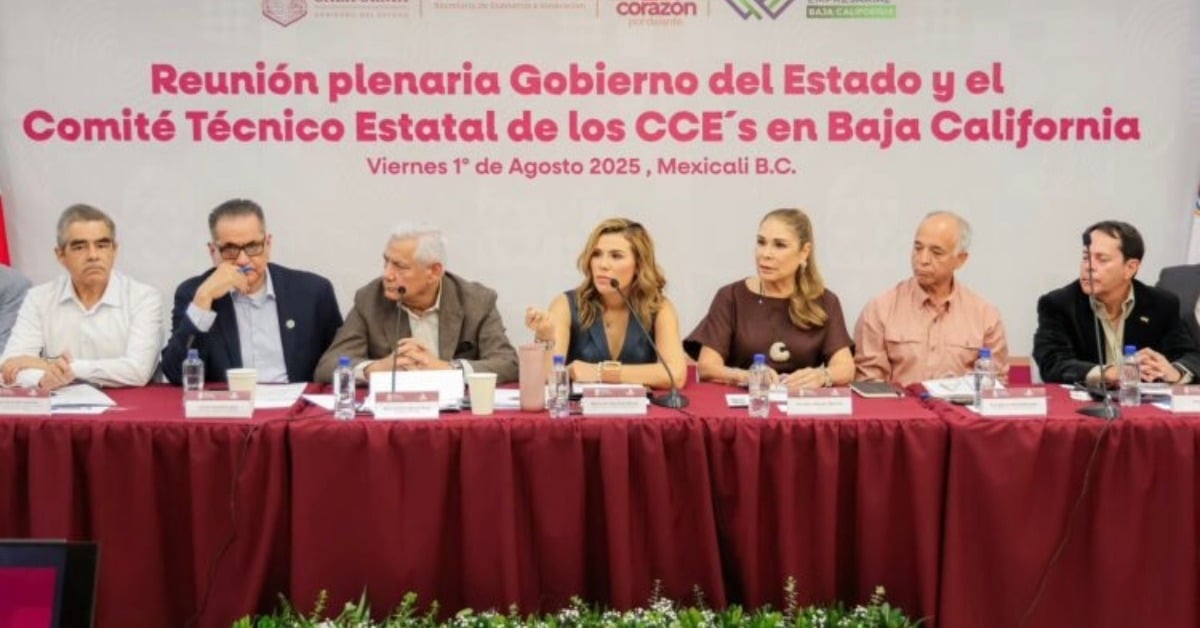
Mexicali, Baja California – Governor Marina del Pilar Ávila Olmeda told business leaders that infrastructure investment in Baja California will reach nearly 100 billion pesos by the end of her administration, a figure she framed as historic and achieved without adding public debt.
She made the announcement during a high-level dialogue with the state’s coordinating business councils, underscoring it as part of a broader economic push that now combines record private capital commitments and a sharp manufacturing rebound.
Historic public works push and execution
The governor’s pledge builds on visible progress in major public works across the state. Projects cited as moving forward include the elevated viaduct, the Rosarito desalination plant, expansion at the Otay II port of entry, and treatment infrastructure—elements that officials say will underpin mobility, water security and cross-border trade capacity. The commitment to finish roughly 100 billion pesos in infrastructure by the end of the current administration signals a consolidation of those scattered investments into a coordinated push, with the governor stressing that the bulk of the spending is being done “without generating debt for citizens.”
Local authorities have set up mechanisms to track progress and adjust deployment in real time, aiming to keep early gains from stalling. Business representatives who attended the meetings demanded clearer timelines and public accountability, reflecting concern that past announcements in the region sometimes lagged in delivery.
Private capital backing the momentum
The infrastructure drive is arriving against the backdrop of Baja California leading the country in private investment announced for 2025. According to the federal Data México platform, the state is poised to attract more than $4.22 billion in private capital, with a projection of 18,750 new jobs tied to that influx. Governor Marina del Pilar has used that ranking to argue the state’s location, skilled labor force and policy consistency are paying off, positioning Baja California as the top destination for productive investment in Mexico.
The private money is concentrated in infrastructure and energy megaprojects, and officials say public spending is meant to complement rather than compete with those flows. The dual signal—strong private interest plus heavy public investment—aims to reduce uncertainty for companies scaling up operations and to lock in supply chain efficiencies that feed off improved roads, water systems and cross-border logistics.
Manufacturing surge and economic ripple effects
The timing of the infrastructure push coincides with a sharp rebound in manufacturing. In the first half of 2025, the state’s manufacturing sector registered a 49.7% increase compared with the same period a year earlier, a figure highlighted by the governor and shown in public briefings as evidence that confidence is translating into output. Officials say that growth reflects both renewed external demand and internal improvements in capacity, and they cast the manufacturing rebound as feeding into a virtuous cycle: stronger output makes the state more attractive to investors, which in turn justifies further infrastructure spending.
Industry leaders at the meeting acknowledged the importance of reliable public services—power, transport and water—in sustaining that manufacturing momentum. The combination of private capital, capacity expansion in factories, and visible investment in backbone infrastructure is the narrative that state officials are using to pitch Baja California as a stable base for regional and cross-border production.
Next steps and risks
State officials now face the task of converting the announced figures into concrete, sequenced deliveries. Business groups expect published milestones and regular public updates so that the promised 100 billion pesos does not remain an abstract target. The ongoing private investment commitments and manufacturing gains give the administration political cover but also raise the stakes: delays or perceived mismanagement could erode the fragile confidence that has driven recent capital flows.
Baja California’s model—pairing infrastructure investment in Baja California with private sector momentum and a rebounding industrial base—will be watched closely by competitors and investors elsewhere in Mexico. If the state sustains execution through the end of 2025 and into 2026, officials argue it could cement a longer-term shift in regional economic balance.