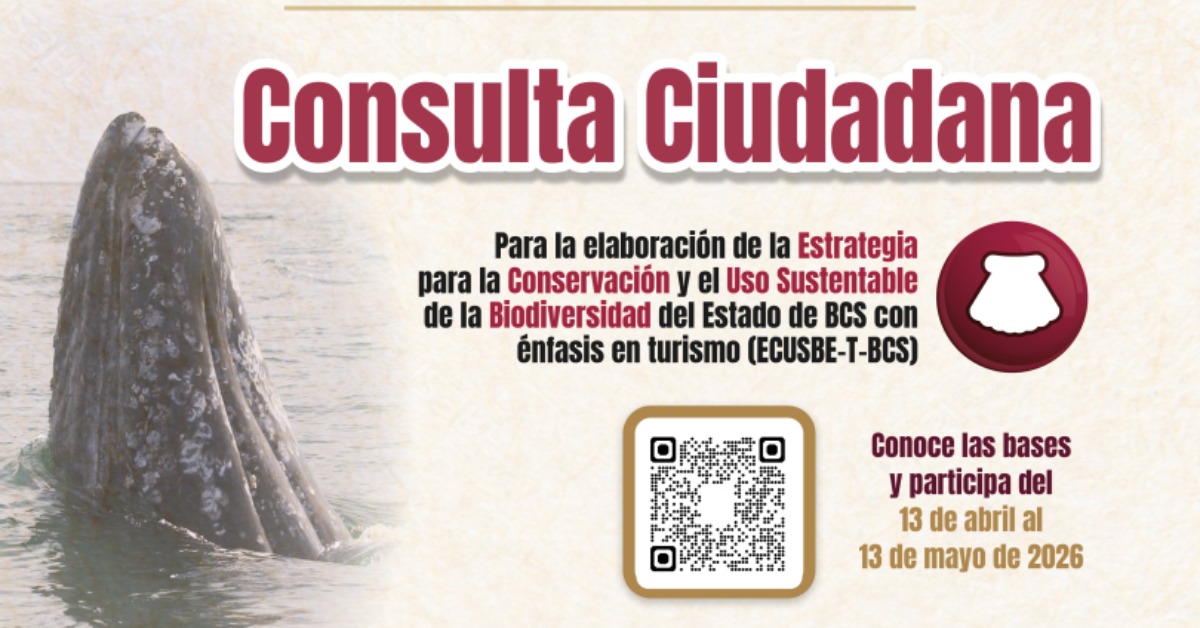
The government of Baja California Sur has opened a public consultation on a state biodiversity strategy intended to guide conservation and the sustainable use of natural resources. The process is being led by the state planning and environment ministry, together with the tourism and economy ministry. Officials say the consultation is intended to collect input from residents, community groups, academics, public institutions, and productive sectors before the strategy moves forward.
The consultation page says the participation window runs from April 13 to May 13, 2026. Comments are being accepted through an online questionnaire tied to the draft document. The state describes the process as part of a broader effort to build a policy framework to protect ecosystems while also recognizing the role of tourism in the local economy.
Why this matters beyond the environment beat
This is not only about wildlife or protected areas. The draft strategy addresses issues that affect everyday life, especially in a state where coastal development, tourism growth, water stress, and land use often collide. The official consultation notice says the process is aimed at environmental planning, with attention to ecosystems and services they provide, including water, pollination, and coastal protection.
For many readers, that is the practical point. Biodiversity policy can sound abstract until it affects the condition of beaches, wetlands, fisheries, dunes, mangroves, urban expansion, or tourism activities near sensitive habitats. In that sense, the consultation sits at the intersection of environmental management and long-term economic planning. It is a planning document today, but the choices behind it can influence how the state approaches growth over time.
The strategy puts tourism at the center
The draft document is formally titled the Estrategia para la Conservación y el Uso Sustentable de la Biodiversidad del Estado de Baja California Sur con énfasis en Turismo, known as ECUSBE-T-BCS. That last part matters. The state is not treating biodiversity and tourism as separate conversations. It is explicitly trying to connect them.
According to the draft, the strategy’s long-term vision runs to 2040 and starts from the idea that tourism remains the state’s main economic activity. The document argues that biodiversity criteria should be folded into public planning, productive activity, and tourism decisions rather than left as a secondary issue. In plain terms, the state is saying that environmental protection cannot sit outside the development model. It has to be built into it.
That framing reflects the realities of Baja California Sur. The state depends heavily on its natural assets, which also need protection. Coastal landscapes, reefs, dunes, islands, mangroves, desert ecosystems, and marine life are not only ecological resources. They also help sustain tourism demand, fisheries, public health, and climate resilience.
What the draft plan would actually cover
The official consultation notice says the strategy is organized around six strategic axes. The draft expands on that point and lays out a plan with 91 actions. Those axes include knowledge, conservation and restoration, education and environmental culture, attention to pressures and threats, sustainable use and management, and integration and governance. The draft also refers to financial mechanisms needed to carry out the plan.
That matters because it shows the proposal is broader than a simple conservation pledge. It is trying to connect research, regulation, public education, restoration work, cross-agency coordination, and financing. In other words, the state is building a framework that could later affect how government departments work together, how local priorities are set, and how environmental criteria are incorporated into development and tourism planning.
The consultation materials also make clear that the strategy has outside technical support. State authorities say the work has been carried out in collaboration with CONABIO, ISLA, and the United Nations Development Program. That support gives the process more technical weight, even though the real test will come later, when the state decides what to adopt, fund, and enforce.
The consultation did not appear overnight
The current process is the latest stage in a much longer buildout. Official biodiversity records show that Baja California Sur joined Mexico’s state biodiversity strategy initiative in 2017 through an institutional agreement with CONABIO. The same records indicate that formal work on the state strategy, with a tourism emphasis, began in 2023, including participatory workshops in La Paz, Los Cabos, Loreto, Mulegé, and Comondú.
That background helps explain why the state is now moving from diagnosis to consultation. In late 2025, officials and researchers published a large Estudio de Estado on biodiversity in Baja California Sur. The study describes a state with arid lands, oases, mangroves, dry forests, and a broad marine influence. It also documents strong biological richness and growing pressure from urban growth, mass tourism, and climate change.
The same study reports that Baja California Sur has recorded 8,053 species and highlights the state’s importance for national fish and bird diversity. Those figures do not resolve the policy debate on their own, but they explain why the government is treating biodiversity as a planning issue, not only a scientific one.
Why international readers should watch this
For international readers living in Mexico, the significance is simple. Decisions like this often shape the rules and priorities that later show up in local disputes over beaches, conservation zones, water access, tourism projects, and land use. A consultation document does not settle those disputes on its own. Still, it can set the terms of future decisions.
Baja California Sur has long marketed its natural setting as part of its identity and economy. That creates a basic tension. Growth depends on the environment, but growth also puts pressure on it. The consultation is one effort to define how the state wants to manage that tension. Whether it becomes a meaningful policy tool will depend on public participation, political follow-through, agency coordination, and money.
For now, the most immediate development is that the process is open. Residents, specialists, and other interested participants have a limited window to weigh in on how the state should protect biodiversity as it plans for tourism and development. That may sound procedural, but in Baja California Sur, it reaches into some of the state’s biggest long-term questions.