A U.S. Treasury action put a spotlight on Cancún after officials designated the Bhardwaj smuggling network and 16 linked firms. Investigators say the group moved migrants from four continents using yachts, hotels, and airport access, then funneled them north. Mexico’s financial intelligence unit was looped in, a shift from past frictions. The case sketches a Tapachula–Cancún–Mexicali pipeline and hints at cartel help. What this means for Quintana Roo’s tourism capital—and for the money behind it—will come down to how fast assets are frozen and who moves to cooperate.
U.S. sanctions spotlight a Cancún hub
The U.S. Treasury’s sanctions arm named the Bhardwaj smuggling network as a transnational criminal organization allegedly anchored in Cancún, detailing a business-like pipeline that used yachts, hostels, hotels, and airport access to move migrants from Europe, the Middle East, South America, and Asia toward the U.S. border. The designation adds leader Vikrant Bhardwaj, three associates, and 16 companies to the U.S. blacklist, blocking property under U.S. jurisdiction and cutting off financial dealings with U.S. persons.
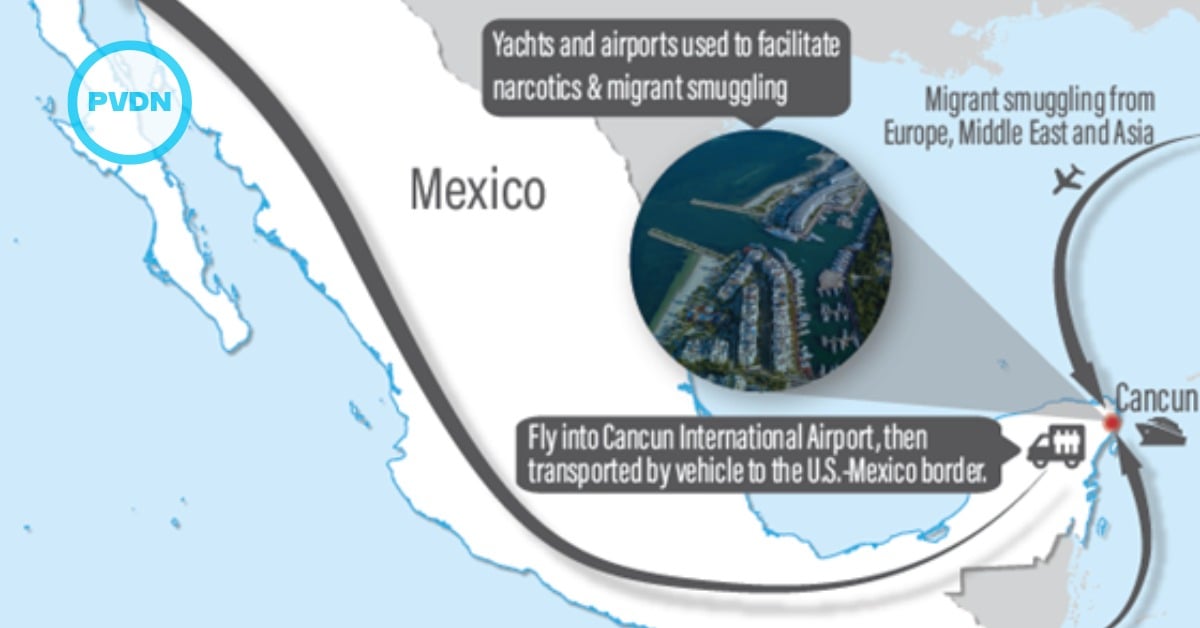
At the core of the action is a picture of logistics, not chaos. Treasury describes a route where migrants enter Mexico by sea or air, are housed around Cancún, and are handed off to partners for the overland push north—an operation federal officials say generated thousands of dollars per person. The first-order effect is immediate: banks and counterparties face penalties if they transact with the network’s named people and companies.
Bhardwaj smuggling network
The Treasury press release outlines a roster that goes beyond one man. Alongside Bhardwaj, officials named José Germán Valadez Flores and Jorge Alejandro Mendoza Villegas as operators with access and influence, including through bribery of officials and movement through Cancún International Airport. Bhardwaj’s spouse, Indu Rani, is listed as part of the financial core. The supporting web includes firms in Mexico, India, and the UAE—among them a shipyard and tourism outfits in Quintana Roo and real-estate and hospitality entities abroad.
Treasury says the network blended sea and air, even using its own yachts and marinas, before sheltering migrants in hostels and hotels across Cancún. Officials also describe operational support from people employed by the Sinaloa Cartel and from the Tapachula–Cancún–Mexicali corridor, which has become familiar to investigators tracing long-haul smuggling flows. It’s a portrait that — fairly or not — touches Cancun’s image as a tourism capital, where infrastructure and anonymity can be exploited by organized crime.
From a compliance standpoint, the designation triggers the 50-percent rule: any entity majority-owned by sanctioned persons is treated as blocked, even if not named. That ratchets up pressure on local intermediaries and service providers who, knowingly or not, extend the network’s reach. U.S. officials say the move was coordinated with Homeland Security Investigations, the DEA, and Mexico’s Unidad de Inteligencia Financiera—coordination that matters after earlier public tensions over U.S. actions against Mexican financial institutions.
What changes on the ground in Cancún
The immediate question in Quintana Roo is speed. If banks and vendors move quickly, funds freeze and contracts seize up, undermining the network’s ability to pay crews, maintain vessels, and book hotel blocks. The broader question is whether local gatekeepers—port administrators, aviation handlers, hospitality operators—tighten controls and report unusual bookings or cash patterns. Treasury framed this case as part of a push to treat human smuggling as a national-security threat, not just a migration issue, and paired the action with a public chart and detailed SDN entries that read like a corporate registry gone awry.
There’s also a political subtext. Earlier in the year, the U.S. drew Mexico’s ire by flagging alleged cartel cash in mainstream financial channels. This time, officials stressed coordination with Mexico’s financial watchdog, suggesting a more aligned approach. For residents, none of that nuance changes the near-term reality: sanctions work best when front companies lose access to suppliers, payroll processors, and fuel. Whether that happens now will show up in port activity, hotel group bookings, and the sudden quiet around once-busy marina slips.