Puerto Vallarta, Jalisco, Sept. 16, 2026 – The Mexican peso traded near 17.14 per U.S. dollar at 7 a.m. Mexico City time Wednesday, little changed before a Federal Reserve decision expected later in the day.
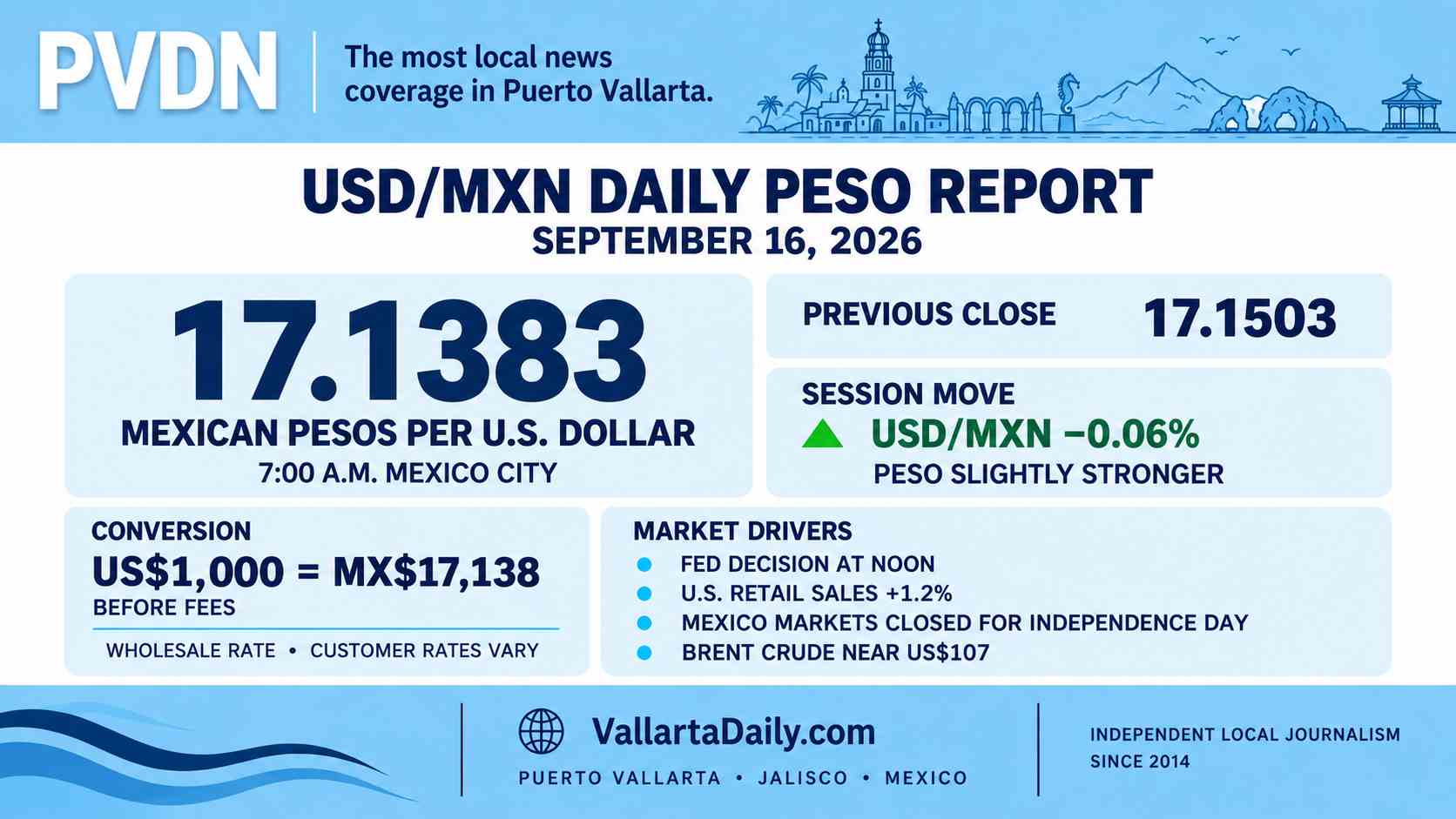
A live wholesale-market quote placed USD/MXN at 17.1383, down 0.06% from the previous session. A decline in USD/MXN represents a stronger peso because each dollar buys fewer pesos.
Banco de México’s official FIX rate was 17.1527 on Tuesday. No new FIX will be determined Wednesday because Sept. 16 is a banking holiday. The central bank lists 17.1277 as the rate applicable to dollar obligations payable in Mexico today.
Mexico’s holiday leaves the peso trading offshore
Mexico’s domestic financial markets are closed for Independence Day. The Mexican Stock Exchange calendar lists Sept. 16 as a full market holiday.
The peso continues to trade internationally, but the absence of Mexico-based banks and institutional investors can reduce liquidity. That can make movements less representative of a normal domestic session and may produce wider differences between wholesale quotes and the rates offered by banks, transfer services and currency exchanges.
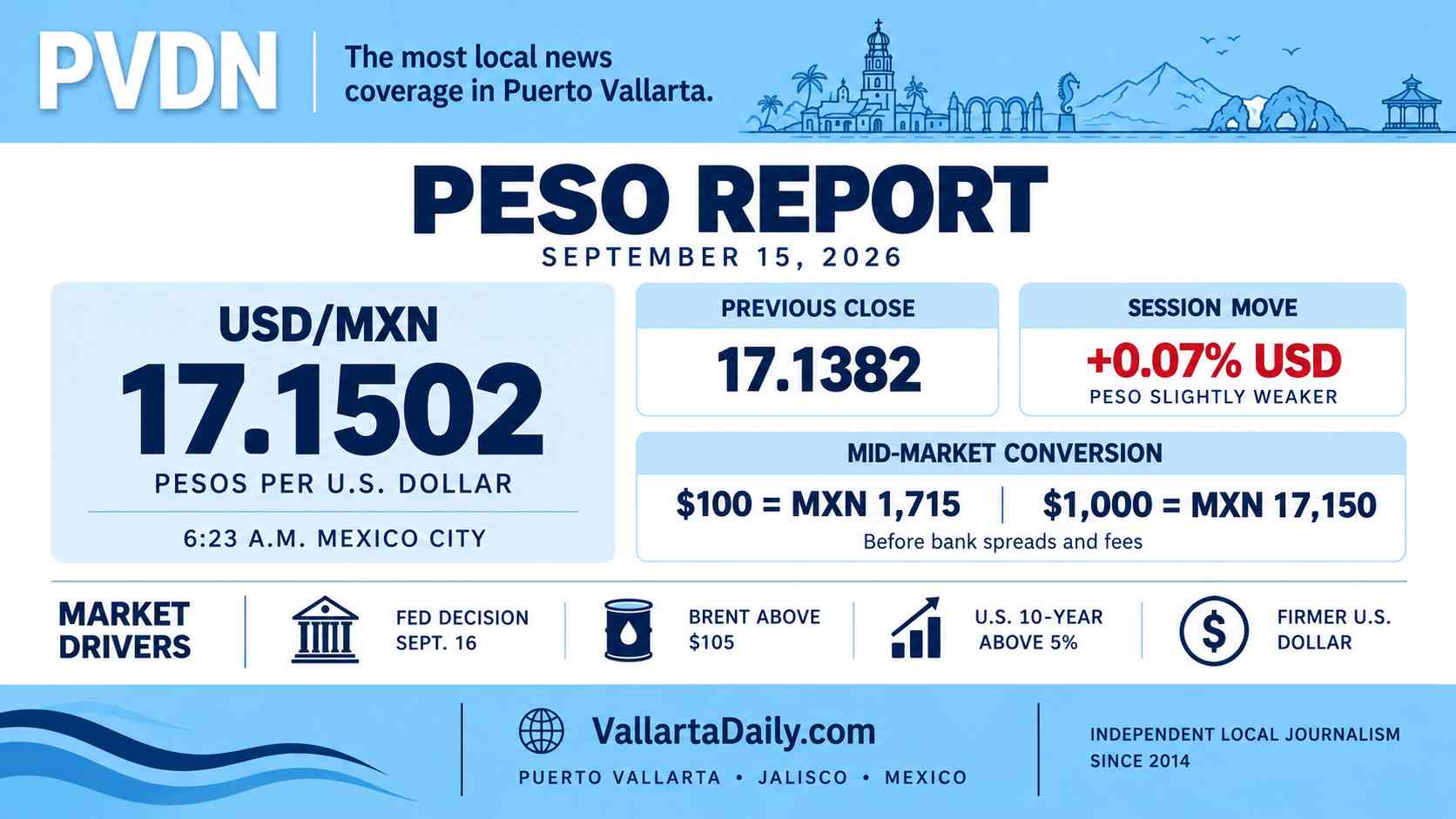
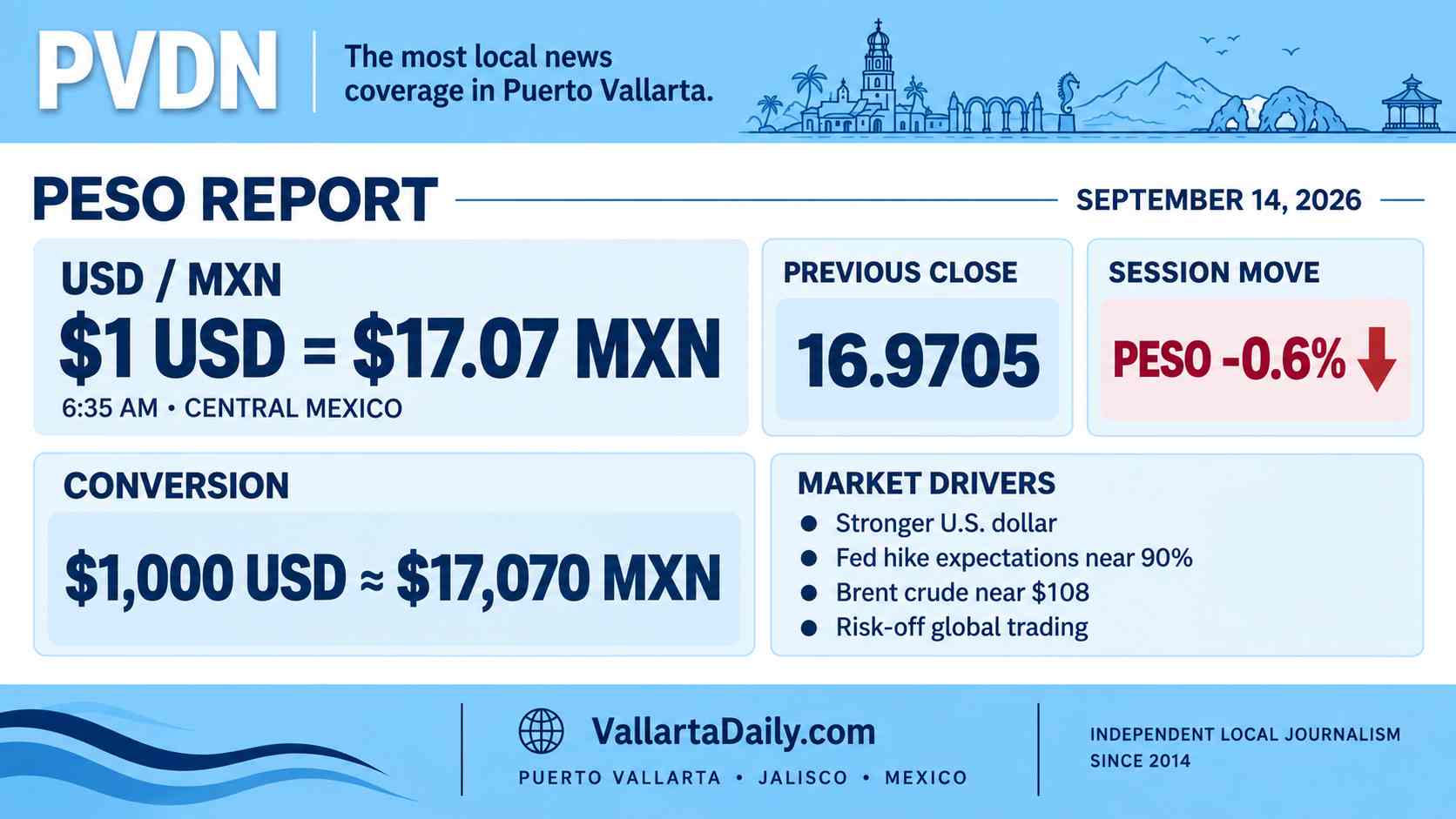
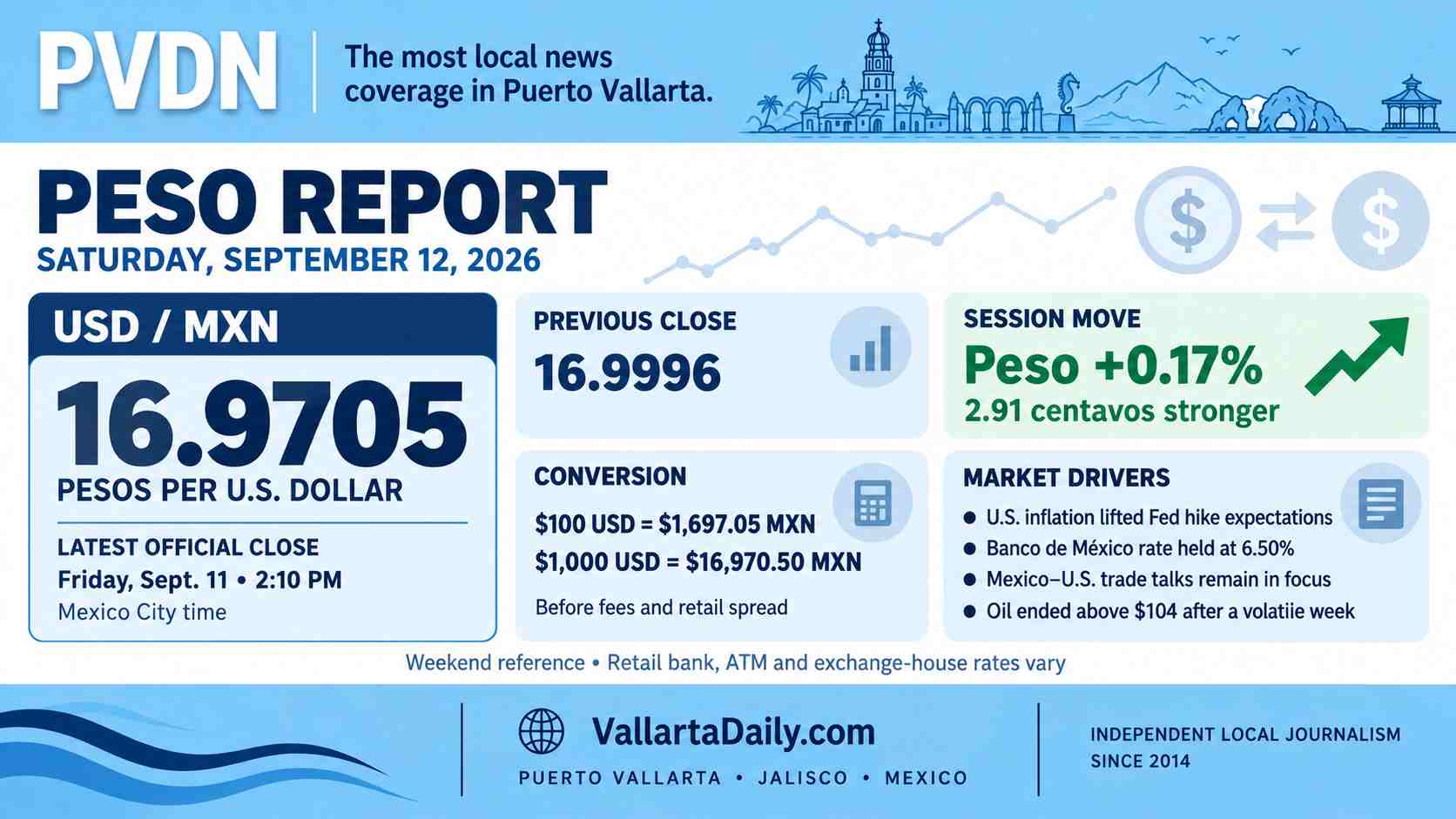
The peso entered Wednesday after two weaker sessions. USD/MXN moved from about 16.97 on Sept. 11 to 17.15 on Tuesday, meaning the dollar gained close to 1.1% over that period. Wednesday’s early move recovered only a small part of that decline.
Federal Reserve decision dominates the session
The Federal Reserve’s policy announcement is scheduled for 2 p.m. Eastern time, or noon in Puerto Vallarta and Mexico City. A press conference is scheduled 30 minutes later.
Interest-rate futures entered Wednesday pricing a high probability that the Fed would raise its target range by a quarter percentage point, from 3.5%-3.75% to 3.75%-4%. The increase would be the first U.S. rate hike since 2023.
Expectations of higher U.S. rates have supported the dollar and pushed Treasury yields higher. The 10-year U.S. yield reached 5.041% Tuesday, its highest level since 2007, while the dollar index stood near a two-week high.
A higher U.S. policy rate would narrow the interest-rate gap with Mexico. That gap has helped support demand for peso-denominated assets, although exchange rates also respond to economic growth, trade flows, political risk and broader market sentiment.
Strong U.S. spending adds pressure before the Fed vote
New U.S. data released Wednesday showed retail sales increased 1.2% in August, exceeding the 0.8% increase expected by economists. July’s result was revised to a 0.5% decline.
A measure that excludes automobiles, gasoline, building materials and restaurant spending rose 1.4%. Economists had expected a 0.4% increase.
The report does not determine the Fed’s decision by itself, but stronger consumer spending gives policymakers less evidence that higher borrowing costs are sharply slowing the U.S. economy. Markets will focus on the Fed’s statement, updated economic projections and comments about whether Wednesday’s expected increase is a single adjustment or the start of further tightening.
Mexican data provide some support
Banco de México held its benchmark rate at 6.5% at its Aug. 6 meeting. That remains above the current U.S. range, even if the Fed raises rates Wednesday.
Recent Mexican economic reports have also been firmer. The country’s industrial activity increased 0.5% in July from June after seasonal adjustment and was 2.4% above its July 2025 level. Construction recorded the largest annual gain among the main industrial sectors at 6.7%.
Those figures offer domestic support for the peso, but Wednesday’s holiday means there are no major Mexican releases or local trading session to compete with the Fed announcement.
Oil and risk appetite remain in the background
Energy prices remain another source of currency volatility. Brent crude traded near $107 a barrel Wednesday morning, while U.S. crude was near $103 after both benchmarks retreated from Tuesday’s gains.
High oil prices can affect the peso in different directions. Mexico is an oil producer, but rising energy costs also add to global inflation concerns, lift bond yields and reduce demand for currencies viewed as carrying greater risk. Wednesday’s decline in oil eased some immediate pressure, although prices remained elevated.
The rate reaching Vallarta households
At the 7 a.m. wholesale rate, US$1,000 equaled about 17,138 pesos before fees. That was roughly 12 pesos less than at Tuesday’s 17.1503 market close.
For Puerto Vallarta residents receiving income in dollars, a stronger peso reduces the number of pesos received when converting the same dollar amount. People earning pesos but paying dollar expenses receive the opposite effect, since fewer pesos are needed to cover the dollar obligation.
Actual customer rates will differ from the market quote. Banks, ATMs, card networks and currency exchanges apply their own spreads and fees. Transfers initiated during the Independence Day holiday may also remain pending until Mexican banking operations resume.
The exchange rate could move more sharply around the Fed announcement at noon Mexico City time. The 17.14 quote reflects conditions at 7 a.m. and should be checked again before any same-day payment or conversion.