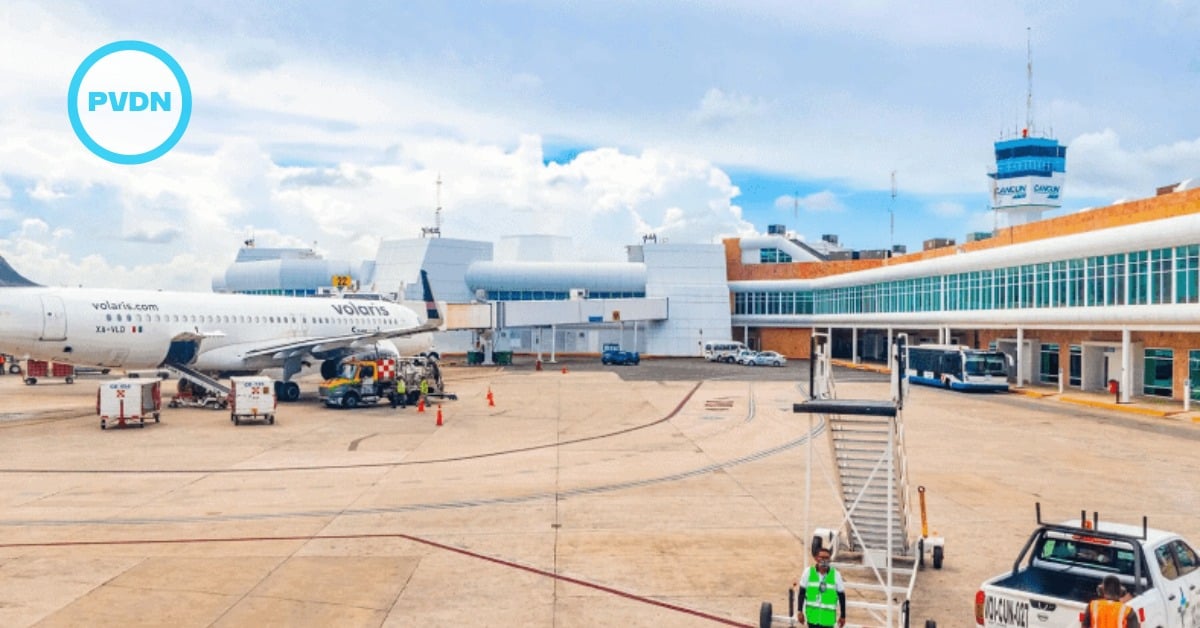
Cancun’s busiest U.S. routes are quietly carrying fewer people, and the ripple effects are real. New tallies point to a sharp slide on trunk routes like Chicago, Dallas, New York, Houston, and Atlanta—enough to erase roughly half a million arrivals once you add domestic shortfalls. It isn’t a collapse, but it is a wake-up call. Canada is picking up some slack, yet hotels and tour operators still feel the dip. What’s driving it—and how fast can Cancun steady the numbers?
Cancun US flights
Cancun’s pipeline from the United States just got narrower. A new analysis cited by Por Esto! shows five key U.S. routes—Chicago, Dallas, New York, Houston, and Atlanta—carried 195,095 fewer passengers in January–September 2025 than in the same period a year earlier. Fold in domestic declines in Mexico City, Monterrey, Toluca, and other links, and the running shortfall approaches 489,021 travelers versus 2024, according to tourism researcher Francisco Madrid Flores.
That headline number tracks with the airport’s broader slowdown. Operator ASUR reported Mexico-wide traffic down 4.5% in September, with Cancun’s international volumes cooling through late summer and early fall. Independent summaries of the same ASUR data show that international passenger movements at Cancun fell year over year in September and that hotel occupancy eased in August. None of that screams crisis—but it does confirm the trend line.
Route by route, the soft spots are clear. Chicago–Cancun is the biggest drag, with more than 100,000 fewer passengers year to date and a double-digit percentage decline. Dallas is firmly negative, and New York, Atlanta, and Houston are all in the red on a smaller scale—figures echoed by national outlets tracking the same datasets.
There are bright spots. Canada is back in force: Toronto–Cancun surged about 25.6% over the same period, a reminder that market mix—not just total headcount—matters for beach cities that live on airlift.
Why the drop, and why now?
Several forces are pulling in the same direction. First, a post-pandemic rebalancing is underway across Mexico’s gateways. Even with Cancun still the king, the region has been digesting a year of shifting schedules and pricing, and the airport’s own data shows the cooling concentrated in late Q3. Hotels, too, saw August occupancy slip from the prior year, signaling softer demand or tougher comps during shoulder season.
Second, the U.S.–Mexico aviation picture has been noisy. Washington recently moved to revoke 13 Mexico–U.S. routes, a political tussle focused on Mexico City’s newer AIFA hub rather than Cancun. Business leaders caution that the immediate hit should be limited because only a couple of the affected routes were actually flying earlier this year, but the headlines don’t help sentiment.
Third, the “new airport effect” in the Mexican Caribbean cut both ways. Tulum’s Felipe Carrillo Puerto International opened with fanfare and dozens of U.S. links, briefly tempting carriers to spread capacity. But by late 2025, several U.S. airlines had trimmed Tulum frequencies, evidence that demand there is still finding its level rather than draining Cancun. In short: some experimentation, some pullback, and a lot of recalibration.
All the while, Cancun remains one of the best-connected leisure airports in the hemisphere. For winter 2025, American Airlines alone lists 19 U.S. routes and remains the top foreign carrier by seats, a sign that big players still see the market as foundational even as they fine-tune. Capacity hasn’t disappeared; it’s being reshaped to match booking curves.
What this means on the ground
For hotels and tour operators, the math is simple: fewer U.S. passengers on core routes equals more work to hold rates and fill rooms, especially outside peak weeks. The nearly 489,000-visitor gap since January isn’t fatal for a destination that handles tens of millions a year, but it’s large enough to dent margins and push marketers to hunt beyond their usual ZIP codes. The very sectors urging “more promotion, better security, and new products” have the right priorities.
Expect a few tactical pivots. Canadian demand is a pressure valve—Toronto and Montreal are already punching above their weight—so watch for packages and shoulder-season deals aimed at those markets. U.S. carriers will keep tinkering with frequencies on Chicago, Dallas, New York, Atlanta, and Houston to right-size planes to bookings. If macro headwinds ease into spring, some of today’s cuts could snap back quickly. Conversely, if the U.S. route spat spreads beyond AIFA, 2026 planning gets trickier.
The bigger picture is resilience. Cancun has weathered shocks before and maintains unmatched connectivity in Mexico. The task for the next two quarters is surgical: protect air seats on the five U.S. trunks that slipped, lean into Canadian growth, and improve the on-the-ground experience that keeps first-timers coming back. The data says the sky isn’t falling. It’s just a little thinner over a few runways—and that’s fixable.