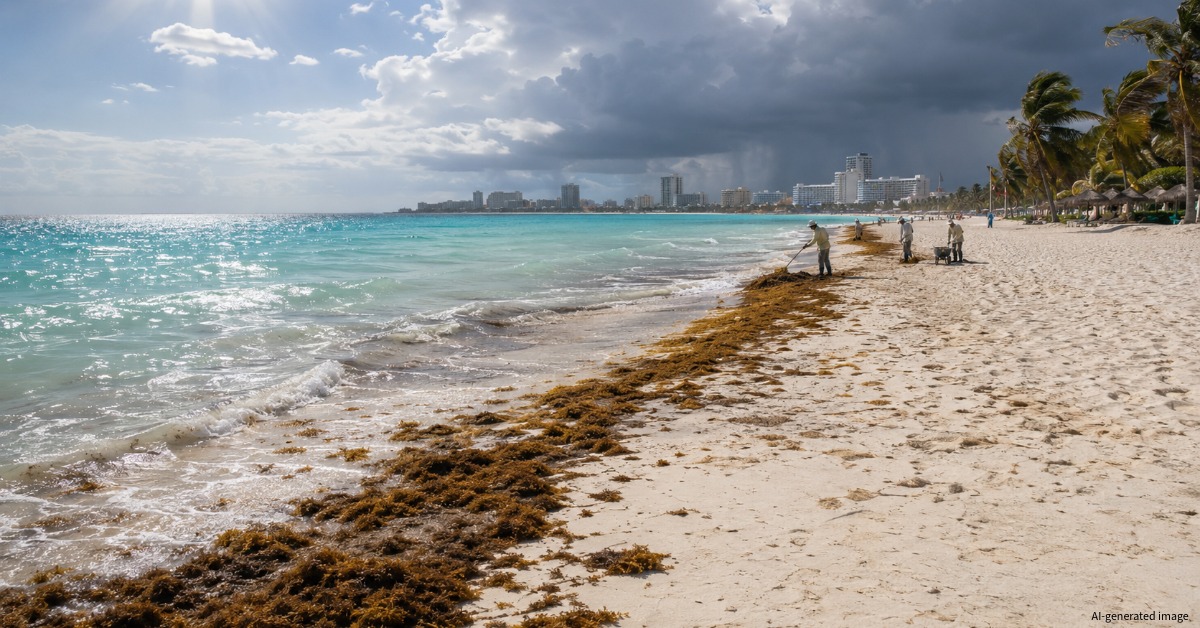
Cancún is entering the period when several conditions can overlap: high heat and humidity, brief rain events, and sargassum arriving on beaches. Current forecasts show daytime highs around 30 to 33°C in the coming days, with passing showers expected on several days. Mexico’s National Meteorological Service also forecast strong showers for northern Quintana Roo on May 14, while local tourism reports said recent suradas—southerly wind events—have pushed more sargassum into parts of Cancún’s Hotel Zone.
That does not mean every beach will be unusable. It means the beach experience can vary from one stretch of sand to another. Sargassum, wind, heat, rain, water clarity, and cleanup work all shape what a visitor will actually find after arriving.
What sargassum is and why it reaches Cancún
Sargassum is a floating brown seaweed that can be useful in the open ocean. It provides habitat, food, and shelter for marine life, including fish, turtles, and seabirds. The problem begins when large amounts drift into shallow coastal areas and pile up on beaches. Winds and currents carry sargassum toward shore, and once it lands, it can affect swimming, beach access, odor, and water quality.
Since 2011, scientists have tracked a larger recurring belt of sargassum across the tropical Atlantic. The University of South Florida’s Optical Oceanography Lab says large quantities now often appear across the Caribbean, Gulf of Mexico, and tropical Atlantic, with the Great Atlantic Sargassum Belt typically peaking around June or July. The lab also notes that sargassum movement is difficult to predict at the level of a single beach because currents, winds, and local coastline features matter.
Why one Cancún beach can be clean while another is covered
Sargassum does not land evenly. A beach facing the wrong wind direction can receive heavy seaweed, while another beach a few kilometers away remains clearer. Beach shape also matters. Long open beaches, curved shorelines, rocky points, and hotel structures can all influence where seaweed collects.
This is why Cancún beach reports often mention specific beaches rather than the destination as a whole. Recent local reporting noted heavier arrivals at Playa Marlín and Playa Ballenas, while Gaviota Azul, Chac Mool, San Miguelito, and Delfines had more moderate arrivals. Officials also identified Playa Delfines and Playa Coral as areas needing close attention, partly because of their size and location.
For visitors, the practical lesson is simple: do not judge all of Cancún by one photo, one hotel review, or one beach camera. Conditions can change quickly, and nearby beaches may look different on the same day.
What barriers can and cannot do
Sargassum barriers are designed to reduce the amount of seaweed that reaches the sand by intercepting or redirecting it offshore. They can help in some places, especially when supported by boats and daily cleanup crews. But barriers are not a complete solution. Strong winds, waves, storms, maintenance problems, and the sheer volume of seaweed can limit how well they work.
Quintana Roo officials have discussed adding more anti-sargassum barriers, including at least 400 meters for Cancún, while the state has also added thousands of meters of barrier equipment along the coast. Still, cleanup usually requires a mix of offshore containment, shoreline crews, tractors, manual labor, and disposal sites.
Heat changes how visitors should plan the day
Cancún’s heat season is not only about the temperature number shown on a phone. Humidity, strong sun, and limited shade can make the body feel hotter, especially on beaches, sidewalks, tours, and public transportation stops.
Visitors should plan outdoor time earlier in the morning or later in the afternoon when possible. Midday is better for shaded meals, indoor attractions, pool breaks, or rest. People who are older, traveling with children, taking certain medications, or not used to tropical humidity should be more cautious with long beach days.
The most useful habits are basic: drink water before you feel thirsty, use sun protection, take breaks in the direct sun, and avoid assuming a short walk will feel easy in high humidity.
Sudden rain is part of the season, not always a ruined day
Rain in Cancún often arrives in short bursts. A forecast showing showers does not always mean a full day indoors. It may mean a brief downpour, fast-moving clouds, thunder nearby, or a wet morning followed by sun.
But rain still matters. Heavy showers can affect roads, tours, visibility, water clarity, and beach runoff. After sudden rain, some beach areas may look murkier, and low-lying streets may flood temporarily. Travelers should keep plans flexible, especially for boat tours, island trips, and outdoor excursions.
Water quality can change after sargassum and rain
Large piles of decomposing sargassum can produce hydrogen sulfide, the gas associated with a rotten-egg smell, and may irritate people with respiratory issues. NOAA also notes that sargassum can contain arsenic, heavy metals, organic contaminants, and marine debris, which is one reason cleanup and disposal are more complicated than simply hauling away seaweed.
Rain can add another layer. Sudden runoff may temporarily affect water clarity and nearshore conditions. Visitors should pay attention to beach flags, lifeguard instructions, local advisories, and visible conditions. If the water smells bad, looks stagnant, or has thick floating seaweed, it is better to choose another beach or return later.
The impact goes beyond tourists
Sargassum is often discussed as a vacation inconvenience, but the issue affects local workers, hotels, residents, and public budgets. Cleanup crews work in hot conditions, often starting early and repeating the same task daily. Hotels may pay for private cleanup. Municipal governments must assign personnel, equipment, fuel, transport, and disposal capacity.
In Cancún, a municipal official recently said thousands of tons had already been collected and that additional workers and tractors were needed for daily removal in affected areas. NOAA also describes sargassum cleanup options as limited and costly, especially during large beaching events.
For residents, sargassum can affect odor, access to public beaches, local fishing, small businesses, and the quality of life in neighborhoods. For workers, it can mean longer shifts in hotter conditions. For municipal budgets, it becomes a recurring seasonal expense rather than a one-time emergency.
What visitors should check before choosing a beach
A good beach day in Cancún now depends on checking conditions close to the time you plan to go. Look for same-day beach photos, local sargassum maps, hotel beach cameras, wind direction, rain forecasts, beach flags, and municipal updates. General weather apps are helpful, but they do not tell the whole beach story.
It also helps to have backup beaches in mind. If one Hotel Zone beach has heavy sargassum, another may be better. Isla Mujeres, protected coves or west-facing areas may sometimes offer different conditions, although they are not guaranteed to be clear. The key is flexibility.
What to know
Cancún still offers beach days, warm water, and outdoor travel, but the season now requires more realistic expectations. Sargassum, heat, and sudden rain are not separate problems. Together, they shape how the coastline looks, how comfortable visitors feel, how safe swimming conditions are, and how much pressure falls on cleanup crews and local budgets.
The best approach is not to ask whether Cancún has “good” or “bad” weather. The better question is: which beach is in the best condition today, at the time you plan to go?