A weekend operation at a Cancún street market began with citizen complaints and ended with officials removing a Morelet’s crocodile and other reptiles from a vendor stall. On its face, it looks like a local enforcement story. But the case also points to a broader issue affecting protected species, animal welfare, and the movement of illegal wildlife through ordinary public spaces in Mexico. What happened in the tianguis de la 100 helps explain why these cases draw federal attention so quickly.
What happened at the Cancún market
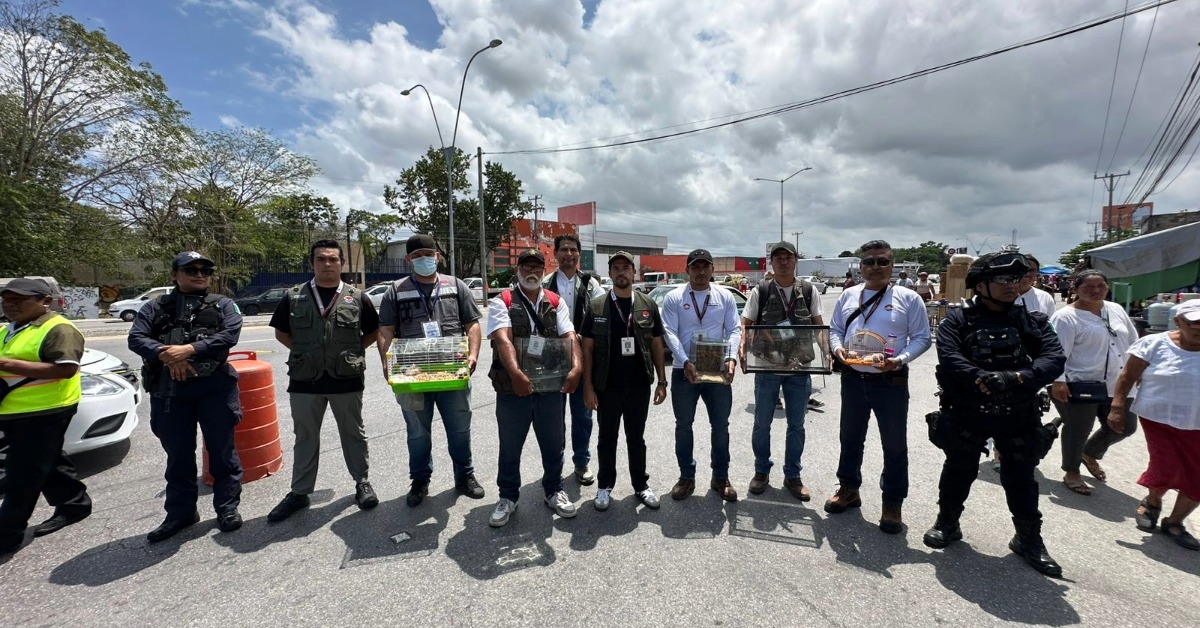
Authorities in Cancún said they seized several wild and exotic animals being offered for sale at a street market in Supermanzana 100 on Sunday, April 12. The action followed citizen complaints about suspected illegal animal sales. Municipal personnel from ecology, street commerce, public security, and animal welfare took part in the operation.
According to officials, the animals found at the stall included a Morelet’s crocodile, a bearded dragon, and a chameleon. Municipal authorities said the animals were removed from the market and placed into custody so they could be transferred to Profepa, the federal environmental enforcement agency that handles wildlife protection cases. The city also said domestic rodents found during the operation were taken in by the municipal animal welfare institute.
The case stands out because it did not unfold in a hidden warehouse or along a highway checkpoint. It happened in a tianguis, the type of open-air market many residents know as a routine weekend shopping space. That matters. For readers outside Mexico, it helps illustrate how the illegal sale of animals can blend into everyday commerce and remain hidden until someone reports it.
Why the species matter
This was not only a story about unusual pets. One of the animals named by authorities was Crocodylus moreletii, known in English as the Morelet’s crocodile. It is native to parts of Mexico, including the Yucatán Peninsula, and has long been considered a species requiring formal management and protection.
That makes the seizure more significant than a simple violation of market rules. When a native reptile tied to wetland ecosystems appears at a market stall, the issue touches both biodiversity protection and the animal’s chain of custody. Officials have not publicly detailed where the seized animals came from or whether the seller presented documents. Those questions are likely to shape what happens next.
The presence of exotic reptiles also adds another layer. Some species may be imported legally under specific rules, while others may circulate through informal or illegal channels. In practice, that often leaves enforcement agencies sorting through permits, transport records, ownership claims, and animal welfare conditions after the seizure has already happened.
Why this matters beyond one stall
It would be easy to treat this as a brief local police-style item. That would miss the larger point. Illegal wildlife sales sit at the intersection of environmental crime, public oversight, and consumer demand. Federal authorities have long warned people not to buy wildlife without documentation that proves legal origin or lawful importation. In Mexico, trafficking in wildlife can also lead to criminal penalties when it involves protected species or commercial activity.
That is why the city’s public message focused not only on the animals already seized, but also on the public’s role in reporting and refusing to buy them. These markets survive when sellers believe there will be buyers and little scrutiny. Complaints from residents often become the first step that triggers inspections.
The Cancún case also arrives at a time when the broader southeast has seen renewed attention on wildlife trafficking. The region combines wetlands, forests, tourism corridors, transport routes, and urban growth. All of that can create pressure points where native species are captured, moved, or displayed outside legal channels. A market seizure may look small on paper, but it can reveal a wider supply chain behind a few animals on a table.
What happens next
For now, the most immediate step is the animals’ transfer and evaluation. Profepa is the authority that determines handling, protection measures, and possible enforcement actions in wildlife cases. That process can include reviewing species status, checking for legal documentation, assessing physical condition, and deciding where animals should be housed.
What remains unclear is whether the case will result only in administrative action or whether it could move into a more serious legal track. That usually depends on details not yet public, including the origin of the animals, the seller’s documentation, and whether the conduct fits federal wildlife crime provisions.
For Cancún residents, the episode is also a reminder that wildlife cases do not happen only in protected reserves or remote jungle areas. They can show up in neighborhood commercial spaces, next to ordinary vendors, and in places families pass through every week. For international readers, that may be the most useful context of all: this is not just a story about unusual animals. It is a story about how illegal wildlife trade can hide in plain sight, and how quickly a local complaint can become a federal environmental case.