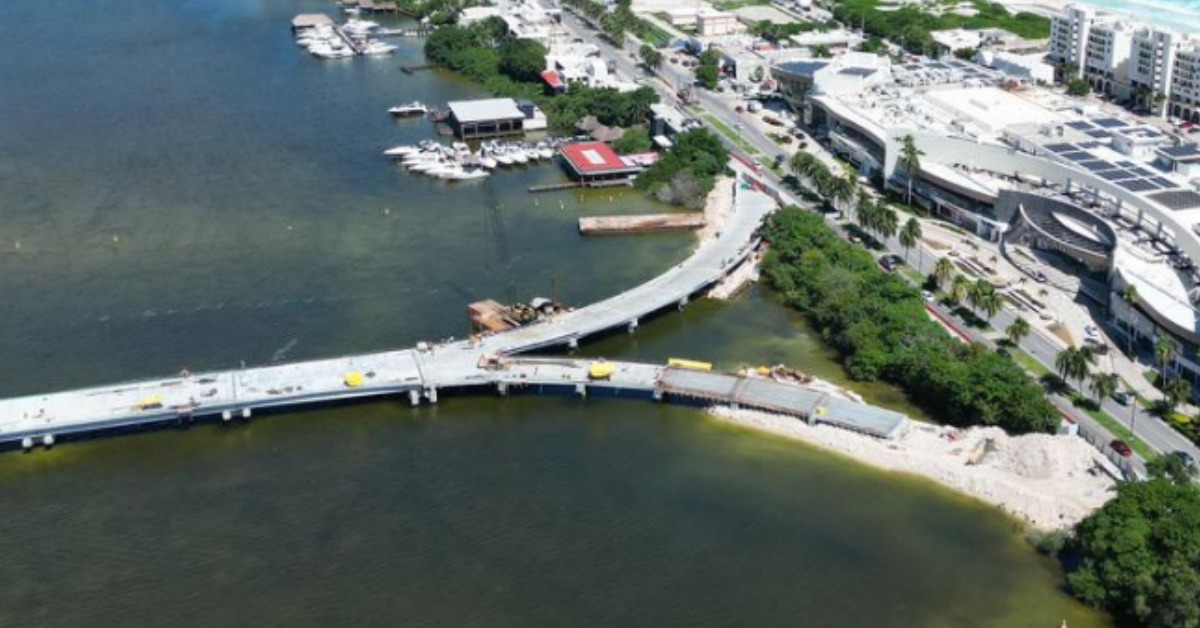
Quintana Roo mobility officials say 38 buses are planned for the Puente Nichupté corridor once the bridge opens. The service is expected to connect the city with the hotel zone via routes along Avenida Kabah and Avenida Las Torres, giving the new crossing an immediate public transport role rather than serving only private cars.
Officials also say the bus rollout will not begin with full passenger service on day one. First, there will be a testing period of about a month after the bridge opens. That phase is meant to help authorities review how the route performs in real traffic, how long trips actually take, and what adjustments may be needed before the service enters formal operation. A final fare has not been announced.
Why this matters beyond the bridge itself
For Cancún, the bus plan may prove almost as important as the bridge. Puente Nichupté has been presented as a major answer to daily congestion between the urban side of the city and the tourism corridor. But a new piece of infrastructure does not change mobility patterns on its own. The public transport network is what determines how much of that benefit reaches residents, hotel workers, and visitors who do not rely on private vehicles.
That is why the announcement matters. Officials say the route could save travelers up to 40 minutes on trips toward the tourism zone. Even if actual times vary once the system begins operating, the estimate gives a sense of what authorities believe the project can change. It also suggests the bridge is being framed not only as a construction project, but as a shift in how people move through Cancún.
The plan points to a more controlled corridor
The operating rules described so far show that the bridge is expected to function as a more controlled mobility corridor. Officials say the route will be limited to mass public transport and private vehicles, while cargo traffic will be restricted. That matters for both safety and traffic flow. It also signals that authorities want the bridge to serve daily passenger movement rather than become another mixed-use route weighed down by heavy trucks.
There is also a broader planning issue behind that decision. If the bridge is meant to reduce pressure on existing routes, then authorities will need to manage not just the opening itself but also how vehicles are distributed once it begins operating. That helps explain why officials are still talking about testing, route studies, and operating rules instead of simply announcing a launch date and a fare.
The opening is close, but not fully settled
The announcement comes as Puente Nichupté moves through its final stage. Recent reporting says the project is already in finishing, signage, and load-testing phases, with the physical work near completion. Federal officials have said the bridge is expected to be completed in April 2026, but there is still no definitive public date for full opening and regular transit service.
That uncertainty matters because the bus plan depends on more than the bridge structure being complete. Authorities still need to finish certifications, define operating protocols, and turn a construction project into a working transport corridor. In practical terms, the story is no longer only about when the bridge opens. It is now about how quickly the crossing can function reliably as part of daily life in Cancún.
The bridge is also part of a bigger debate
There is another layer to this story that helps explain why the project keeps drawing attention. Puente Nichupté has been promoted as one of the most important mobility works in Cancún, but it has also faced scrutiny over rising costs, delays, and environmental concerns around the lagoon system. Those issues do not disappear just because a bus network is now being attached to the project.
Still, the latest announcement changes the focus in an important way. It begins to answer a question many residents and regular visitors have had for months: not just when the bridge will open, but what daily use of the bridge will actually look like. If the bus service begins as described, the project may start to affect everyday movement in a more visible way than the construction updates ever did.