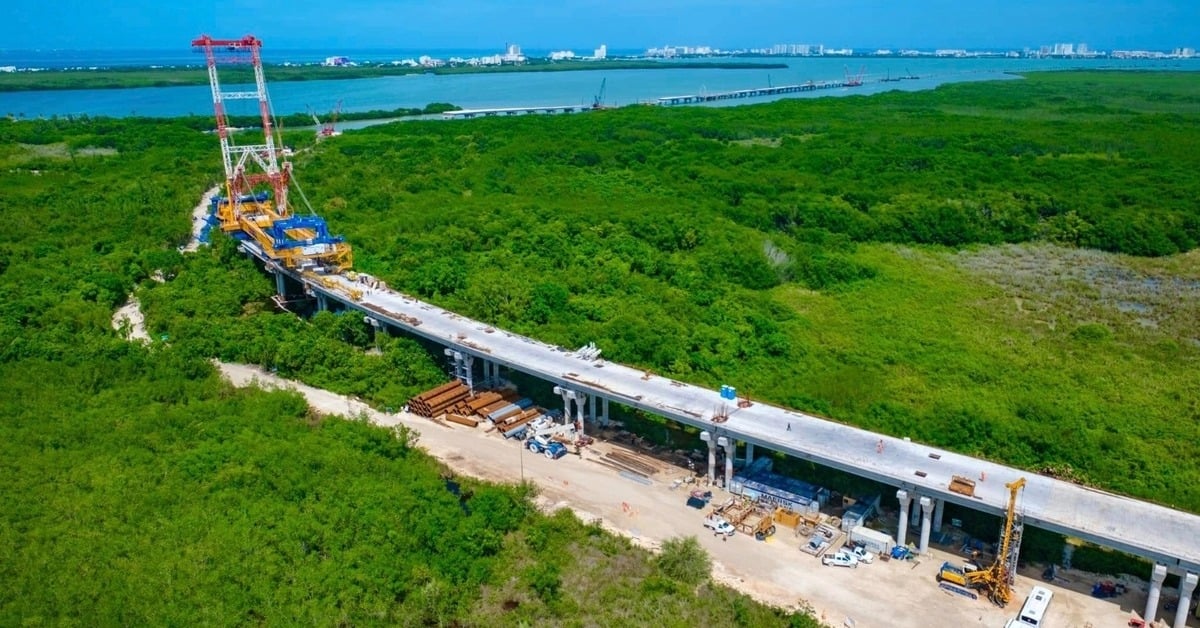
President Claudia Sheinbaum said there will be a “big celebration” when the Puente Vehicular Nichupté opens in Cancún. She made the comment during her morning press conference and said she still needed to speak with Governor Mara Lezama to coordinate the event.
The remarks matter because they place the bridge opening at the center of the federal government’s public agenda. Sheinbaum also signaled that the inauguration could take place on May 1 or May 2, reinforcing the idea that the launch is now imminent. That does not appear to be a final confirmed date, but it is the clearest public window yet.
For Cancún, the bridge is more than a ceremonial project. It has become one of the most visible infrastructure works in Quintana Roo, promoted as a fix for chronic congestion between the urban core and the hotel zone, where thousands of workers, tourists, and service vehicles move every day.
Why the bridge matters in Cancún
The Nichupté bridge is designed to create a new connection between Avenida Colosio and Boulevard Kukulcán, giving drivers another route into the hotel zone. That is important in a city where a single bad traffic jam, weather event, or road incident can ripple through daily life.
For many readers who live in Cancún part-time, own property there, or visit often, the project is easy to understand in practical terms. The hotel zone depends heavily on a limited set of road connections. When traffic backs up, it can affect airport runs, work commutes, deliveries, emergency response, and travel times for visitors. Officials have long argued that the bridge will reduce those choke points and make movement more predictable.
The project is also part of a larger federal effort to reshape transportation in the southeast. That broader pitch links the bridge to other works such as the Tren Maya, airport access, and regional tourism mobility. In that sense, the inauguration is being framed not just as a local road opening, but as a symbol of public investment in one of Mexico’s most important tourism corridors.
A major project with delays and higher costs
The bridge has been presented as a transformative public work, but its path to opening has not been simple. The project has faced delays, revised timelines, and a major cost increase.
Recent reporting places the bridge at about 97 percent complete, with the remaining work focused on final connections, load testing, markings, certifications, and operating protocols. Officials have said the structure stretches roughly 11.2 kilometers in total, with about 8.8 kilometers crossing the lagoon system and the rest made up of access connections.
Its budget story has drawn just as much attention as its engineering. What began at a much lower projected cost has grown to more than 12 billion pesos, according to the latest widely cited figures. That increase has turned the bridge into a bigger political story because it raises the usual questions associated with large public works in Mexico: delays, scope changes, oversight, and whether the finished project will justify the final bill.
The environmental questions are not going away
Even as the opening appears close, the Nichupté bridge continues to face scrutiny over its environmental impact. The structure crosses a sensitive lagoon and wetland system that includes mangroves and other habitats that have long been under pressure from urban growth.
Authorities have defended the project with mitigation and restoration plans. Those measures include rehabilitation work in nearby wetland areas and broader conservation commitments. Even so, critics have argued that the bridge adds pressure to an already fragile ecosystem. The concerns have centered on direct land disturbance, changes in mangrove areas, runoff risks, and the cumulative effects of additional infrastructure in a heavily developed tourism zone.
That means the bridge will likely remain a two-track story even after the ribbon-cutting. One track is about mobility and convenience. The other is about what more construction means for the Nichupté lagoon system and the future of Cancún’s environmental balance.
What readers should watch next
The biggest unknown now is not whether the bridge is closed, but whether the opening date holds. Public remarks point to an early May inauguration, yet final approvals still matter. Until vehicles are actually allowed onto the route, there remains a gap between political messaging and full operation.
Another point to watch is how quickly the bridge changes daily movement patterns. Officials have already linked future public transport planning to the opening, including adjustments to bus service once the route is in use. That suggests the bridge could shape more than private driving. It may alter how workers and visitors move through the city more broadly.
For Cancún residents, foreign homeowners, and regular visitors, the significance is straightforward. If the bridge performs as promised, it could ease one of the city’s most familiar daily frustrations. If it falls short, the debate over cost, delays, and environmental tradeoffs will only grow louder.