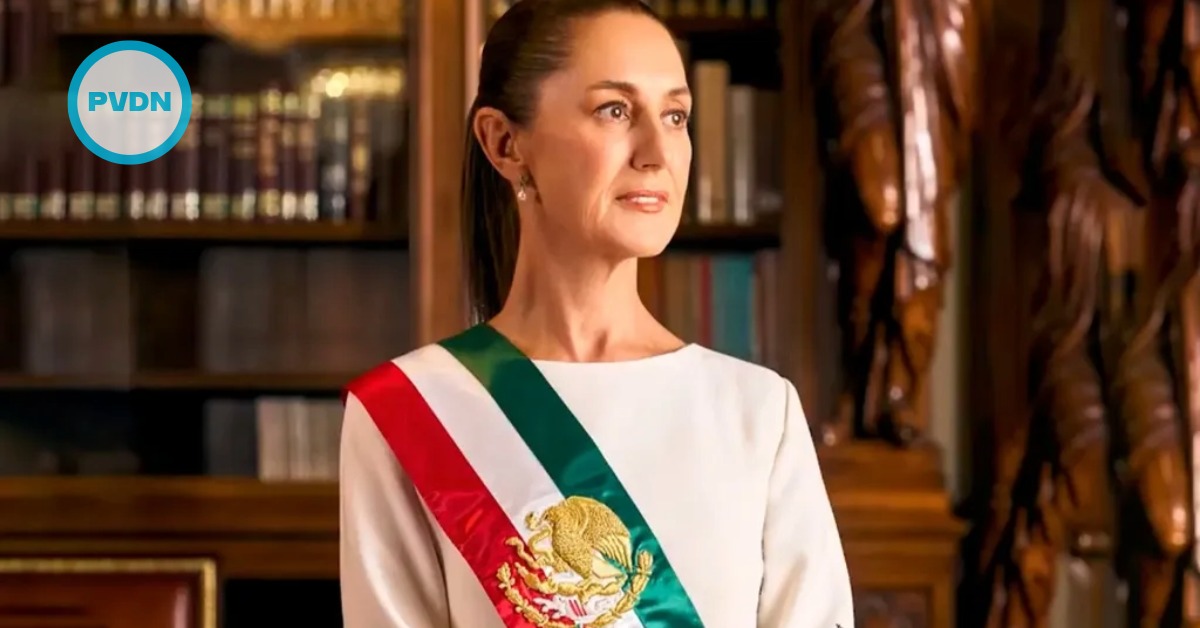
Forbes now ranks Claudia Sheinbaum among the world’s top five most powerful, spotlighting her security agenda, social programs, and historic role.
Forbes has pushed Mexico’s president even further into the global spotlight. In its 2025 list of the world’s 100 most powerful women, the business magazine places Claudia Sheinbaum in a small circle usually dominated by European and North American leaders. For a country often viewed abroad through the lens of violence, migration and inequality, seeing its first woman president ranked alongside the planet’s most influential figures carries heavy political symbolism.
This year’s “Power Women” ranking is led by European Commission chief Ursula von der Leyen, European Central Bank president Christine Lagarde, Japan’s prime minister Sanae Takaichi and Italy’s premier Giorgia Meloni, with Sheinbaum in fifth place. The list weighs criteria such as money, media presence, political impact and the breadth of each woman’s influence. On that scorecard, Mexico’s president now stands as the only Latin American head of government in the top tier.
The recognition lands after an intense first year in which Sheinbaum moved from historic victory to the grind of governing. Sworn in on October 1, 2024, she became both the first woman and the first Jewish person to lead Mexico, after a career that blended climate science with left-wing politics. Before winning the presidency she ran Mexico City, where she championed electrified transport corridors, cable cars over hillside settlements and a policing model built around crime data and closer coordination between forces.
Security record under the microscope
Security is one of the main pillars behind the new ranking, and also one of Sheinbaum’s most contested fronts. Federal data presented this year show that the daily average number of homicide victims has fallen by more than a quarter since she took office, making 2025 the period with the lowest murder rate since the middle of the last decade. The government credits a strategy that puts more National Guard troops on the streets, prioritises arrests of regional crime bosses and leans heavily on intelligence-led operations.
Officials point to tens of thousands of detentions, large weapons seizures and drug confiscations measured in hundreds of tons as evidence that the state is clawing back ground from organised crime. In some of the country’s most violent states, including Guanajuato and Zacatecas, reported killings have dropped sharply compared with the peak years of the previous administration. Supporters argue that, after a long stretch in which homicide numbers barely moved, any sustained decline is politically and morally significant.
Yet those same figures come with caveats that sit in the background of any celebration. Independent analysts warn that lower homicide counts do not automatically mean safer communities, especially in regions where disappearances and extortion continue to rise. Human rights organisations still document thousands of missing people and persistent impunity in murder cases, even as headline numbers improve. Business groups say criminal networks retain control of extortion rackets in ports, tourist hubs and border corridors that are vital to Mexico’s economy.
For Sheinbaum, the security picture is a balancing act. International investors and foreign governments study the statistics closely as they decide where to place factories and supply chains. Mexican families judge her performance in more personal ways, asking whether kidnappings are falling on the roads they travel, whether their neighbourhoods feel calmer at night and whether local police respond when they call for help. The Forbes ranking, in that sense, rewards not only the numbers but also the sense that Mexico may at last be bending a stubborn curve.
Beyond security, Sheinbaum’s social agenda also underpins her growing reach. Her government has preserved and expanded the welfare programmes launched under her predecessor while adding new benefits of its own. A pension aimed at women aged sixty to sixty-four, a scholarship scheme for public school students and a door-to-door health-care programme for seniors and people with disabilities rank among the flagship initiatives. The federal budget for well-being programmes in 2025 runs into the hundreds of billions of pesos, which officials say will reach tens of millions of households.
Claudia Sheinbaum powerful
The Forbes list treats this mix of hard and soft power as a single package. Mexico’s president oversees Latin America’s second-largest economy, presides over a nearshoring boom that is rewriting North America’s manufacturing map and directs vast public spending on welfare and infrastructure. That combination of economic weight, diplomatic visibility and domestic popularity helps move her from a regional figure to a global one in the eyes of the ranking.
There is also the symbolism that numbers can’t fully capture. When Sheinbaum took the oath of office, she told Congress it was “the time of women” in a country where femicide, wage gaps and glass ceilings have long shaped daily life. Her leap into the top five of a global power list makes that message visible far beyond Mexico’s borders. For many Mexican girls, seeing a woman lead the country and appear alongside the world’s most influential leaders is its own kind of signal.
At the same time, the ranking arrives while her government faces real tests. Violence in states such as Michoacán and Colima continues to shock the country, even as national averages improve. Families of the disappeared still demand answers. Environmental groups and Indigenous communities press the administration over energy projects and megaprojects they fear will damage land and water. The question hanging over the rest of her term is whether the promise reflected in the Forbes list can withstand those pressures.
For now, the recognition places Mexico’s president in a new league of global visibility. It gives her extra political capital in negotiations over trade, migration and climate, and it raises expectations among allies and critics alike. Being named one of the world’s five most powerful women is not a trophy she can leave on a shelf. It is a spotlight that will follow her every decision, and that, in the end, will be judged less by rankings than by the security, opportunity and dignity Mexicans feel in their daily lives.