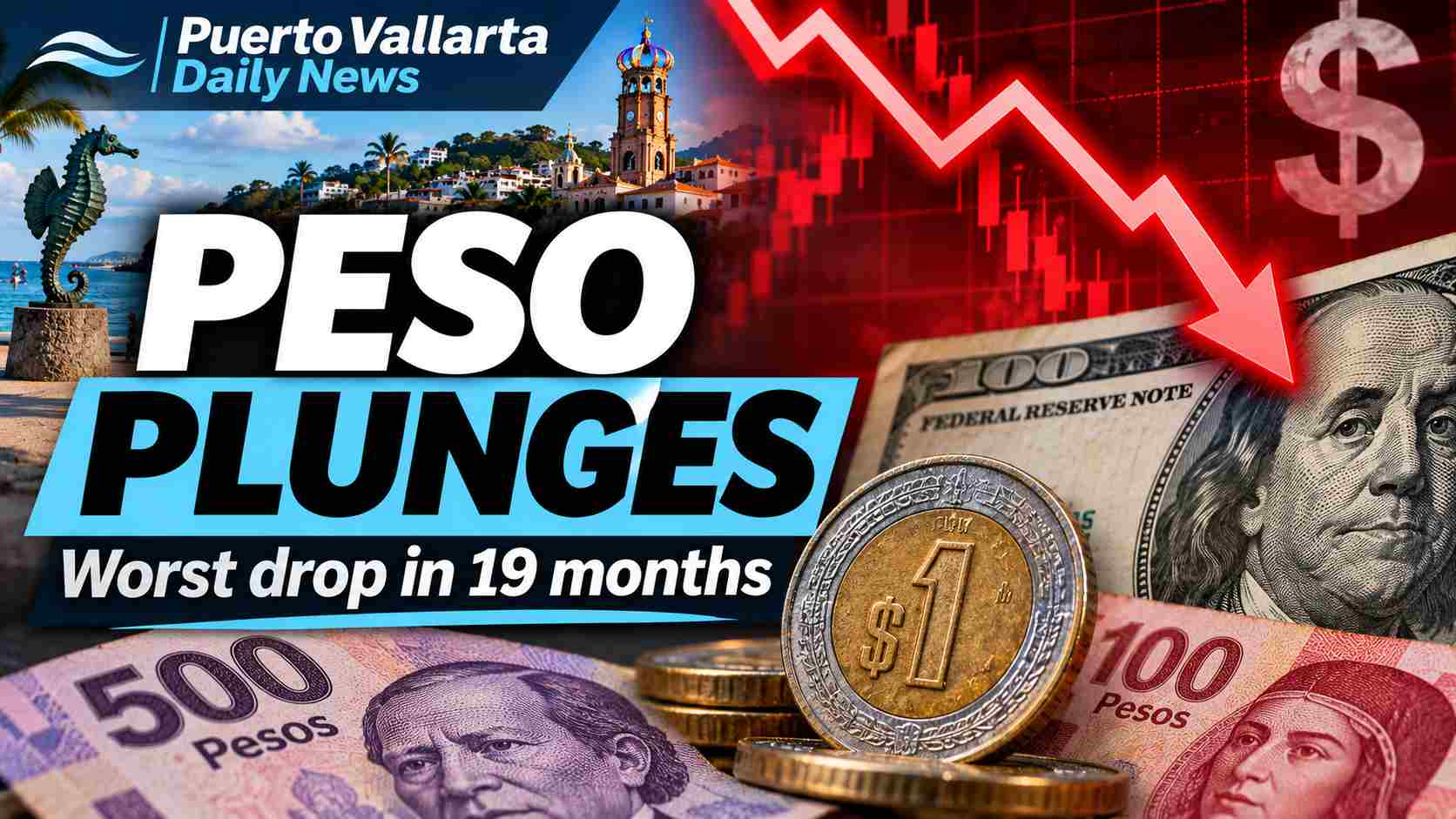
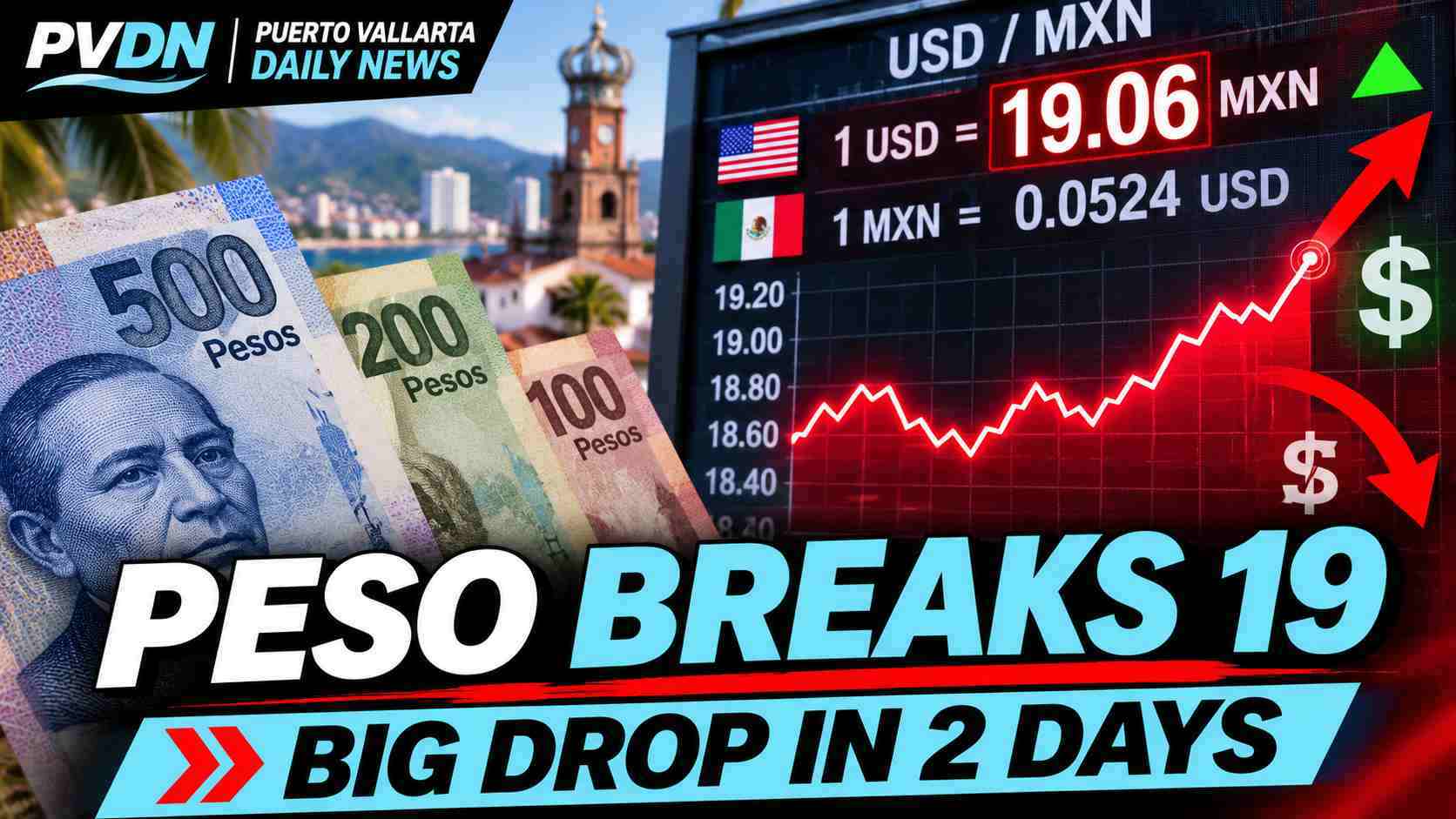
Mexico’s peso closed at 19.1182 per dollar after a second day of losses. Banxico’s minutes reveal why the rate debate is divided.
Mexico City, Mexico, November 19, 2026 – The Mexican peso fell for a second consecutive day Thursday, closing above 19 per U.S. dollar for the first time since June 2025 as newly released minutes from Banco de México revealed disagreement among central bank officials over interest rates and the risks of a weaker currency.
The peso ended the November 19 trading session at 19.1182 per dollar, according to Banco de México’s official exchange-rate records.
That’s another 27.26 centavos lost in a single day, equivalent to a 1.45% decline, following Wednesday’s much larger 2.26% drop.
In just two trading sessions, the exchange rate moved from 18.4298 pesos per dollar on Tuesday to 19.1182 on Thursday.
Nearly 69 centavos in two days.
The last time Mexico’s currency closed above 19 per dollar was June 23, 2025, when the exchange rate reached 19.1453.
Thursday’s decline was especially significant because it came after the publication of new information about Mexico’s own monetary policy.
While Wednesday’s selloff was largely driven by developments in the United States, Thursday brought renewed attention to decisions made by Banco de México and concerns about whether Mexico is lowering interest rates too quickly.
For Americans living in Puerto Vallarta on dollar-based retirement income, the weaker peso means more pesos from the same amount of dollars.
For Mexican businesses buying imported supplies and families earning pesos, the consequences can move in the opposite direction.
And the latest information from the central bank suggests the pressure on Mexico’s currency may not disappear quickly.
Banxico’s latest minutes reveal a divided central bank
Thursday’s biggest development came from Banco de México itself.
The central bank released the official minutes of its November monetary policy meeting, providing details about the discussions behind its November 5 decision to lower the benchmark interest rate from 6.50% to 6.25%.
The meeting took place November 4, but the detailed account of the discussions wasn’t published until Thursday.
Three members supported the cut.
Governor Victoria Rodríguez Ceja and deputy governors José Gabriel Cuadra García and Omar Mejía Castelazo voted to lower the rate by a quarter of a percentage point.
Two others disagreed.
Galia Borja Gómez and Jonathan Heath Constable wanted to leave the rate unchanged at 6.50%.
That split matters because interest rates have become one of the main concerns for investors deciding whether to hold Mexican pesos.
Lower rates can help stimulate economic activity by reducing borrowing costs. They also make peso-denominated investments less attractive compared with investments offering higher returns elsewhere.
The difference becomes particularly important when other countries are raising their own interest rates.
And that is precisely what investors are concerned about.
Mexico is cutting rates while the United States considers increases
The Federal Reserve has taken a different approach from Banco de México.
American officials have become increasingly concerned about inflation and have signaled that additional interest-rate increases may be necessary.
Minutes from the Fed’s October meeting, released Wednesday, contributed to a stronger dollar and a broad selloff in emerging-market currencies.
Mexico’s peso was among the hardest hit.
The difference between American and Mexican interest rates has been an important source of demand for the peso.
For years, international investors have borrowed money in currencies offering relatively low interest rates and invested it in Mexican assets paying higher returns.
The arrangement is commonly called the carry trade.
It can produce attractive returns when exchange rates remain relatively stable.
But that advantage becomes smaller when Mexico cuts rates while the United States raises them.
Investors may then decide the additional return isn’t worth the risk of holding pesos, particularly when the currency is already losing value.
Selling those investments can create more demand for dollars and place further pressure on the peso.
The latest Banxico minutes show that some members of its governing board are worried about that situation.
Two central bankers warned against cutting rates
Galia Borja was particularly concerned about Mexico’s position relative to other countries.
In her written dissent, Borja warned that lowering interest rates while other major economies maintain tighter monetary policies could increase volatility in Mexican financial markets.
Her concern was that Mexico could make its currency more vulnerable to movements in global investment flows.
Jonathan Heath raised a related argument.
He said another reduction in interest rates weakened Mexico’s monetary policy position and could produce results contrary to the goals that justified the cut.
Both officials also expressed concerns about inflation.
Their arguments were based on economic conditions as they stood during the November 4 meeting. The comments were not written in response to Thursday’s exchange-rate decline.
Still, investors received those arguments at a time when the peso was already under pressure.
The three officials who supported the rate reduction saw the situation differently.
They argued that inflation was gradually moving toward Banco de México’s target and that economic conditions justified a limited adjustment in borrowing costs.
They also believed the currency’s recent depreciation would have a relatively small effect on consumer prices.
That disagreement is central to understanding Thursday’s market reaction.
The majority believes Mexico can maintain a lower interest rate without seriously undermining inflation control.
The dissenting members are more concerned about the consequences of reducing rates while international financial conditions are becoming less favorable.
Banxico says rates may remain unchanged for some time
Despite the disagreement over November’s cut, the central bank’s published position points toward a pause in further reductions.
The governing board said keeping the benchmark rate at 6.25% for an extended period would support the return of inflation toward its 3% target.
It also said future decisions would depend on inflation, economic activity, expectations and the effect of currency movements on consumer prices.
That is not a guarantee that interest rates will remain unchanged for a specific number of months.
The bank has not committed itself to a fixed timetable.
Some investors remain skeptical about how long the pause will last.
In an analysis published Thursday by Banco Base economist Gabriela Siller, she questioned whether the majority’s comments showed sufficient concern about the recent increase in inflation and currency volatility.
Siller argued that investors might doubt the central bank’s guidance if they believe policymakers remain inclined to cut rates again.
That interpretation helps explain why the peso weakened even though the central bank was signaling that it intended to pause.
Investors are weighing the bank’s stated plans against the possibility that changing economic conditions could produce a different decision.
The peso’s decline is now more than a one-day market reaction
At that point, the latest completed trading session was Wednesday, when the peso closed at 18.8456 per dollar.
Thursday’s decline extended the losses and pushed the currency beyond a level it had not crossed at the daily close for nearly 17 months.
The exchange rate reached an intraday high of approximately 19.1364 pesos per dollar.
For the peso, a higher exchange-rate number means a weaker currency because more pesos are needed to purchase one dollar.
The dollar also strengthened internationally, although Mexico’s currency faced pressure tied specifically to the release of Banxico’s minutes.
César Valencia, an analyst at GTCFX quoted by El Economista, attributed Thursday’s losses partly to the perception that Mexican central bankers were less concerned about the inflationary effects of a weaker peso.
He also pointed to the prospect of a narrower interest-rate difference between Mexico and the United States.
That combination has been building for several months.
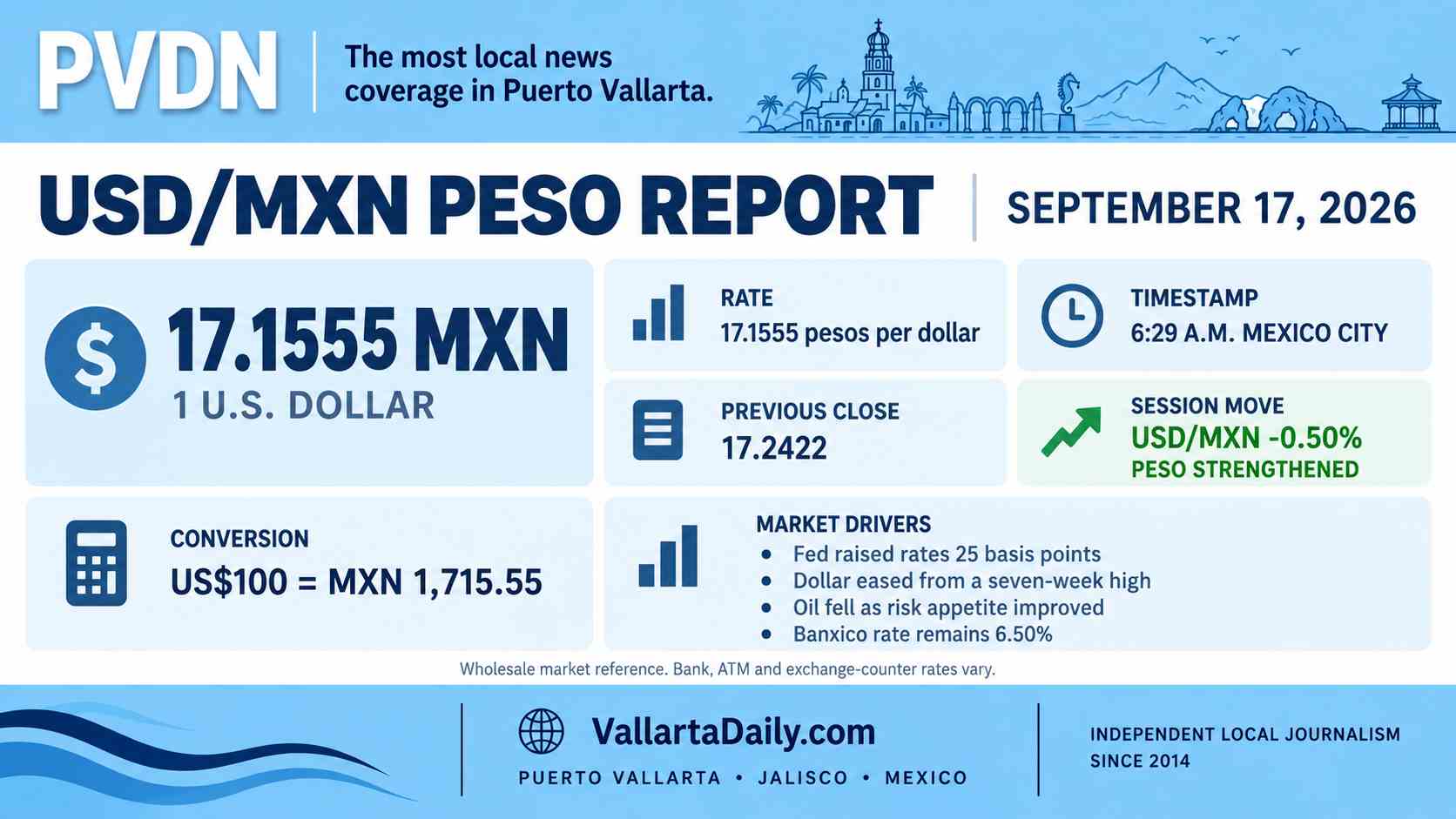
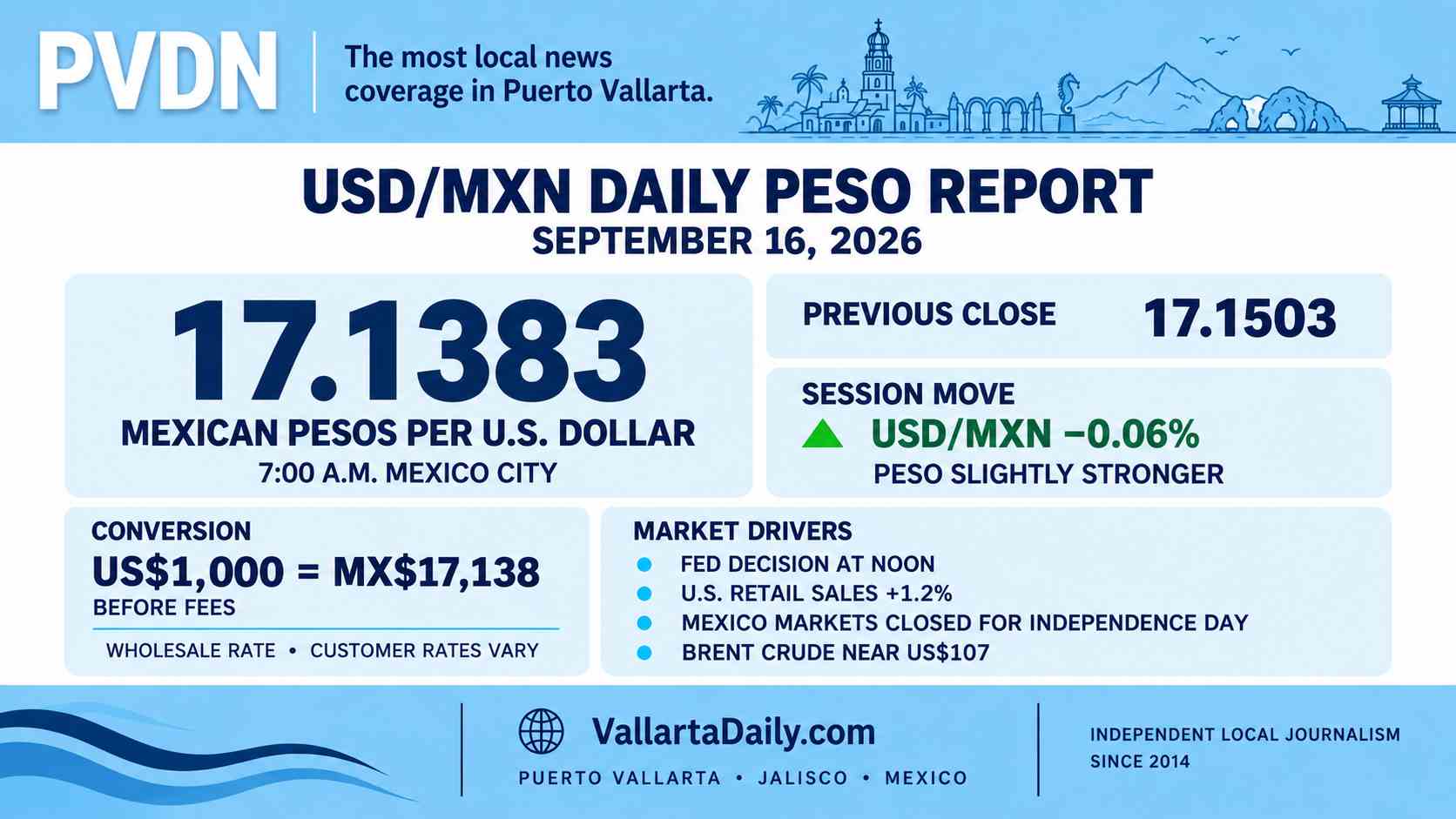
In September, Mexico’s currency was trading considerably stronger, with exchange rates near 17.15 pesos per dollar at one point.
By late October, the peso had weakened substantially. The latest two-day decline pushed it even further.
The movement does not establish that the peso will continue falling. Currency markets can reverse direction quickly, particularly after large declines.
But the latest close shows that investors are reassessing the peso against a changing interest-rate outlook.
What a dollar buys in Puerto Vallarta has changed considerably
For residents receiving U.S. dollar income, the exchange-rate change is easy to measure.
At Tuesday’s closing rate of 18.4298 pesos per dollar, US$1,000 was worth approximately 18,430 pesos before exchange fees.
By Thursday’s close, that same US$1,000 was worth approximately 19,118 pesos.
That’s a difference of roughly 688 pesos on every US$1,000 exchanged, using the two wholesale market closing rates.
For someone converting US$3,000 in monthly retirement income, the difference works out to approximately 2,065 pesos.
Those are examples based on market closing rates, not guaranteed amounts offered by banks, ATMs or currency exchange businesses.
Financial institutions set their own buy and sell rates, and transaction fees can reduce the amount customers receive.
The timing also matters.
A person who exchanged money Tuesday has already completed that transaction. Someone making the same exchange after Thursday’s market close may receive a different rate depending on where and when the exchange takes place.
American retirees and property owners receiving income in dollars may benefit from the weaker peso when paying expenses priced in Mexican currency.
That can include utilities, groceries, property maintenance, medical services and other local costs.
But the currency movement does not automatically make Puerto Vallarta less expensive.
Businesses may eventually adjust prices if imported goods become more costly. Some property owners and service providers also set prices in dollars, limiting the benefit of a weaker peso for customers paying with American currency.
Canadian residents face another distinction. The peso’s movement against the U.S. dollar doesn’t establish how much more or less their Canadian dollars will buy. That depends on the exchange rate between the Canadian dollar and the peso.
Remittances are another important part of Vallarta’s economy
The recent depreciation also changes the peso value of money sent from abroad.
Earlier this month, Vallarta Daily reported that Puerto Vallarta and Bahía de Banderas received US$167.1 million in remittances during the first nine months of 2026.
That was more money in dollars than during the comparable period of 2025.
But when converted into pesos, the value was approximately 190 million pesos lower.
The stronger peso earlier in the year had reduced how much local families received in Mexican currency from the same dollar transfers.
The exchange-rate movement this week reverses that effect for people receiving dollars now.
A US$500 transfer, for example, had a wholesale market value of approximately 9,215 pesos at Tuesday’s closing rate.
At Thursday’s closing rate, the equivalent would be about 9,559 pesos.
That is roughly 344 additional pesos before transfer costs and differences in exchange rates.
The benefit depends on the actual rate offered by the money-transfer provider when the recipient receives the funds.
It also depends on how long the peso remains at its current level.
A weaker peso doesn’t automatically mean higher inflation
One concern raised by currency depreciation is the cost of imported products.
When the peso loses value, Mexican businesses generally need more pesos to buy goods priced in dollars.
That can affect equipment, imported food products, manufacturing supplies and other items purchased internationally.
Some of those increased costs can eventually reach consumers.
But the effect isn’t immediate or uniform.
Businesses may have existing inventory, contracts at earlier exchange rates or other ways to absorb temporary currency movements.
Banco de México’s governing board addressed that issue in the minutes released Thursday.
The majority argued that the recent depreciation would have a limited effect on inflation because economic demand remained relatively weak and earlier monetary policy restrictions were still influencing the economy.
That was the majority’s assessment, not a finding that imported prices cannot rise.
Other board members expressed greater concern that continued currency weakness could eventually place more pressure on consumer prices.
The disagreement will matter if the peso remains weak for an extended period.
A short-lived movement in exchange rates may have little effect on what households pay.
A longer depreciation can create more pressure on businesses that repeatedly purchase goods and supplies from abroad.
What happens after the peso crosses 19?
Thursday’s close leaves the Mexican currency at its weakest official daily closing level since June 2025.
There has been no new Banco de México interest-rate decision.
The 6.25% benchmark rate remains unchanged following the November 5 reduction, and Thursday’s announcement consisted of the detailed minutes explaining that earlier decision.
The Federal Reserve has also not announced a new rate increase this week.
Investors are responding to the information now available and their expectations about what both central banks may do next.
The next developments will come from U.S. inflation and economic reports, signals from Federal Reserve officials and future Banco de México policy decisions.
Markets will also watch whether the peso stabilizes after its two-day decline or continues weakening.
For Puerto Vallarta residents managing income and expenses in different currencies, the immediate change is already measurable.
The dollar’s official interbank closing rate moved from 18.4298 pesos Tuesday to 18.8456 Wednesday and 19.1182 Thursday.
At Thursday’s closing rate, every US$1,000 converted at the wholesale market rate would be worth about 688 pesos more than it was two trading sessions earlier, before fees.
The next trading session will determine whether that difference begins to narrow or grows larger.