President Sheinbaum wants federal prosecutors to explain why the Coahuayana car bomb case was downgraded from terrorism to organized crime.
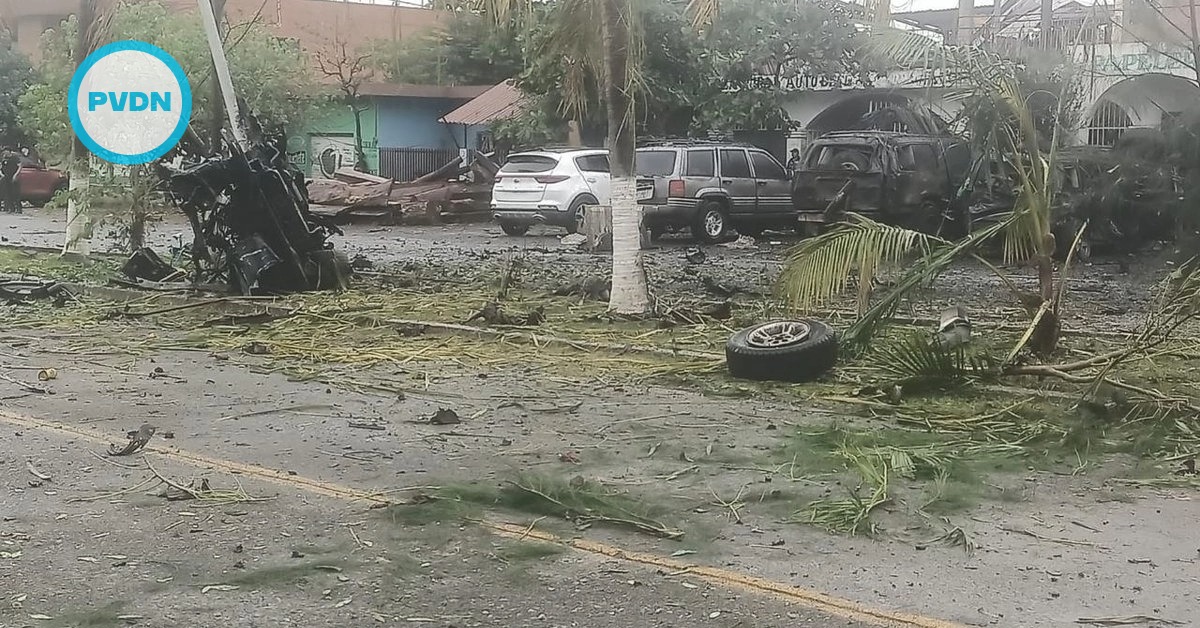
At midday on Saturday, a pickup packed with explosives detonated outside the headquarters of a community police force in Coahuayana, a small coastal municipality in western Michoacán. The blast ripped through a central avenue, killing at least five people and injuring more than a dozen, including community officers and bystanders. Homes, shops and even a nearby hospital suffered damage as the shock wave tore through the town center. Human remains were scattered across the street, a scene that locals compared to a war zone.
Residents in this banana-growing region have lived for years with gunfire, extortion and, more recently, explosive devices dropped from drones. Witnesses say this blast was different. They describe a single, deafening detonation that shook buildings hundreds of meters away and threw debris high into the air. Among the dead are members of the community police and the driver of the truck, which had reportedly been loaded with bananas, raising questions about whether he knew what he was carrying.
Coahuayana sits on a strategic corridor where criminal groups fight over crops, mining routes and access to the Pacific coast. Community police forces emerged there more than a decade ago, when residents organized to push back against cartel control. The state later folded some of these groups into formal security schemes, yet local leaders say they remain outgunned. For them, the Coahuayana car bomb feels like a message aimed not only at one base, but at an entire project of community self-defense.
Coahuayana car bomb
The explosion triggered an immediate response from federal authorities. Mexico’s Attorney General’s Office announced that it had opened an investigation for the federal crime of terrorism, citing the use of explosives against a public security installation and the impact on the civilian population. Terrorism charges in Mexico’s federal code apply when acts such as bombings seek to produce alarm, fear or terror in the population to threaten national security or pressure authorities.
Within roughly a day, the same office adjusted its position. In a new statement, prosecutors said the case would move forward under the framework of organized crime and related offenses, not terrorism. The announcement did not detail why the classification changed, only that investigators were working with federal and state security agencies on site. That quiet shift, made while families were still identifying remains, set the stage for Monday’s political storm in the capital.
During her morning news conference, President Claudia Sheinbaum said she expects prosecutors to explain both decisions in public. She stressed that the Attorney General’s Office is autonomous and that it is up to prosecutors to decide whether a case fits terrorism or organized crime. At the same time, she pointed to the new attorney general, Ernestina Godoy, and said the country needs clarity on how these categories are applied. The president also insisted that the investigation must run its full course and that the federal government will keep security deployments in the area.
For families in Coahuayana, the legal terms matter less than the immediate loss. Community members spent the weekend searching for missing relatives and gathering at improvised wakes. Local authorities have pressed for more troops and equipment, arguing that the use of a car bomb marks an escalation in a region already marked by ambushes, roadside mines and drone attacks. The fear is that if this attack is not treated with the maximum legal weight, similar tactics could become more common.
Why the label matters in law
Mexico’s federal code defines terrorism as the use of explosives, fire, toxic substances or other violent means that cause serious harm or risk to people, public services or infrastructure, when the aim is to generate alarm, fear or terror in the population or to pressure authorities. The offense carries heavy prison terms and is grouped with crimes against national security. Organized crime statutes, by contrast, focus on groups of three or more people who repeatedly commit certain serious crimes, such as drug trafficking, extortion and illegal arms dealing.
On paper, a car bomb outside a police base in a contested region could fit either frame. If prosecutors pursue terrorism, they must prove not only the material facts of the explosion, but also that those behind it sought to intimidate the broader population or coerce the state. Organized crime charges require evidence of a criminal structure and its profit-driven activities. Legal scholars note that in Mexico, most cartel violence ends up in the organized crime bucket, even when tactics look indistinguishable from political terror.
The debate is not new. Security analysts have tracked how criminal groups in Mexico have adopted tactics usually associated with terrorism, including car bombs, public massacres and attacks on civilian spaces meant to send a message. At the same time, authorities have resisted formally labeling cartels as terrorist organizations inside Mexico, in part to keep the fight within a criminal justice framework rather than a counterinsurgency one. The Coahuayana case lands squarely in that long-running argument over words, law and power.
International pressure adds another layer. This year, the United States formally designated several Mexican cartels, including the Jalisco New Generation Cartel, as foreign terrorist organizations. That step, taken abroad, does not change how Mexico classifies crimes on its own territory. It does, however, raise the stakes of how high-profile attacks like the Coahuayana car bomb are described, at a time when transborder cooperation on security is deeply politicized.
Mexico is also seeing a broader shift in the tools criminal groups use. Security records show a steep rise in improvised explosive devices, from small roadside bombs to drones carrying grenades. In Michoacán alone, authorities have documented hundreds of such devices in recent years, including attacks that killed farmers and soldiers on rural roads. In 2024, a car bomb outside a police station in the neighboring state of Guanajuato injured officers and civilians, underscoring how vehicle-borne explosives are becoming part of the arsenal in multiple states.
For Coahuayana, the national debate can feel distant. Residents are focused on burying their dead, repairing shattered windows and trying to make sense of another violent turn in a conflict that has dragged on for years. Yet the way this case is labeled will shape everything from access to federal victim support funds to the message sent to the armed groups that rule many stretches of western Mexico.
If prosecutors hold to an organized crime classification, they may argue that it offers a clearer path to target the network behind the attack, not just the bomb itself. If they return to a terrorism frame, they would signal that vehicle bombs against local security forces cross a different line. For now, the only certainty is that a small town has suffered a devastating blow, and that the country’s legal language is struggling to keep up with the violence people there live every day.