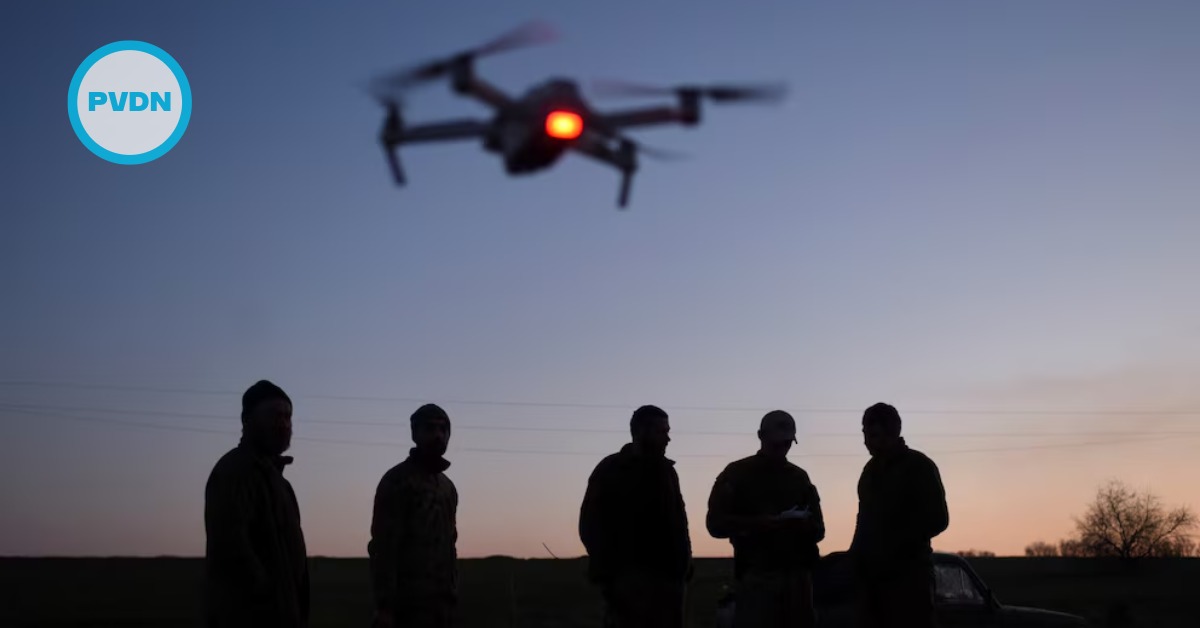
A small drone can cross a canyon, hover over a patrol route, and vanish in minutes. That simple advantage is reshaping Mexico’s fight with organized crime—because groups aren’t just moving drugs with drones anymore; they’re watching, mapping, and sometimes striking. U.S. officials now describe thousands of suspicious flights near the border and warn that cartels adapt faster than defenses. Behind the scenes, Mexico and the United States are building an electronic “air curtain.” What does that actually look like on the ground?
From gadgets to weapons
For years, drones were treated as the modern equivalent of a lookout on a hill: cheap, disposable, and useful mainly for information. That era is ending. A report circulating in Mexico argues that criminal groups have moved drones from a logistics tool into a tactical weapon—one that can spy, coordinate, and, in some cases, deliver explosives with unnerving precision.
The shift isn’t mysterious. Commercial drones are easier to buy than most people realize. They fly quietly, they can stream video in real time, and they don’t require a runway or a trained pilot. When a device like that lands in the hands of groups that already control territory, road networks, and supply chains, it becomes more than a toy. It becomes a way to extend power upward—into the airspace that used to belong exclusively to the state.
U.S. officials have described drones being used to surveil law enforcement and to move contraband across the border, often at night or at altitudes that make them harder to spot. In congressional testimony, a senior Homeland Security official said drones were detected in large numbers near the southern border in late 2024, with patterns suggesting deliberate evasion rather than hobbyist flying. That same testimony warned that drones have already been used for “kinetic attacks” in Mexico, and that the tactics seen in overseas war zones are rapidly “finding their way” closer to home.
In Mexico, the fear isn’t just that drones can watch. It’s that drones can strike. Dropping an explosive from above changes the psychology of any confrontation. It removes distance and replaces it with uncertainty: the threat might be overhead, silent, and unseen until the last second.
The border becomes contested airspace
Border security is usually described in ground terms—walls, fences, checkpoints, patrol routes. Drones flip that logic. They can jump the barriers that cost billions, travel over rivers and ravines, and return to the Mexican side before authorities can triangulate an operator.
U.S. officials have offered a sense of the scale they say they’re facing. In mid-2025 testimony, Homeland Security cited more than 27,000 drone detections within roughly 500 meters of the U.S.-Mexico border over the final six months of 2024, with many flights occurring after dark. The same testimony linked drone detections to significant drug seizures and described drones as a tool not only for smuggling, but also for hostile surveillance—watching where agents are, when shifts change, and which routes are open.
That matters because surveillance isn’t passive. In the wrong hands, it becomes targeting data. If a patrol pattern is known, an ambush becomes easier. If a convoy route is mapped, a roadblock can be timed. And if a checkpoint is observed, a diversion can be staged somewhere else. A drone doesn’t have to carry a bomb to change the battlefield; it only has to give one side better information than the other.
For expats living in Mexico, especially those who travel by road or who live in states where criminal groups have a visible footprint, the unsettling part is how normal this can look from the outside. A drone overhead might resemble wedding footage or real estate marketing. The difference is intent, and intent is not something you can see from the street.
Inside the “cortina aérea”
The report’s most striking phrase is the idea of a “cortina aérea”—an aerial curtain or electronic shield—built to detect, track, and neutralize drones before they can deliver contraband or explosives. On paper, it sounds like a clean solution. In reality, it is a complicated engineering problem layered on top of a political one.
Detecting small drones is hard. They can be made of plastic and composite materials that don’t stand out like aircraft. They can fly low, blend into cluttered radar environments, and appear for minutes rather than hours. Even when they’re detected, the next step—stopping them—comes with tradeoffs. Jamming radio links can disrupt other communications. Spoofing signals requires sophisticated tools and tight coordination. Physical interception can be dangerous in populated areas.
Both Mexico and the United States are moving in that direction anyway, because the alternative is to let criminal airspace become the norm. The Mexican military has signaled it is investing in research and development tied to drone countermeasures, including work on frequency inhibitors and data-analysis tools. In parallel, reporting on defense planning has pointed to purchases aimed at protecting troops from explosives and drone attacks in some of the country’s most contested regions, where security forces have faced ambushes, improvised mines, and aerial threats.
On the U.S. side, the pressure is both legislative and operational. Homeland Security has argued that counter-drone authority needs to be extended and expanded to keep pace with evolving threats. The Defense Department has also described the southern border as part of a growing unmanned-systems challenge, and has said transnational criminal organizations are using drones to track movements of U.S. forces near the border—an admission that the problem is not hypothetical.
Why the drone race favors criminal groups
One reason drones spread so quickly among criminal organizations is that they ride on consumer innovation. When the commercial market improves batteries, cameras, sensors, and flight stability, everyone benefits—including actors the market never intended to serve.
That creates a brutal asymmetry. A cartel can test tactics cheaply, fail quickly, and adjust without writing policy memos or waiting on procurement cycles. A government has to weigh legal authority, airspace rules, safety, collateral effects, privacy, and jurisdictional boundaries. Even when the state moves fast, it often moves more slowly than an opponent that answers only to itself.
The report’s claim that criminal networks recruit specialized technical help—people who can modify payloads, extend range, or improve evasion—is plausible in that context. Drones don’t require a massive research lab to become more dangerous; they require tinkering, iteration, and a willingness to experiment. If the lessons of global conflict are that improvisation wins early, drones are the perfect tool for improvisers.
What this means for daily life in Mexico
This story is not a warning that drones are about to become a common threat in every neighborhood. Most people in Mexico will never see the kind of drone warfare described in the report, and everyday risks still depend far more on location, local dynamics, and situational awareness than on technology.
But it does mean the security landscape is modernizing in an uncomfortable direction. Drones add a vertical dimension to conflicts that were once mostly on roads, in fields, and around checkpoints. They can be used to intimidate, to monitor, and to attack in ways that are harder to predict.
For expats, the practical takeaway is less about fear and more about understanding the direction of travel. If you live near the border, or you spend time in regions where security forces and criminal groups regularly clash, drone incidents are part of the backdrop officials on both sides are planning around. If you hear of counter-drone deployments or heightened surveillance in a corridor, it’s usually a response to a pattern authorities have already observed.
And if you ever encounter something unusual—like persistent drone activity near sensitive infrastructure, military installations, or during an active security incident—the safest assumption is that it’s not your job to investigate. The era the report describes is one where curiosity can collide with organized operations. Staying out of the way is not paranoia; it’s basic risk management.