Escuinapa gun battle sparks arson blockades on the Mazatlán–Tepic corridor, leaving three dead as federal forces move in.
On Wednesday, December 17, 2025, Escuinapa, Sinaloa woke up to a kind of noise people don’t confuse with fireworks. Residents reported sustained gunfire across multiple points in and near the municipal seat. The first reports placed the start around daybreak, with the most consistent timelines pointing to roughly 7 a.m. The tension spread fast because the sounds were not isolated to distant rural roads. They were close enough to town that families described hiding inside their homes and trying to keep children quiet.
Authorities later found three people dead near where the violence appears to have begun. The location was described as the area around Colonia Insurgentes, at the turnoff toward the community of El Roblito. Two of the victims were found burned inside a vehicle. A third body was discovered beside another vehicle nearby. Officials did not immediately release identities, ages, or any clear explanation of whether the dead were participants in the clash or caught up in it. That uncertainty matters, because in fast-moving episodes like this, early assumptions can harden into “facts” long before investigators finish basic work at the scene.
For locals, though, the immediate reality was simpler and more frightening. It wasn’t just that gunfire was audible. It was that movement felt risky. People heard reports of armed men near orchards and on the outskirts, and they watched smoke rise from different directions. A town that normally moves to the rhythm of schools, errands, and morning work suddenly felt locked down.
Arson Blockades Turn Roads Into Traps
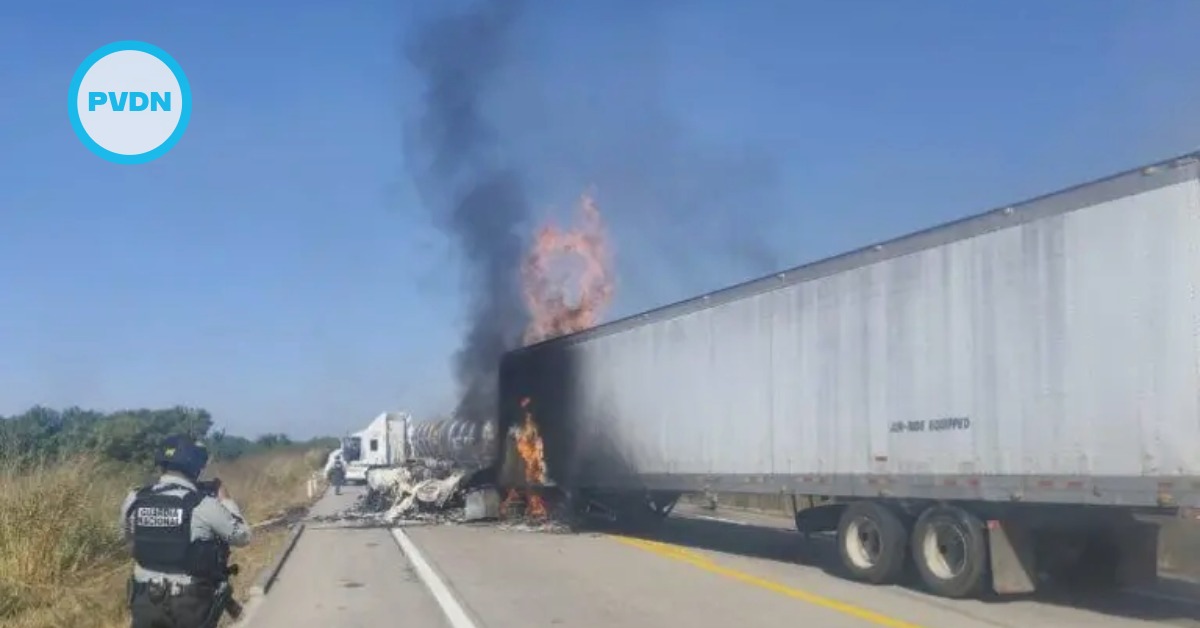
Almost at the same time the gunfire was being reported, the highways became part of the story. The Mazatlán–Tepic toll road, a key stretch for travelers moving along Mexico’s Pacific side, was blocked for hours by burned vehicles. Reports from the scene described tractor-trailers set on fire at roughly kilometer 182, with another burned cargo unit around kilometer 183. Those aren’t just random markers. They’re the kind of points that can strand drivers far from towns, with limited exits and few safe places to turn around.
The toll road disruption matters because it is not simply a local street closure. It is a corridor that connects Sinaloa to Nayarit and beyond, feeding traffic toward Tepic and the coastal routes that many residents and visitors use when heading toward beach towns and larger cities to the south. When it goes dark, the ripple spreads: freight stops, buses get delayed, and regular drivers find themselves staring at an unmoving line of cars with no clear information about what’s ahead.
At the same time, blockades were also reported on Federal Highway 15 in the Escuinapa area, including the stretch that connects the municipal seat with Tecualilla. That detail is important because it suggests a broader attempt to choke movement, not just interrupt one road. When both a major toll road and key free-road segments are compromised, detours become less useful and the region can feel sealed off.
Within the town itself, additional vehicles were reported burned. Among those described were a gas service vehicle, a private car, and a vehicle used to transport farmworkers. Even without a full official accounting of every damaged unit, the pattern is clear: this was not only a clash of armed groups. It included the deliberate use of fire to block and intimidate, the kind of tactic that magnifies fear because it transforms ordinary infrastructure into a threat.
The Official Response Was Fast, and It Went Airborne
Once reports spread, authorities launched an interagency operation. The forces mentioned in early official and security-source accounts included the Mexican Army, the National Guard, and Sinaloa’s State Preventive Police. A security point was also set up outside the IMSS Bienestar hospital in Escuinapa, a move that signals both concern about potential injuries and an attempt to secure a sensitive location where panic can spike.
The operation did not stay on the ground. Aerial patrols were reported, including helicopter flights and the use of a small aircraft associated with the Navy. For residents, that kind of response can be double-edged. On one hand, seeing federal forces arrive can feel like relief. On the other, helicopters and armed convoys are a reminder that authorities do not treat the situation as routine. When the sky becomes part of a security operation, people often assume the risk is ongoing, even if gunfire has quieted.
As crews worked to remove burned vehicles and restore circulation, the region moved into a familiar limbo: the violence appears to have ended, but normal life does not snap back instantly. Roads remain unpredictable. Information is fragmented. Families wait to hear if schools will open, if shops will operate, and whether it’s safe to drive across town for something as basic as groceries or medicine.
Conflicting Early Messages and Why That Happens
One of the most striking features of the Escuinapa episode was how quickly official messaging shifted. Around midday, the governor publicly acknowledged the confrontations, the roadblocks, and the deployment of federal forces. At that point, he said there were no reported deaths directly tied to the clash. That statement did not last long. Later that same day, reporting based on security sources described three people found dead at the initial area of violence.
This kind of discrepancy does not automatically mean anyone was lying. It often means the information pipeline is messy. In incidents with multiple sites and burned vehicles, investigators have to secure areas before they can confirm what they’re seeing. Bodies inside charred vehicles may not be immediately visible or accessible. Different agencies may be operating on different timelines, and early statements are sometimes made while the situation is still unfolding.
For readers, especially expats who may be used to very different emergency communication cultures, it’s worth understanding how these moments work in Mexico. Social media can flood the zone with videos and voice notes within minutes. Official confirmations can lag behind, particularly when authorities are trying to avoid spreading panic, or when they genuinely do not have verified counts yet. The challenge is that uncertainty itself becomes a stressor. People are stuck between rumor and silence, and both can feel dangerous.
Reports of Explosions and Drones Add a New Layer of Fear
As the morning unfolded, reports circulated that the violence included explosions, and at least one local authority figure spoke publicly about alleged drone activity. Claims like that are especially alarming because they suggest tactics that can spill beyond direct gunfire and into broader public danger.
At the same time, these are exactly the details that require careful handling. In Mexico, rumors of “explosives” can refer to many things, from firecrackers used to intimidate, to homemade devices, to more serious weaponry. Drones, too, can range from surveillance tools to platforms used for dropping small explosive devices. Without a detailed official forensic account, the public is left with partial descriptions and fear-filled interpretations.
What can be said with confidence is that residents and local officials described a morning of extraordinary intensity, and that fear was not limited to bullets. When people mention explosions, smoke, and drones in the same breath, it reflects a community struggling to explain what it experienced. Even if later investigations narrow down what was real and what was misidentified in the chaos, the psychological impact on a small city can last much longer than the actual firefight.
What This Means for Travelers and Expats
Escuinapa is not a tourist postcard town, but it sits in a region that matters to travelers. The Mazatlán–Tepic corridor is used by locals and visitors moving between Sinaloa and Nayarit, and it connects into routes that feed traffic farther south. For expats living in Mexico, the practical takeaway is not to panic, but to respect how quickly a normal drive can become complicated.
When an arson blockade happens, it is not like a construction delay where you wait it out. These closures can be sudden, absolute, and dangerous. Drivers can be stuck between burned vehicles ahead and uncertainty behind. Phone signals can be inconsistent. Information may arrive through rumor first, and official updates second. If you travel regularly along long stretches of highway in Mexico, it’s wise to keep your habits grounded in reality: avoid driving into conflict zones when there are active reports, and treat sudden closures as a reason to stop and reassess, not to push forward.
It also matters that this happened in mid-December, when many people travel for the holidays. Increased traffic does not cause violence, but it increases exposure. More cars on the road means more potential bystanders and more people stranded when blockades appear. Even if the incident remains geographically limited, the disruption can be felt widely, especially when it hits a main corridor rather than a back road.
For expats, there’s also the emotional side. Episodes like this can make Mexico feel unpredictable, even if your daily life is calm and safe. That reaction is normal. The healthiest response is to separate the country you live in from the headlines you read. Mexico can hold both realities at once: communities where people feel secure and connected, and regions where criminal conflict erupts violently and suddenly.
The Human Reality Inside Escuinapa
Behind the highway headlines, there is a quieter story about what it feels like to live through a morning like this. Parents deciding whether to send children to school, then hearing schools suspend activities. People who work hourly jobs wondering if they’ll lose a day’s pay, but also knowing the risk of leaving the house is not theoretical. Small businesses deciding whether to open their doors while smoke is still visible and rumors are still spreading.
In towns like Escuinapa, fear spreads quickly because communities are tightly connected. A voice note from a cousin becomes a neighborhood warning. A video of distant gunfire becomes “they’re right outside.” Even when those messages are imperfect, they function as informal survival systems. The problem is that they also intensify anxiety, especially when nobody can offer a clear, verified picture.
The mayor urged residents to stay home and limit movement until conditions stabilized. That kind of message, simple as it is, speaks to how authorities view the immediate priority in these moments: reduce exposure, reduce movement, and give security forces space to operate.
There is also a longer-term human impact that does not show up in a single-day casualty count. After burned vehicles are cleared and roads reopen, people are left with questions that don’t have easy answers. Who was fighting? Why here? Will it happen again? Is it safe to go back to work tomorrow? Those questions linger, especially when official information remains limited.
The Wider Context in Southern Sinaloa
Southern Sinaloa has long been a region where organized crime dynamics can flare, partly because it sits on important movement routes. When clashes happen, they often spill into public infrastructure: highways, town entrances, and key junctions. The use of blockades is not random. It is a tactic meant to slow down authorities, fragment response, and create confusion. Burning vehicles, especially cargo units, is an extreme version of that tactic because it’s hard to remove quickly and it creates a visible message of control.
Authorities have not publicly provided detailed motives or identified the groups involved in Escuinapa. State-level security messaging framed the violence as a clash between rival criminal groups. That framing is common in regions where authorities want to avoid naming organizations before investigations advance, or where naming them could escalate tensions.
For readers, the key point is that these events are rarely “about” the town itself. Escuinapa becomes the stage because of geography, timing, and criminal rivalry. That does not comfort residents, but it helps explain why a place that feels calm on most days can suddenly become the center of a major security operation.
What We Still Don’t Know, and What to Watch Next
Even with multiple reports aligning on the basics, there are major unanswered questions. Authorities have not publicly identified the dead. They have not said whether anyone was injured. They have not provided a clear account of how many separate confrontation sites there were, beyond acknowledging multiple points across the municipality and the highway blockades.
It is also not clear what triggered the morning’s violence, or whether it was connected to an earlier dispute, a targeted attack, or a broader struggle for control. Investigators will likely focus on vehicle forensics, ballistic evidence, and any surveillance or witness accounts that can clarify who moved where and when.
For the public, the next signals to watch are not rumors. They are concrete updates: whether authorities announce arrests, whether they report seizures of weapons or vehicles, whether schools and local government offices return to normal operations, and whether additional highway incidents appear in neighboring areas. Escuinapa’s episode was intense, but the bigger question is whether it was isolated or part of a wider pattern of pressure in the region.
For expats living in Mexico, the goal is not to live in fear. It is to stay informed in a grounded way. When something like this happens, it’s a reminder that safety here can be hyper-local. Your day-to-day life may be peaceful, and still you may depend on highways and regional stability that can change fast. Holding both truths is part of living in a complex, beautiful, and sometimes volatile country.