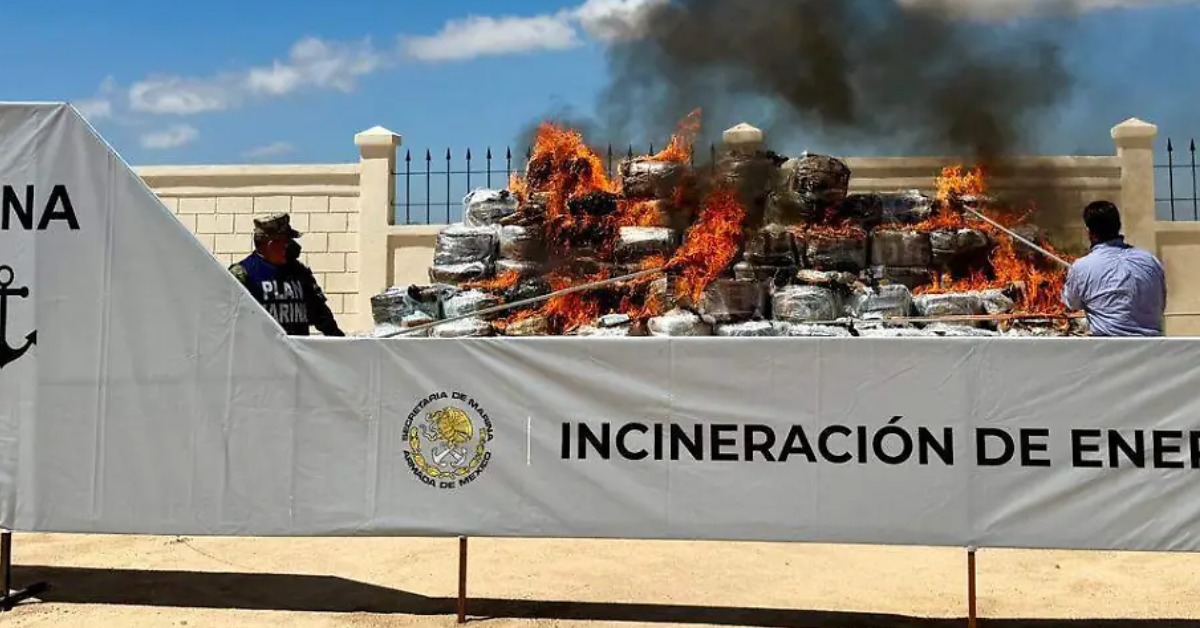
Federal authorities incinerated more than 4.4 tons of cocaine at naval facilities in Cabo San Lucas, saying the drugs represented about 9 million doses removed from the illegal market.
The destruction took place on Thursday, April 23, at the Marine Infantry Battalion facilities in Los Cabos. The operation involved the Secretaría de Marina, the Armada de México, the Fiscalía General de la República, federal prosecutors, state officials, municipal representatives, and members of the regional peace-building security table.
Authorities said the destroyed shipment totaled 4,495 kilograms of cocaine. Officials described the event as part of the formal process used in Mexico to eliminate seized narcotics after they are secured, documented, tested, and authorized for destruction.
Why the Los Cabos burn matters
For many residents, the public image of a drug seizure is the moment authorities announce an arrest or show packages recovered from a boat, vehicle, or warehouse. The Los Cabos burn shows the next step in that process.
Large drug seizures do not simply disappear after an operation. They become evidence. They must be weighed, secured, tested, and held under chain-of-custody rules. Once legal requirements are met, authorities can move the drugs to a controlled destruction process.
In this case, the amount was large enough to require a coordinated federal event. The cocaine was placed in a designated area at the naval facility before it was destroyed. Personnel from the Fiscalía General de la República certified the substance before the burn.
Officials said the drug was tested with cobalt thiocyanate, a chemical reagent commonly used in preliminary cocaine identification. The test produces a blue reaction when it comes into contact with compounds associated with cocaine.
The seizure behind the burn
The cocaine destroyed in Los Cabos was linked to a prior maritime seizure in the Pacific. Federal and local reports said the original seizure involved a vessel detected off the coast of Baja California Sur during maritime and aerial patrols.
Security officials reported that a small boat with three outboard motors was identified about 56 nautical miles southeast of Cabo San Lucas. Four people were on board. Authorities said the vessel made evasive movements when naval personnel approached.
After an inspection, federal forces reported finding 150 bundles, each containing 30 packages with a white powder believed to be cocaine. Fuel was also seized, including containers and a larger tank with hydrocarbons.
The March 2025 seizure was reported as one of several major maritime operations carried out by Mexico’s Navy along Pacific trafficking routes. The route matters because Baja California Sur sits near open-water corridors used by vessels moving north through the Pacific.
What happens during a drug incineration
A drug incineration is not meant to be a symbolic event. It is a legal and administrative step in a criminal investigation.
Before destruction, authorities must confirm what is being destroyed. That process normally includes documentation, weighing, representative sampling, and chemical verification. Federal prosecutors and oversight personnel are present to reduce the risk of substitution, loss, or diversion.
The goal is to make sure seized drugs cannot return to the illegal market. This is especially important with large shipments, where storage creates security risks. Each stage must be recorded so the criminal case can continue without the full shipment remaining in physical custody.
In Los Cabos, authorities said the destruction guaranteed the final elimination of the cocaine and prevented its possible reentry into criminal activity.
A Pacific route issue, not just a local story
Although the burn happened in Los Cabos, the case is part of a larger maritime security issue. Mexico’s Pacific coast is a key corridor for drug trafficking because it offers long distances, remote waters, and access to routes that connect South America, Central America, and North America.
Traffickers use different types of vessels, including small boats, fishing-style boats, and semi-submersibles. Many carry extra fuel because they are designed for long movements at sea. That detail matters because fuel seizures often appear alongside large cocaine seizures.
For foreign residents in Mexico, the story is not about daily life in tourist areas. It is about the scale of trafficking routes that pass through Mexican territory and waters. Los Cabos remains a major tourism destination, but Baja California Sur is also positioned along a maritime corridor that federal authorities continue to monitor.
Why authorities count doses
Officials often translate drug weight into estimated doses to explain the public-health impact of a seizure. In this case, authorities said the 4,495 kilograms represented about 9 million doses.
That estimate is not the same as a street-value calculation. It is a way to describe how much product could have reached consumers if the shipment had continued through the trafficking chain.
The number also helps explain why large cocaine seizures receive federal attention. A single maritime operation can involve tons of drugs, several suspects, multiple agencies, and a criminal investigation that continues long after the initial arrest.
The broader security message
The Los Cabos burn fits into Mexico’s broader strategy of using naval patrols, intelligence, and interagency operations to intercept maritime shipments before they reach land routes.
The Navy has played a central role in those efforts because many large seizures happen offshore. Once drugs are brought to land, federal prosecutors and other agencies take over the legal process.
Authorities presented the burn as part of ongoing operations against organized crime. The practical result was the destruction of a large cocaine shipment that had already been removed from circulation.
For residents, the main takeaway is straightforward. The April 23 burn was not a new street-level incident in Los Cabos. It was the final disposal of a large maritime seizure tied to Pacific trafficking routes and handled through federal procedures.