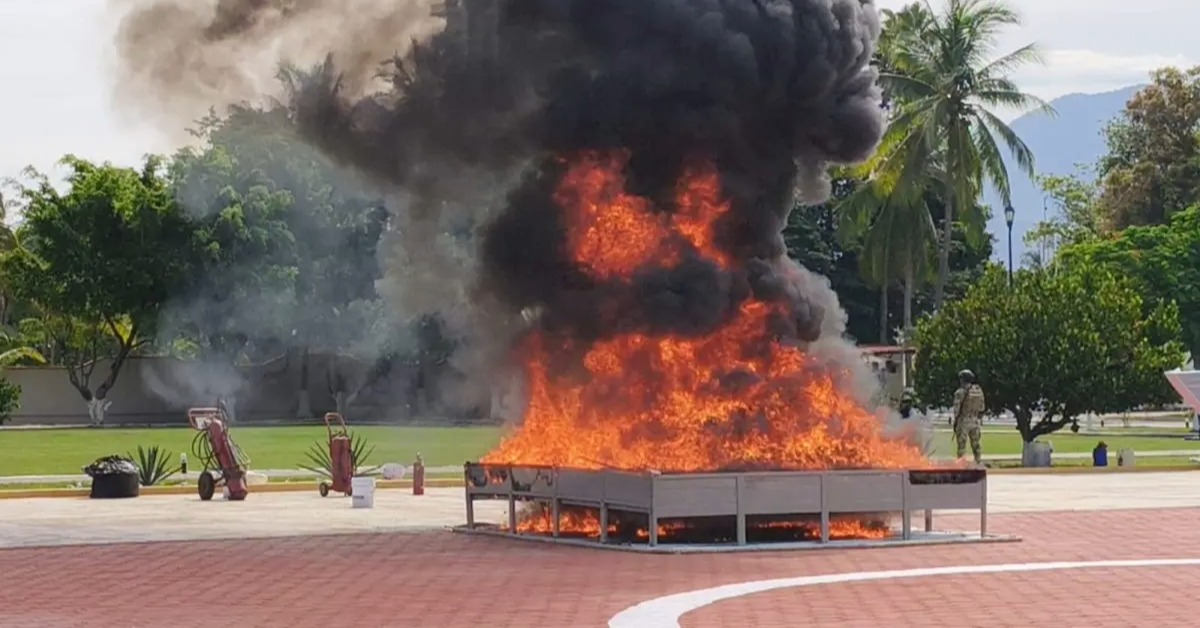
Puerto Vallarta, Jalisco – The large column of black smoke seen Friday morning over the Naval Zone in Puerto Vallarta came from the controlled incineration of more than one and a half tons of cocaine hydrochloride seized last May in national waters off the coast of Jalisco. The destruction was presented by federal and state authorities as a direct strike against organized crime and a measure to safeguard public health.
Puerto Vallarta cocaine incineration was carried out at Navy facilities in the city with officials from all three levels of government in attendance, including the state governor and representatives of the Attorney General’s Office (FGR). The Specialized Regional Control Prosecutor’s Office (FECOR) confirmed the drugs had been tied to an investigation into crimes against public health. Forensic photography and chemistry experts were on site to verify and document the procedure, ensuring chain-of-custody protocols and the integrity of the destruction.
Cocaine seized in May
The cocaine had been seized in late May during a maritime operation conducted by members of the Mexican Navy near the municipality of Puerto Vallarta. The shipment, consisting of more than 1,500 kilograms of cocaine hydrochloride, was intercepted in national waters off Jalisco as part of broader surveillance and interdiction efforts. The seizure was then turned over to the FGR for analysis and integration into active investigation files.
Officials emphasized that the incineration eliminated the possibility of the drugs re-entering the market. The Attorney General’s Office calculated that destroying the haul prevented the production and distribution of over 22 million doses, delivering a significant blow to criminal groups operating in the region. That scale of loss undercuts trafficking networks’ revenues and their capacity to fuel addiction and violence tied to drug distribution.
Public demonstration of interagency coordination
The ceremony also served as a public demonstration of interagency coordination. Authorities framed the destruction not only as evidence of enforcement success but as part of a sustained effort to disrupt the supply chains that underlie organized crime in western Mexico. By making the incineration a visible, verified event, officials sought to reinforce public trust in the justice system’s handling of high-risk contraband and the transparency of its procedures.
Local security officials noted that such maritime interceptions and follow-up actions are key components of a layered strategy to keep illicit narcotics from reaching towns and cities. The Navy’s role in detection and interdiction was complemented by the prosecutorial work of the FGR and the forensic confirmation required to move cases toward prosecution. The destruction also removes a common vector for corruption or diversion—seized drugs held in storage—by ensuring they are permanently removed from circulation under tight supervision.
More than 1.5 tons of cocaine
Observers in public safety circles pointed to the volume of drugs involved—more than 1.5 tons of cocaine—as a reminder of the scale at which trafficking organizations attempt to move product through Mexican waters. Incineration of this magnitude, conducted publicly and with technical oversight, sends a signal to those networks and to the communities affected by their operations that seizures do not end on boats or in storage rooms but culminate in complete destruction.
Residents in and around the Naval Zone reported seeing the plume of smoke and taking notice of the heightened security presence. Authorities encouraged the public to remain vigilant and to report suspicious activity that could aid ongoing investigations. The FGR continues to pursue related leads in the broader probe into crimes against public health, seeking to identify and hold accountable those involved in the trafficking chain that began with the maritime shipment.
The public display of the incineration underscores the government’s dual message: that it can intercept large-scale drug shipments and that it will follow through to ensure the seized substances cannot harm communities. As investigations progress, officials indicated more operations and judicial actions are expected in the effort to dismantle the networks tied to this and similar seizures.