Let’s start with the corner I would treat most carefully: Avenida Los Tules at Jesús Rodríguez Barba.
The latest public complaint I could verify, published July 25, said the traffic signals had been out for more than four months. Drivers described congestion, disorderly crossings and a growing risk of a serious crash. VallartaDaily documented the same signal and lighting failures in June.
I found no later published confirmation that the lights were repaired, nor any municipal timetable for restoring them. That does not prove they remain dark this morning, but it does mean residents have been left without accessible public follow-through.
Until you can see the signals operating, approach that junction slowly and do not assume cross traffic has been stopped. Make eye contact, leave room and resist the temptation to follow the vehicle ahead into the intersection.
A citywide upgrade has not answered the Fluvial problem
Puerto Vallarta’s Cabildo approved a MXN 14 million first phase of traffic-signal modernization in January. That initial work was directed toward Avenida México, while officials estimated that a fully integrated citywide system could eventually cost up to MXN 200 million.
The Los Tules–Jesús Rodríguez Barba junction was not publicly identified as part of that first phase. For Fluvial residents, the immediate question is therefore much smaller than a MXN 200 million modernization plan: Who is responsible for this particular repair, and when will it be completed?
Road safety also has a painful human context at Fluvial’s western entrance. On August 3, the city presented a monthly educational grant to the son of Clarisa Rodríguez, who died following the January 12 collision at Francisco Medina Ascencio and Fluvial Vallarta. The criminal case remains under investigation.
Rain is exposing the usual weak spots
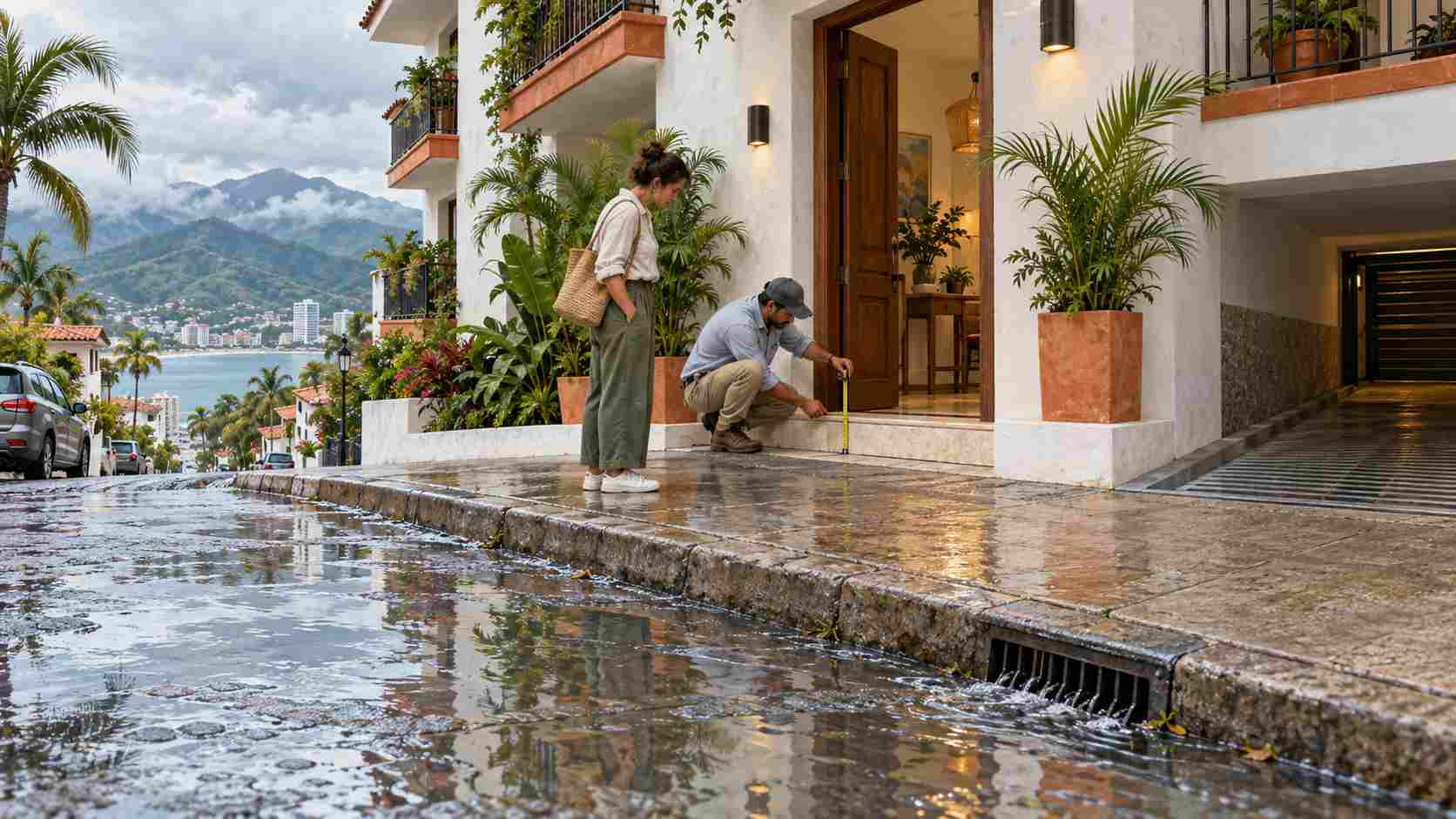
A nearly three-hour storm on July 28 left slow traffic and waterlogged sections in Fluvial, with some motorists forced to divert. Another strong storm produced significant ponding around Puerto Vallarta on August 3, although that report did not identify a specific Fluvial street.
After sustained rain, give yourself extra time and do not drive into water when you cannot judge its depth or see the pavement. Fluvial’s wide streets can create a false sense that every route will remain passable.
Crews had already been removing trash, sand, and debris from the channel running toward Francisco Medina Ascencio before the peak of the rainy season. Continued ponding tells us that drain and canal maintenance cannot be treated as a one-day cleanup.
Fluvial was also among the 139 neighborhoods affected by the July 24–26 water interruption connected to emergency work near the Puerto Vallarta–Las Varas highway. Service returned gradually, and there is no current outage alert. Still, it is a useful reminder to check your cistern, float valve, and pump before the next interruption exposes a problem.
SEAPAL receives reports through 073 and WhatsApp at 322 105 8226. Its Fluvial service office is inside UNIRSE at Grandes Lagos 236, open Monday through Friday from 8:00 a.m. to 3:30 p.m.
Grandes Lagos is carrying Fluvial’s next wave of growth
The most consequential neighborhood change may be the private CMQ hospital under construction on Avenida Grandes Lagos. CMQ says the project will have more than 40 hospital beds.
Better access to medical care is welcome. A project of this size will also bring ambulance movements, deliveries, staff vehicles, visitors, and additional demand for curb space. Fluvial should not have to wait until opening day to learn how that traffic and parking will be managed.
Residents also raised questions in May about the continuous discharge of groundwater from the construction site. They asked authorities to clarify the permits, technical studies and mitigation measures behind the work. I could not find a subsequent published municipal response. That remains an open accountability question, not proof that the work is unauthorized.
Residential construction is moving at the same time. The developer of MCS Fluvial posted a July construction update for its project at Carlos Jongitud Barrios 288. It is being marketed as a seven-level development with 42 residences.
One building does not transform a neighborhood. A residential tower, new hospital and additional commercial development arriving together can. Their cumulative effect will be felt in parking, delivery traffic, construction noise and pressure on already unreliable infrastructure.
That commercial pressure became visible when authorities permitted the removal of a mature ficus on Grandes Lagos for a planned plaza. The tree was estimated to be between 60 and 80 years old. According to the municipal explanation, the final justification was that the plaza’s architecture could not be adapted around it.
The developer was required to pay a fee and provide replacement trees, but the publicly reported information did not specify how many trees, where they would be planted, or how their survival would be monitored. That is the part worth watching now. The original tree is gone; the remaining promise can still be measured.
One confirmed opening and one request for readers
On the lighter side, Natisa Macaron & Bakery announced the opening of a new Fluvial branch and production center at Grandes Lagos 235, Local 5, in mid-June. It is one confirmed addition to the neighborhood’s growing mix of locally oriented businesses.
For the next Fluvial Vallarta neighborhood report, I would especially like a current photo of the Los Tules signals, taken safely while you are stopped or standing off the roadway. Please include the date, approximate time, and direction you were traveling.
The same applies to streetlights that remain dark, sidewalks blocked by construction, chronic double-parking, replacement trees connected to the Grandes Lagos plaza, or a business that has opened or quietly disappeared. You can share those details through our Puerto Vallarta news-tip community.
If the Los Tules lights are finally operating, I will be happy to strike them from the next report. If they are not, we will keep the public record open. Fluvial does not need another glossy description; it needs a running account of what was promised, what was fixed, and what residents are still being asked to tolerate.