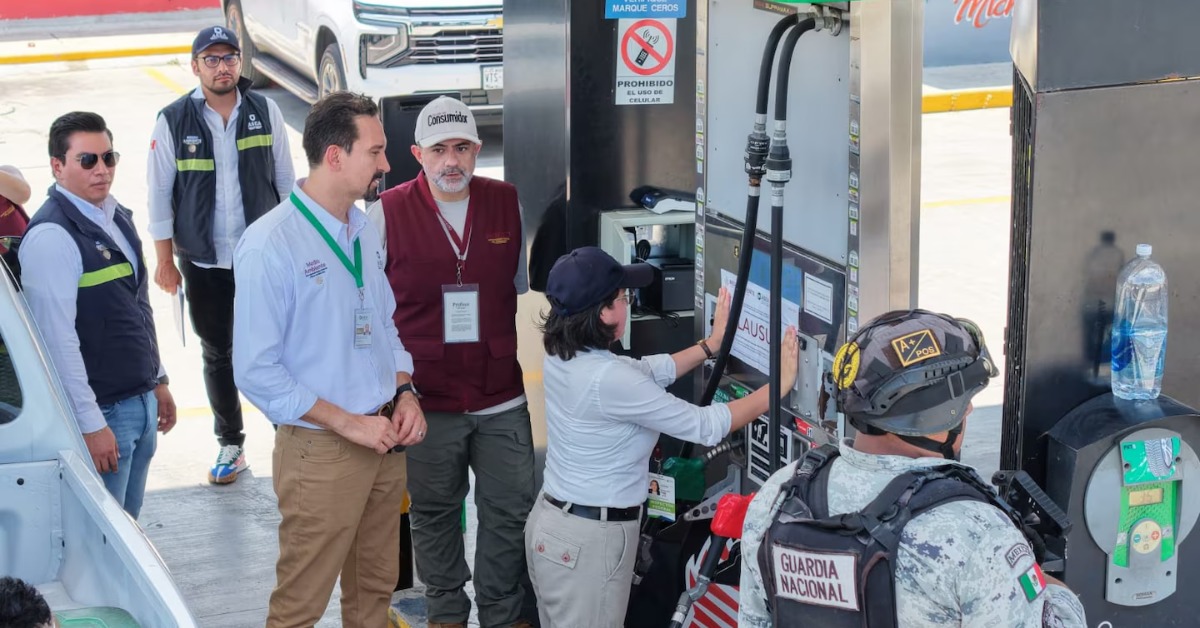
Puerto Vallarta, Jalisco – On August 1, 2025, the Federal Consumer Protection Agency (Profeco) and the Agency for Safety, Energy and Environment (ASEA) closed 12 gas stations in Puerto Vallarta and Bahía de Banderas during a verification operation. The action, part of a national strategy to stabilize fuel pricing and protect buyers, also included the immobilization of 20 measuring devices. At least one station was reported to the Attorney General’s Office (FGR) for dispensing short liters of fuel.
Gas stations shut down in Jalisco and Nayarit
In Puerto Vallarta, Jalisco, inspectors visited six stations: Servicio Las Mojoneras, Servicio Las Juntas, Servicios Gasoro, Gasolinera Los Vecinos, Combustibles De la Bahía, and one operating under the business name Alfonso Cobián Ramírez. Authorities immobilized 13 measuring instruments and imposed temporary closures because none of the stations had a current Environmental Impact Statement (MIA) on file.
In Bahía de Banderas, Nayarit, the same day, six additional stations were examined: Energía de la Bahía, Autoexpress GSM, Grupo Gasolinero Samara, Operadora Construrent, Grupo Octano, and Oh My Gas. Seven instruments were immobilized there, including one flagged for delivering short liters of fuel—which led to a formal complaint to the FGR. All six were also temporarily closed for failing to present valid environmental permits.
The inspections were led by Iván Escalante Ruiz, head of Profeco, and Armando Ocampo Zambrano of ASEA, under the “Extraordinary Verification Operation” tied to the national strategy aimed at giving consumers confidence and cracking down on irregular practices at service stations.
What the operation means and the national context
The interventions in Jalisco and Nayarit are part of a broader campaign. So far, authorities have carried out at least 20 operations across 19 states, inspecting 120 gas stations, issuing 110 closures, immobilizing 629 measuring devices, and filing 36 complaints with the FGR for short liters. These figures reflect an ongoing emphasis on both measurement accuracy and environmental compliance.
Lapses in valid environmental impact authorizations remain a frequent cause for shutdowns. Previous operations have seen stations closed for missing required environmental documentation or for operating without proper certification, underscoring the dual focus: ensuring consumers get the quantity they pay for and that stations meet ecological standards.
Cases of short liters trigger not only administrative immobilization and closure but also activate legal pathways. When fuel dispensers are found underdelivering, complaints are elevated to the FGR, which can open criminal investigations if intentional or systemic undersupply is confirmed.
Consumer impact and official stance
Closing stations in tourist-heavy zones like Puerto Vallarta and Bahía de Banderas creates concern among drivers and businesses that rely on steady mobility, especially during peak seasons. Authorities, however, frame the shutdowns as preventive steps to protect buyers and restore transparency in a critical part of daily commerce.
Profeco has emphasized that the operations are meant to prevent short-term gains from undermining public trust. Immobilized measuring devices remain out of service until they pass recalibration and compliance checks, while environmental-related closures aim to halt unregulated ecological impacts.
Next steps for affected stations
The closed gas stations must correct their deficiencies—either by renewing environmental authorizations or fixing and revalidating measuring equipment—before they can apply for reopening. In cases involving short liters, the FGR complaint may lead to deeper probes and possible additional sanctions. Authorities have warned that operations will continue, with follow-up inspections to ensure no irregular reopening or repeat violations.
Public commitment from authorities
Profeco and ASEA reiterated that verification is ongoing and closures are part of a sustained oversight regime. Their message to service stations is clear: adherence to environmental rules and delivery accuracy is mandatory, and noncompliance will carry both administrative and legal consequences.
The operation in Jalisco and Nayarit, with the gas stations shut down in Jalisco and Nayarit, reinforces the federal government’s push to safeguard fuel consumers by targeting both environmental lapses and shortchanging practices. The closures and formal complaints are intended to signal that oversight is active and only stations that meet legal standards will be allowed to operate normally.