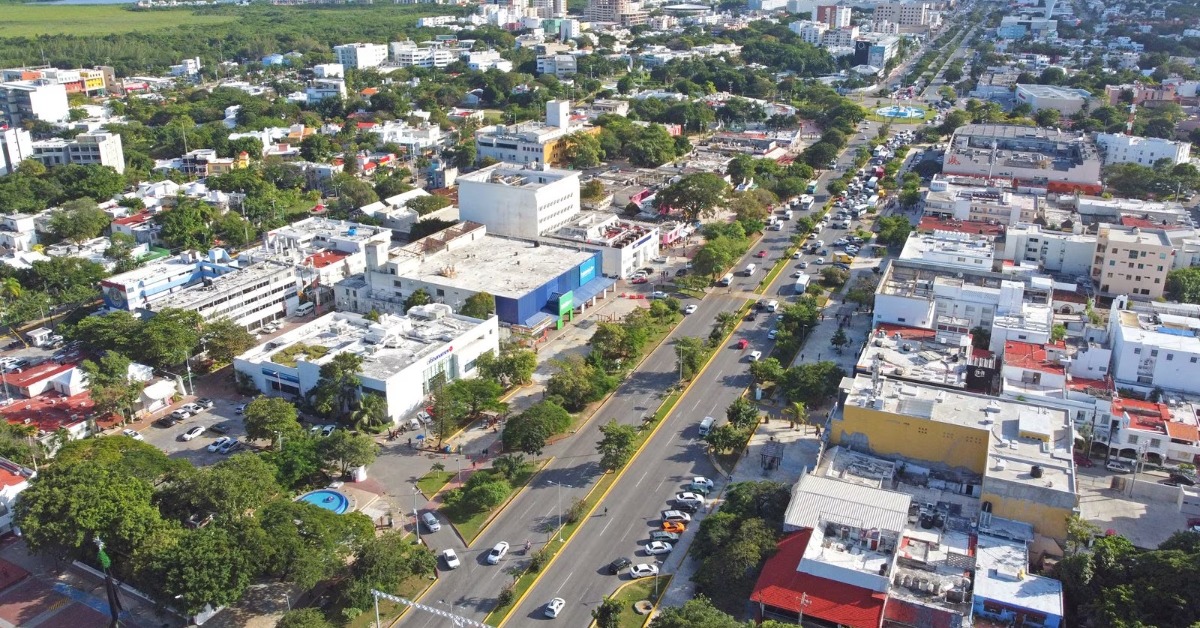
Cancún, QR – What was once a mixed-use, residential core in Cancún has shifted sharply in the last two years. Gentrification in Cancún city center is no longer a distant warning; it is a lived reality for residents facing rising rents, disappearing long-term housing, and an influx of foreign buyers who view local property prices as bargains compared to their home markets. The result: entire homes converted into commercial fronts or short-term vacation rentals, and long-term residents increasingly edged out.
Cristian Guillermo Hernández Rendón, president of the Quintana Roo College of Appraisers, said the pressure has intensified recently, with tourism-driven demand changing the very character of the city’s heart. “The center has ceased to be a residential area and has become almost a commercial area,” he noted, describing how whole houses are repurposed into shops or Airbnb-style accommodations, bringing a constant flow of pedestrians that diminishes appeal for those who want to live there full time.
The economic shifts are stark
In some parts of downtown Cancún, rents have climbed between 10% and 20%, while property values in high-demand corridors—especially those with easier access to beaches or tourist draws—have seen increases up to 30%. These shifts are not isolated; they reflect a pattern where infrastructure, investor interest, and the premium placed on proximity to tourism amenities compound into rapid value escalation.
Foreign buyers are a central force in this dynamic. Their purchasing power, amplified by favorable currency comparisons and the ability to deploy capital that outpaces many local buyers, gives them an outsized influence on what is considered “affordable.” Properties that seem attainable by Cancún standards often appear to them as relative bargains compared to prices in their home countries. That mismatch deepens the wedge between long-term residents and external investment.
At the same time, neighborhoods on the periphery of the core—such as Colosio and Huayacán—are experiencing a shift in development priorities. Vertical projects and mid- to upper-market residential construction are replacing what historically might have included social interest housing. Developers are increasingly steering away from programs aimed at affordability, instead chasing higher returns from stacked, market-oriented builds that appeal to investors or short-term occupants.
The transformation is not limited to Cancún
Just over an hour’s drive south, Tulum displays a more acute version of the tension between speculative real estate and grounded ownership. There, a surge of “blind transactions”—where foreign buyers purchase properties based only on digital renderings or plans without ever seeing the actual land—has amplified risk and uncertainty in the market. These deals often occur in early phases of development and have led to cases in which promised projects never materialize, leaving buyers stranded, and contributing to a broader erosion of trust in the system.
The fallout in Tulum has been severe enough to draw national and international scrutiny. A Bloomberg investigation detailed a cascade of failed developments, missing titles, unfinished promises and even deaths tied to the collapse of high-profile speculative projects. Foreign investors, lured by the prospect of luxury coastal homes and fast appreciation, have found themselves locked into pre-sales that never delivered, with few legal avenues moving swiftly enough to resolve their losses.
Back in Cancún, the consequences extend beyond individual transactions. Longer-term residents report a fraying of community cohesion as the built environment shifts toward transient uses. Traditional neighborhoods feel less stable. Local commerce is increasingly tailored to visitors rather than residents. The pressure is not just economic—it is cultural, altering the texture of daily life in spaces that used to be anchored by long-term families and local routines.
The growing gap between investor-driven development and housing needs has led to a paradox: while prices surge and certain segments of the market boom, broader investment sentiment shows signs of cooling. Some local real estate professionals have noted decreased new capital inflows even as prices rise, suggesting that affordability limits and broader economic uncertainty could eventually blunt the current acceleration—though not before existing displacement effects deepen.
Gentrification in Cancún city center
Local advocates and housing observers are watching closely. If the current trajectory holds, the downtown core risks becoming a zone optimized for short-term consumption and external ownership, rather than a place where a diverse urban population can live, work, and build long-term roots. The challenge for municipal leadership and planners will be balancing tourism and investment with housing stability—something that, so far, gentrification in Cancún city center has done little to assure.
Residents and some public officials are beginning to talk about policy responses, from zoning adjustments to incentives for keeping properties in stable residential use. Whether those efforts can catch up to market momentum remains uncertain. In Tulum, calls for greater transparency, due diligence requirements for foreign buyers, and stronger regulation of pre-sale marketing aim to prevent future “blind” losses and restore confidence.
For now, the visible signs are clear: gentrification in Cancún city center is reshaping who can afford to live there, and in nearby Tulum, risky speculative practices are widening fractures in an already overheated real estate market. The coming months will show whether the region can temper displacement while still capturing the economic benefits tourism brings—or if the current imbalance hardens into lasting exclusion.
gentrification, Cancún real estate, Tulum property fraud, foreign buyers, housing displacement