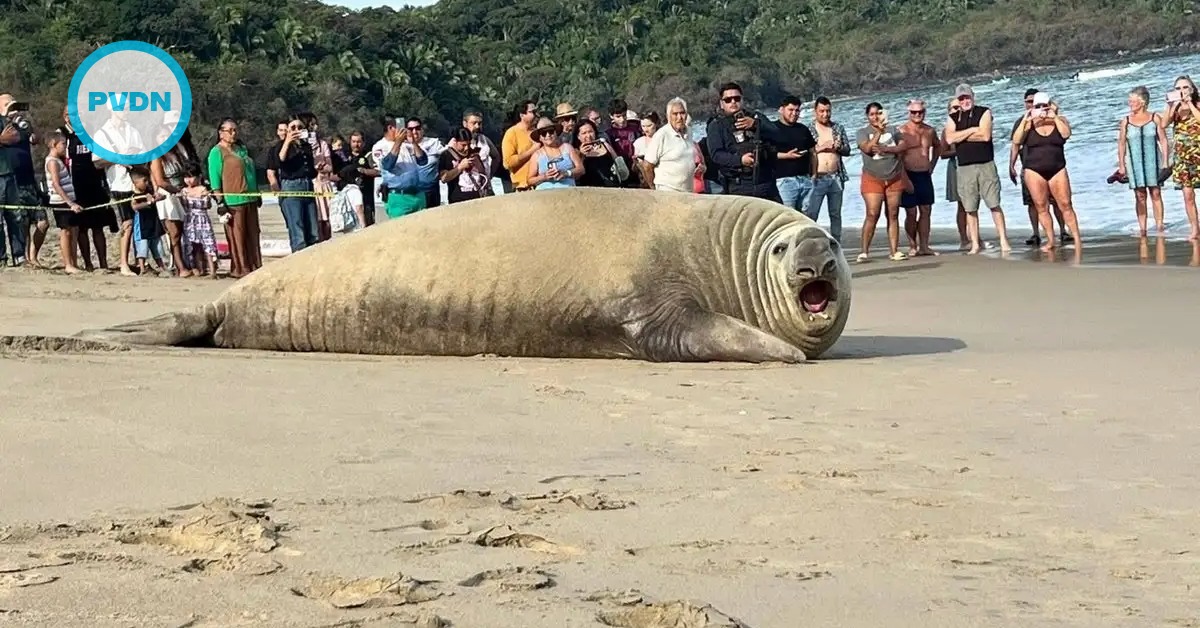
Beachgoers in a quiet Nayarit cove got an unexpected visitor Tuesday: a massive elephant seal stretched out on the sand. Two days earlier, the same animal had surfaced farther north near San Blas, then slipped back into the Pacific. Now it was back—about 100 kilometers away—drawing cameras, curious kids, and a fast response from authorities. For now, it looks calm, almost sunbathing. Why is it roaming these warmer waters, and what happens next if it stays?
A surprise haul-out in Los Ayala
On Tuesday morning, January 27, a huge elephant seal hauled itself onto Los Ayala beach in Compostela, Nayarit. The animal’s size stopped people in their tracks. Swimmers pointed from the water. Families gathered at the edge of the sand, phones raised, trying to make sense of what they were seeing. Elephant seals are built for the open ocean, not crowded shorelines. This one looked like it belonged in a nature documentary. Los Ayala is a small cove near Rincón de Guayabitos. It’s roughly an hour north of Puerto Vallarta. It’s better known for calm waves and weekend sun. That contrast made the moment feel surreal. By late morning, word had spread beyond the palapas and beach chairs, and the crowd thickened. Some visitors edged closer for a better shot. Others hung back, uneasy about how a wild animal might react. The mood stayed upbeat overall. But the question was obvious: who would make sure the seal could rest quietly and safely?
Protocols activated on the beach
Not long after the sighting, responders arrived and began treating the beach like a controlled scene. Firefighters and municipal Civil Protection staff moved first. Federal environmental inspectors from Profepa followed. Together, they set up a perimeter and activated protocols for handling marine mammals that come ashore. State security and emergency personnel helped manage onlookers. The goal was simple: protect the animal and prevent an accident. Officials asked beachgoers to keep their distance and avoid touching or feeding it. Even when a seal looks sleepy, it can move fast. Stress can also push it back into the water too soon. Authorities also began a visual health check. They looked for wounds, fishing-gear marks, or signs of illness. Early reports described the seal as alert and without visible injuries. Officials said they would keep watch and decide if any relocation is needed. For now, the plan is to monitor. The hope is that it rests, then returns to sea on its own.
Two beaches, one wandering seal
The Los Ayala appearance was not the seal’s first stop. On Sunday, January 25, it was seen farther north on Miramar’s beaches in San Blas. People also reported it near Santa Cruz de Miramar and Potrerillos. Responders said it looked healthy. They did not see obvious injuries or signs of disease. Minutes later, it returned to the Pacific. Two days later, it surfaced again in Compostela, roughly 100 kilometers away. That quick jump along the Nayarit coast fueled a familiar mix of theories. Was it disoriented, exhausted, or simply taking breaks as it moved? Whatever the reason, the pattern fits a basic truth about elephant seals. They spend most of their lives at sea. But they do come ashore when they need to rest. When that happens on a popular beach, the challenge is keeping the encounter safe. It also means giving the animal time to decide its next move.
A familiar traveler and what happens next
To many longtime residents, the story has a familiar name: Panchito. Marine monitoring groups have used photo identification since 2020. They track a recurring elephant seal that turns up on Mexican beaches, then vanishes for months. Some specialists describe that visitor as a southern elephant seal. That species is normally tied to colder Southern Hemisphere waters. The idea sounds impossible at first. Then you remember what these animals do best: travel. The best-known individual is estimated to weigh hundreds of kilos. In past years, sightings have been logged from Nayarit up to Baja California. Elephant seals are built for long migrations and deep dives. Some “vagrants” end up far outside the usual range. That context matters because a seal on the sand is not automatically sick or stranded. Resting, cooling off, and even shedding skin and fur can be normal. Still, every unexpected haul-out is treated cautiously. Illness, entanglement, or fatigue can look subtle from a distance.
Officials say the best help the public can offer is restraint. Give the seal a wide buffer. Keep kids and pets back. Resist the urge to “guide” it toward the water. Pushing a resting animal into the surf can cause panic. It can also shorten the recovery time it requires. Under the national protocol for marine-mammal strandings, Profepa coordinates the response with local and state agencies. Together, they decide whether the animal can be left to rest or needs intervention. In cases like Los Ayala, the most common outcome is also the simplest. The seal rests for hours, sometimes longer, then returns to the sea on its own. Until that moment, the cordon and the watch will likely remain in place. For anyone living along Mexico’s Pacific coast, the sight is a reminder. Wildlife does not recognize municipal boundaries. A little distance is often the most humane response in moments like this.
With information from La Jornada, Milenio, Infobae, Secretaría de Seguridad y Protección, PROFEPA