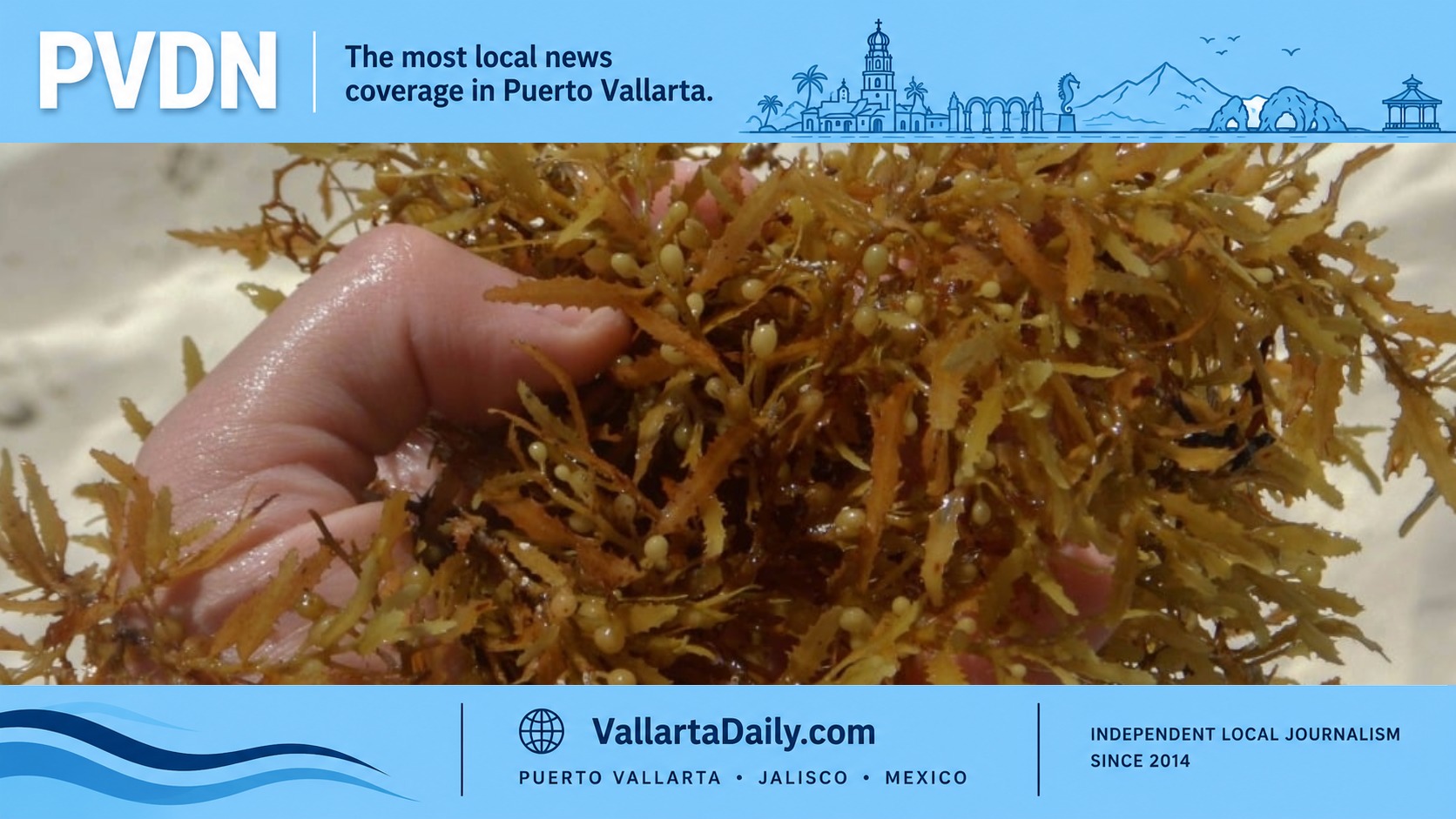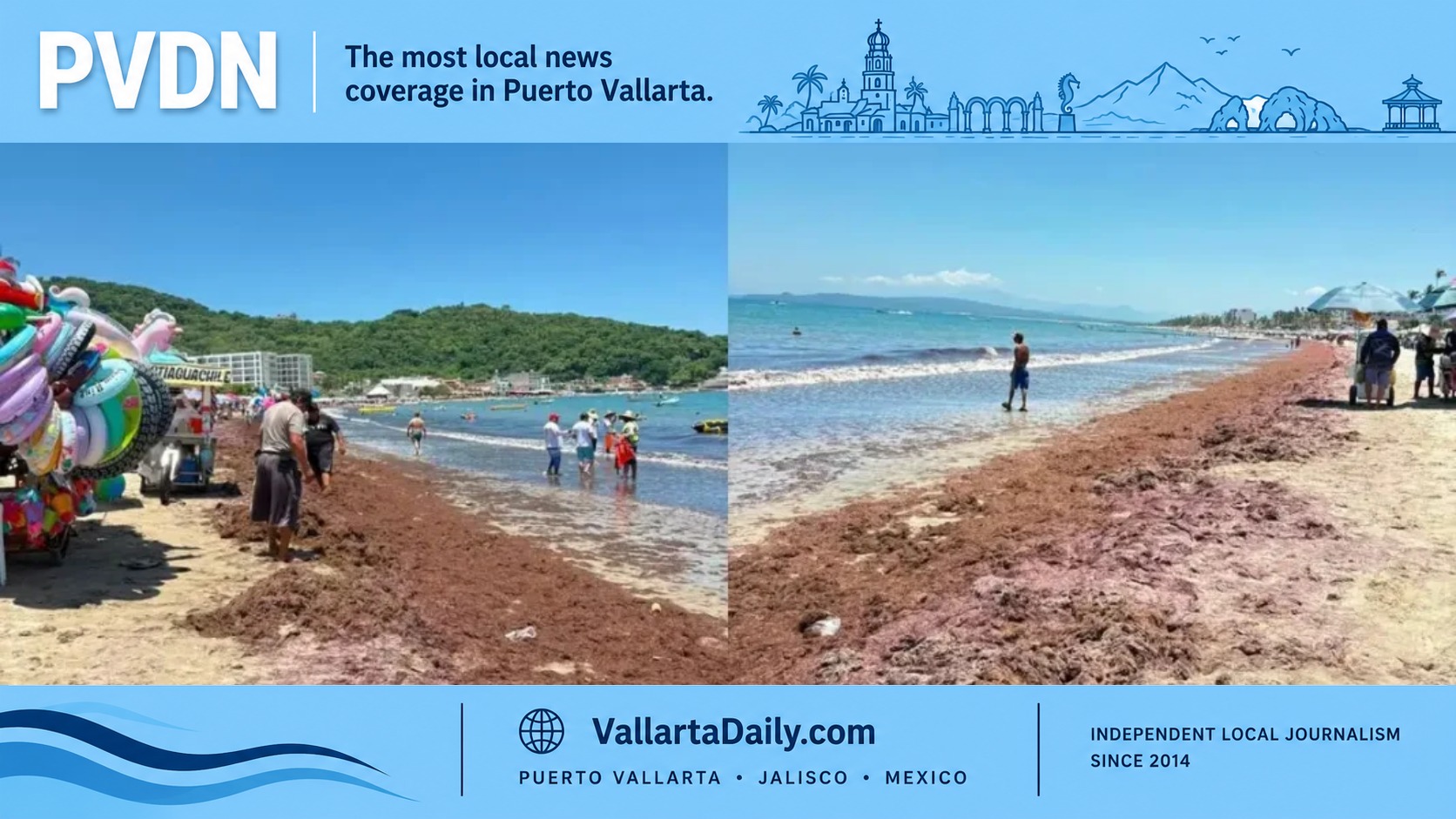
Rincón de Guayabitos, Nayarit, July 13, 2026 – A heavy accumulation of brown algae, locally known as sargassum, covered sections of the beach at Rincón de Guayabitos over the weekend, prompting residents, boat operators, and tourism workers to head onto the sand to remove it during the opening days of the summer vacation period.
The algae had appeared in smaller quantities since the first week of July, but the buildup reported Sunday, July 12, was substantially larger. It initially concentrated near Hotel Los Cocos before spreading across a longer section of the Guayabitos shoreline.
Cleanup work began before the weekend and continued Sunday morning, with boat operators and other community members removing algae by hand. The Government of Compostela also organized a cleanup effort promoted by Mayor Gustavo Ayón.
The Guayabitos accumulation was not the first sargassum cleanup reported along the Nayarit coast this month.
On July 2, the Bahía de Banderas municipal government reported removing sargassum from Punta Esmeralda in the El Tizate area. Municipal personnel from several departments participated in that operation.
The two reports place visible accumulations in separate Nayarit municipalities within about 10 days, including one within Bahía de Banderas and significantly closer to Puerto Vallarta than to Guayabitos.
There is not yet enough information to determine whether the material collected at Punta Esmeralda and Guayabitos came from the same event, involved the same species, or was transported by the same combination of currents, wind, and wave action. Neither municipality published laboratory results or a technical assessment tracing its origin.
“Sargassum” refers to a broad group of brown algae rather than a single organism or a specific coastal event.
The vast accumulations affecting Cancún, Tulum and other Caribbean destinations are primarily associated with the free-floating species Sargassum natans and Sargassum fluitans. Mexico’s CONABIO sargassum monitoring program tracks those pelagic species in the Atlantic and Caribbean, where large floating mats are transported over considerable distances.
The Pacific coast has its own diverse communities of marine algae, including species that grow attached to rocks and other submerged surfaces before breaking away. A University of Guadalajara-led inventory of Jalisco’s coastline documented 263 macroalgae species and identified Puerto Vallarta as one of the better-represented areas in northern Jalisco.
That local biology was central to a warning PVDN published seven years ago.
In July 2019, PVDN reported concerns raised by university researchers after they examined photographs and video showing small patches of algae at Mismaloya. The researchers said the material seen around Puerto Vallarta was not necessarily the same drifting sargassum overwhelming the Caribbean.
They described algae growing locally on the seabed or rocks, breaking loose during the warmer season and reaching the shoreline. They also warned that excessive nutrients from polluted water could contribute to increased growth.
The article was ridiculed at the time, and PVDN was accused of publishing fake news because some readers believed sargassum could never become an issue on Mexico’s Pacific coast.
The new accumulations do not prove that Puerto Vallarta faces a Caribbean-style invasion, nor do they establish pollution as the cause of the material removed this month. They do, however, settle the narrower question behind much of the 2019 criticism: sargassum and other substantial brown-algae accumulations can occur along this coast.
Guayabitos also experienced a smaller appearance in 2021. At the time, a local hotel association representative described it as a natural event marking the beginning of the rainy season and said that tides normally carried the algae away. Residents quoted this weekend said they had not previously seen it in Sunday’s quantity.
The immediate problem is largely one of accumulation and decomposition. Sargassum in the water is part of a marine ecosystem, but thick piles left on the beach can begin to decay. UNAM researchers note that decomposing sargassum can release hydrogen sulfide, reduce oxygen in nearshore water, and produce strong odors.
No gas measurements, health advisories or reports of environmental damage have been issued for Guayabitos or Punta Esmeralda. The amounts documented in Nayarit also remain far below the enormous volumes routinely collected in Quintana Roo.