Puerto Vallarta, Jalisco, Sept. 4, 2026 — Travel agents are steering some Caribbean customers toward Pacific resorts, where Puerto Vallarta avoids Cancun-style sargassum but still has locally occurring seaweeds.
Jorge Hernández, president of the Federación Mexicana de Asociaciones Turísticas, estimated Mexican Caribbean arrivals were down 10% this year. An account published Sept. 1 quoted him saying, “Five percent of that 10% decline has been recovered by sending tourists to other beach destinations without sargassum, mainly Pacific beaches.” PVDN translated his remarks from Spanish.
A Sept. 2 Puerto Vallarta report added the city to those Pacific options. It described Banderas Bay as entirely free of sargassum. Our review found that wording works only as shorthand for the Caribbean mass-arrival problem.
What the distinction means locally
Puerto Vallarta does not receive the vast floating masses associated with Cancún, Tulum and other Caribbean destinations.
At a July 30 federal briefing, Environment Secretary Alicia Bárcena called 2026 an atypical Caribbean season. She said up to 90,538 metric tons could move through Mexican Caribbean waters daily during peak conditions. Federal officials estimated that about 10% reached Quintana Roo’s coast.
Mexico’s Navy monitoring system follows floating sargassum from the western central Atlantic into the Mexican Caribbean. Its coverage does not extend to Puerto Vallarta or Mexico’s Pacific beaches.
For visitors, this means there is no recurring Cancun-style sargassum season to plan around. Temporary seaweed, woody debris and cloudy runoff can still affect individual beaches.
Residents, beachfront businesses and public crews also face cleanup costs. Puerto Vallarta’s Dirección de Servicios Eficientes lists beach cleaning among its municipal duties.
Its July-September 2025 activity report recorded between 68.5 and 70.7 metric tons of beach trash monthly. It separately reported removing 69 to 81.9 metric tons of palizada, or woody storm debris, each month.
Municipal records sometimes use sargazo as an operational label for organic beach material. That wording is not a scientific identification of the algae being removed.
Sargassum is a genus, not one event
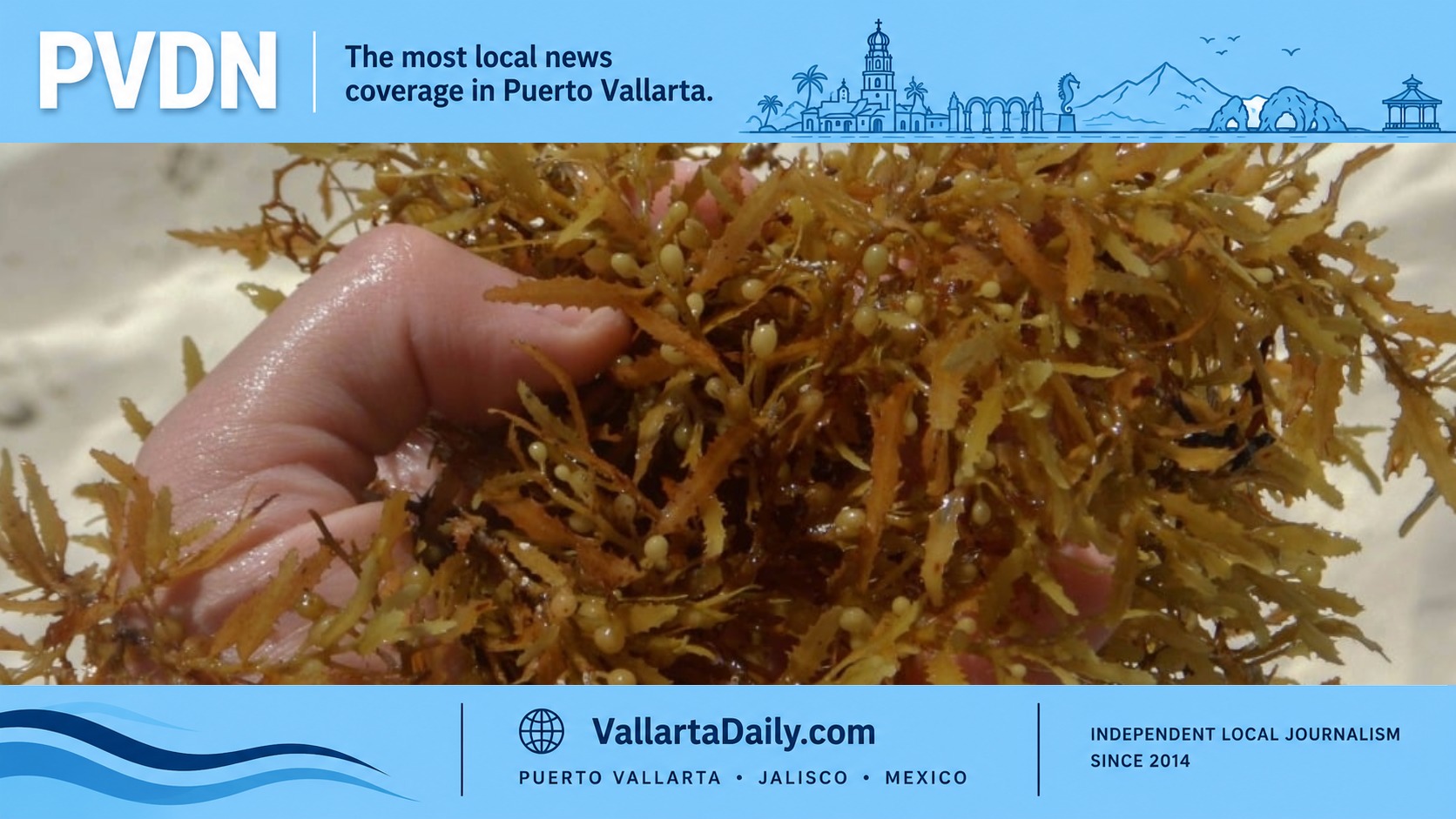
The word sargassum can refer to many species of brown macroalgae. It also has become shorthand for the Atlantic phenomenon affecting Caribbean tourism.
Mexico’s biodiversity commission, CONABIO, identifies the Caribbean masses primarily as Sargassum natans and Sargassum fluitans. These species float freely at the ocean surface rather than remaining attached to rocks.
Puerto Vallarta has locally occurring Sargassum of a different kind.
A peer-reviewed University of Guadalajara-led study documented wild populations of Sargassum liebmannii along Jalisco’s coast. Researchers collected specimens at Playa Los Muertos, Conchas Chinas and Garza Blanca during July and August 2019.
Those populations occupied subtidal areas with rocky or mixed substrates. Their growth varied with depth, wave exposure, and local habitat.
Calling Puerto Vallarta free of Caribbean-style sargassum is therefore supportable. Saying no Sargassum exists in local waters is not.
What actually washes onto Pacific beaches
Several kinds of material can appear along Puerto Vallarta’s shoreline.
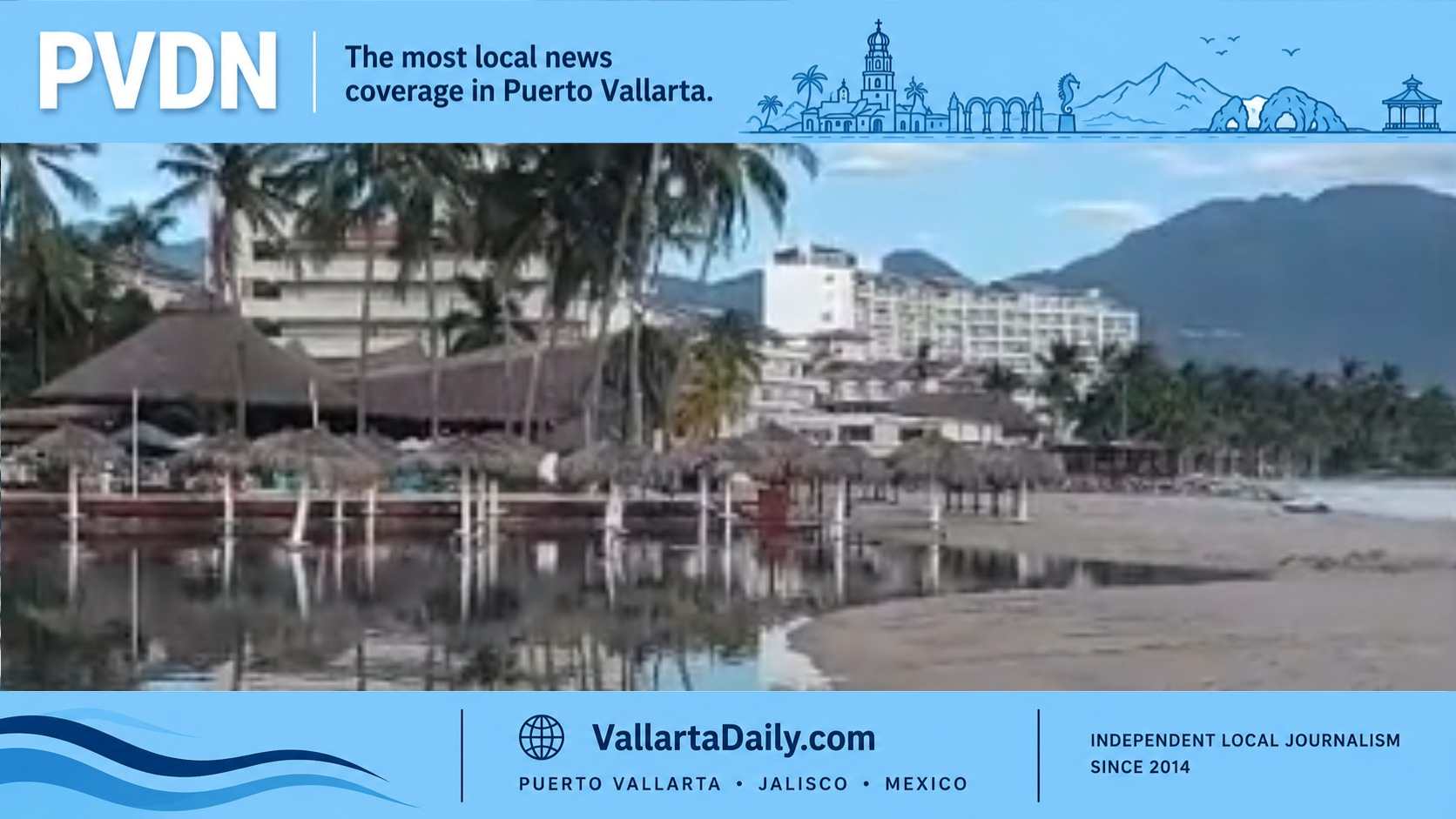
Local brown, red and green macroalgae can detach from reefs or rocky seabeds. Waves and currents may then carry the fragments into coves or onto sand.
A July 2026 case in Rincón de Guayabitos showed why identification matters. University of Nayarit specialists examined samples after photographs raised concerns about sargassum.
The researchers identified Hypnea, a red macroalga, rather than Sargassum. Guayabitos lies in Compostela, north of Banderas Bay, so the event was not a Puerto Vallarta stranding.
Rainy-season runoff produces another common type of beach material. Rivers and mountain streams carry branches, leaves, wood, sediment, and discarded plastic into Banderas Bay.
During an August cleanup at Islas Marietas, park director Areli Zuleth Cueto Valdivia said crews found more woody debris than plastic. She attributed much of it to rivers and streams, including the Río Ameca.
“Sometimes the current arrives, and today it is full of trash; the next day it wakes up clean, or the reverse,” Cueto said. PVDN translated her remarks from Spanish.
A reddish, brown, or green water column may be something else. A University of Guadalajara review found that microscopic phytoplankton blooms have produced several water colors in Banderas Bay.
Those blooms occur within the water. They are different from visible macroalgae piled on the sand.
When local seaweed is most likely to appear
Puerto Vallarta does not have a fixed Atlantic-style sargassum calendar.
Seasonal research presented by University of Guadalajara scientists found that Sargassum liebmannii generally begins developing in winter. It reaches maturity during spring and declines during summer.
The researchers sampled Jalisco locations, including Puerto Vallarta, across multiple seasons between 2004 and 2019. Their findings describe the plant’s growth cycle, not a guaranteed beach-stranding season.
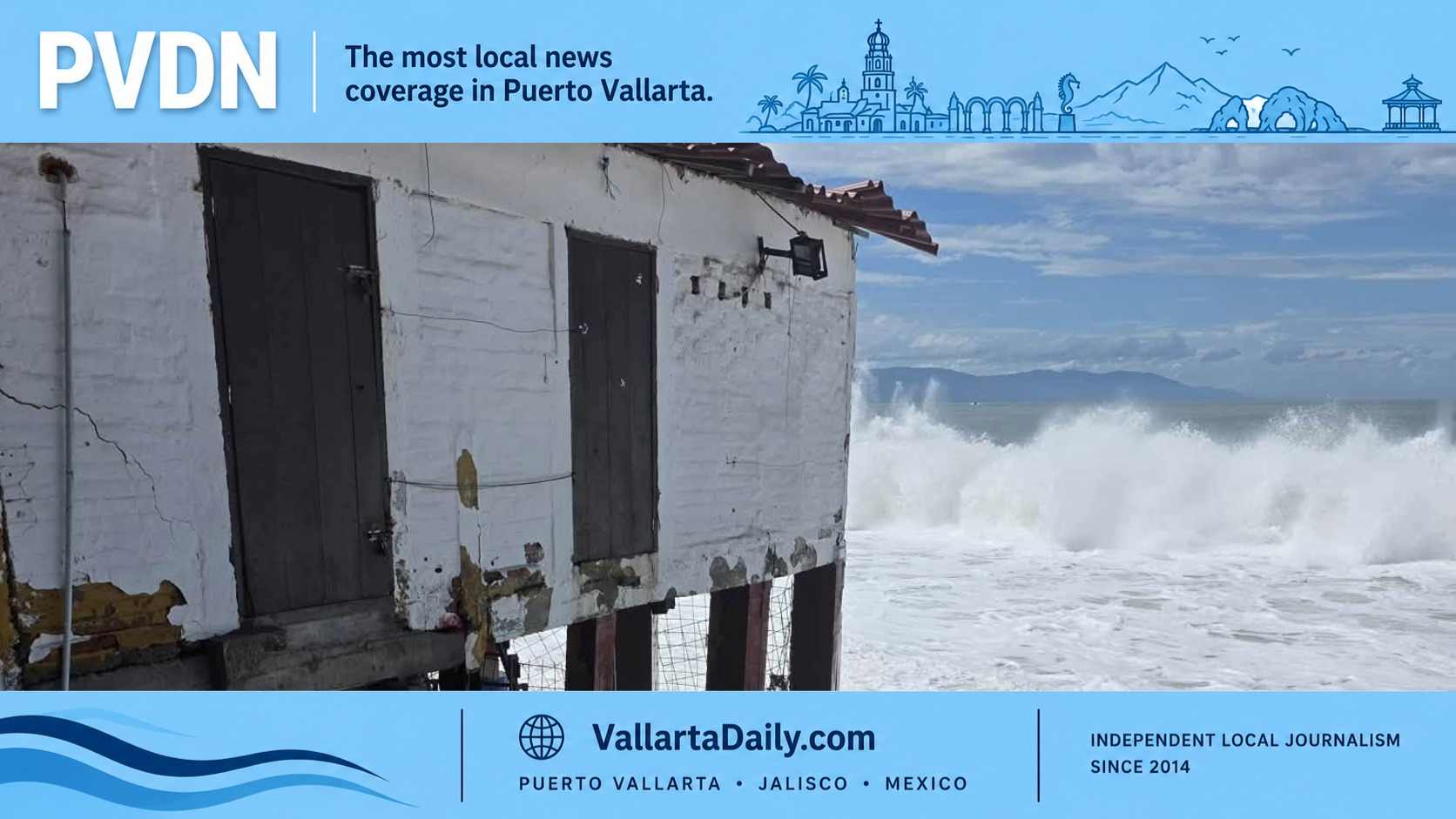
Swell, wind, and local currents determine whether detached material remains offshore or reaches a particular beach.
Banderas Bay’s circulation is also complex. A 2023 study found that the Mexican Coastal Current can separate near Cabo Corrientes and form eddies in front of the bay, particularly during summer. Those currents can redistribute floating local material without connecting Vallarta to the Atlantic sargassum belt.
Which Puerto Vallarta beaches are normally clearest
No municipal or federal agency publishes a permanent ranking of Puerto Vallarta beaches by seaweed or visual clarity.
A beach can also be clear of algae but cloudy with sediment. It can look clean while bacteria exceed health limits. These are separate conditions.
Immediately after heavy rain, runoff is more likely near major river mouths:
- The Río Cuale between Centro and Zona Romántica
- The Río Pitillal beside Playa Holi in the Hotel Zone
- The Río Ameca near Boca de Tomates and the Jalisco-Nayarit border
- The Río Los Horcones at Boca de Tomatlán
For travelers seeking clear-looking water, Palmares, Punta Negra and Las Gemelas are reasonable first checks after several calm, dry days. These beaches sit along Federal Highway 200, away from the Cuale, Pitillal and Ameca mouths.
They are not guaranteed to be free of seaweed. Rocky habitat, beach shape, and changing swell can concentrate natural wrack in any cove.
Conditions can also differ across a short distance. Playa Los Muertos near the Calle Francisca Rodríguez pier may look different from the sand closer to the Río Cuale mouth.
Beach cleanup has an ecological limit
Not every natural strand line should be treated as garbage.
NOAA guidance says seaweed deposited ashore decomposes and returns nutrients to the marine ecosystem. The National Park Service says beach wrack provides food and shelter for insects, crustaceans, and shorebirds. It can also trap windblown sand.
International Blue Flag beach criteria generally call for natural algae and debris to remain unless they become a nuisance or safety problem.
Large accumulations may still require removal from busy public beaches. Plastic, contaminated waste, heavy wood and decomposing material require different handling from a thin line of natural seaweed.
How to check conditions before visiting
- Check PVDN’s latest Puerto Vallarta beach warnings and the local weather guide. Beach flags cover surf, currents, and wildlife risks, not the amount of seaweed.
- Read the flag posted at the beach and ask a municipal lifeguard. On-site information is more current than a travel listing.
- Use the federal Playas Mx application for bacteriological test results. The app does not measure seaweed or daily water clarity. PVDN’s beach-water testing explainer explains the limits of those results.
- Ask a hotel, beach club, or tour operator for a same-day photograph when beach appearance could affect a booking.
- Use CONABIO’s sargassum alerts when comparing Cancún, Tulum, or other Caribbean destinations. They are not Puerto Vallarta forecasts.
Broader beach and trip information is available in the Puerto Vallarta visitor FAQ.