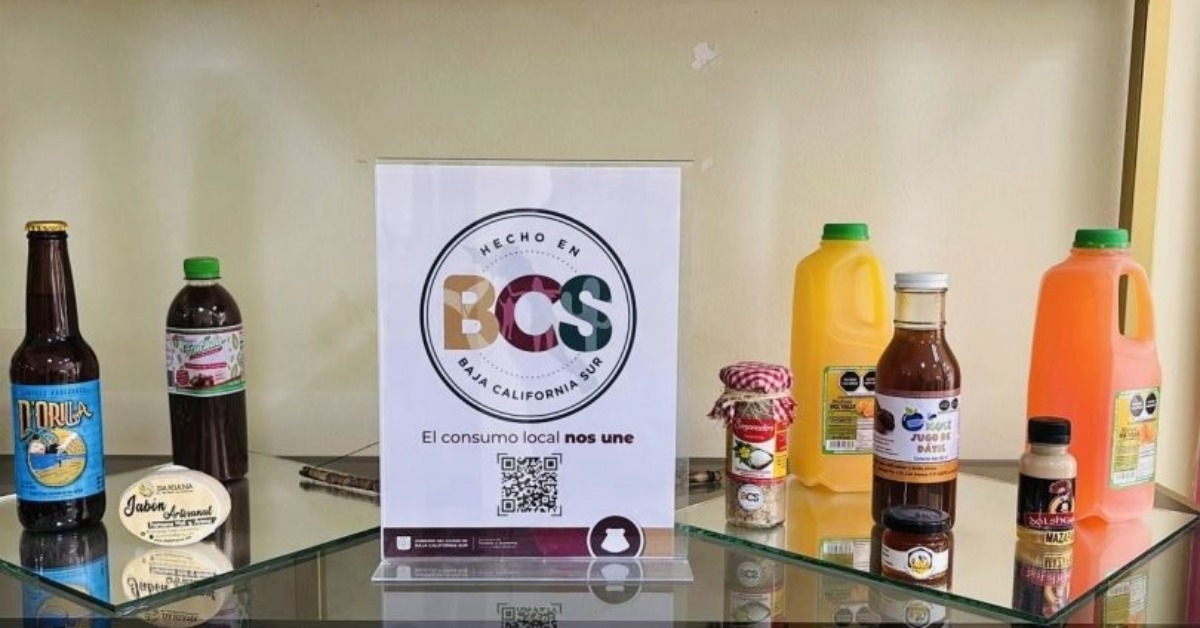
Baja California Sur is renewing its push behind Hecho en BCS, a state-backed label meant to identify goods and services with a clear local origin. Officials describe it as a way to strengthen local consumption, give smaller businesses a stronger market identity, and connect regional production with a broader customer base. In practical terms, that means helping shoppers recognize local products more easily while giving producers a label they can use on packaging, signage, and promotional materials.
For readers who are not deeply familiar with how regional business programs work in Mexico, the idea is straightforward. The label is meant to tell buyers that a product comes from the state and has been made with local participation, local inputs, or both. That matters in a place like Baja California Sur, where imported goods often dominate shelves and where small producers can struggle to compete on visibility, distribution, and price. The program is being framed as a way to narrow that gap, while also tying everyday purchases to the state’s own economic base.
More than a stamp on a package
What makes Hecho en BCS more than a branding exercise is the support structure around it. State officials say the label is paired with training, technical guidance, marketing support, financing pathways, and help with packaging and commercial readiness. That matters because many small producers do not fail for lack of a product. They fail because they cannot get into the systems that move products consistently, whether that means stores, hotel purchasing departments, restaurant buyers, or larger distribution channels.
That is also why the state keeps linking the label to supply chains. The goal is not only to sell at occasional fairs or seasonal markets. It is to move local goods into repeat purchasing networks. Recent public statements about the program have highlighted efforts to connect producers with hotels, restaurants, supermarkets, and convenience stores. In that sense, the label works as both a badge and a filter. It tells buyers what is local, but it also helps officials organize which businesses are ready to be introduced to larger commercial partners.
Why this matters in Baja California Sur
The push lands at an important moment for Baja California Sur. The state has a strong tourism economy, but tourism does not automatically guarantee that local producers benefit in a meaningful way. A destination can have high visitor spending while still relying heavily on outside suppliers for food, beverages, gift items, and other consumer goods. When that happens, more money leaks out of the local economy than many residents realize.
Programs like Hecho en BCS are meant to address that problem by increasing the share of purchases, services, and sales that are local. That has implications well beyond artisan markets. It can affect food producers, beverage makers, household goods businesses, design workshops, and other small enterprises trying to move from micro-scale survival to more stable growth. If more hotels, restaurants, and retailers buy from local suppliers, the benefit is not limited to one shop or one craft table. It can support a broader chain of packaging, transport, marketing, and local employment.
There is also a cultural layer to the program. Officials have repeatedly described the label as a tool of identity as much as commerce. That language is common in regional development programs, but in Baja California Sur, it reflects a real concern. Local identity can be diluted in fast-growing tourism markets, especially when outside brands dominate what visitors see and buy. A label like Hecho en BCS is one attempt to make local production more visible in a state where the global tourism image can overshadow what residents themselves produce.
What readers may notice in daily life
For many residents and foreign readers living in the state, this story is relevant in a practical way. It is partly about what appears on shelves, in hotel gift areas, at food counters, and in local shops. A stronger Hecho en BCS network could make it easier to identify which products actually come from the state, rather than simply being marketed with regional imagery. That distinction matters when buyers want their spending to support businesses rooted in the community.
The official product catalog already shows that the program reaches beyond traditional handicrafts. It includes a broad range of locally tied goods, from food and beverages to art, ceramics, and other consumer items. That breadth matters because it suggests the label is being positioned not as a niche souvenir tag, but as a wider economic platform. The more categories it covers, the more useful it becomes to consumers and institutional buyers alike.
The next test for the program
The next major checkpoint will come soon. State officials have scheduled the Second Hecho en BCS Business Meeting for April 23 in San José del Cabo. The purpose is to place producers in front of strategic buyers and expand the role of local goods in commercial channels. Organizers say the first edition created business links with large chains and tourism-sector buyers. The second round will be watched as a test of whether that early momentum can become something more durable.
That is the real measure of success. A label can attract attention, and public campaigns can generate goodwill. But the deeper question is whether Hecho en BCS can help small businesses secure repeat orders, improve margins, and stay visible in a competitive market. If it does, the program could become one of the state’s more practical tools for strengthening local enterprise. If it does not, it risks becoming another well-meaning seal that shoppers notice briefly and then ignore.