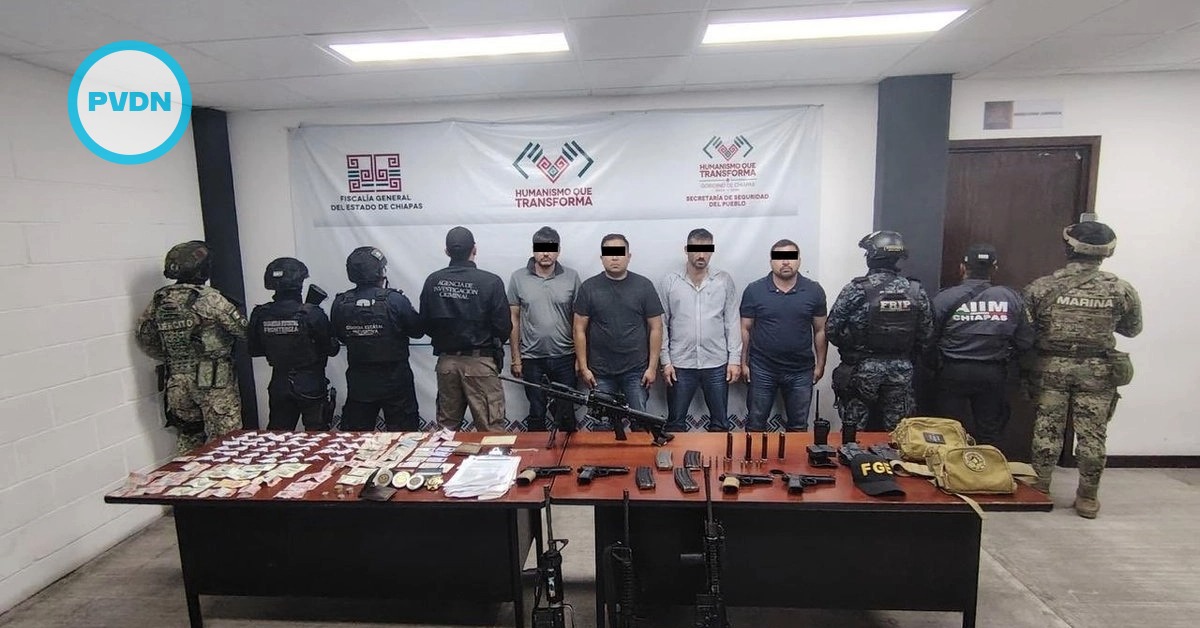
Four men accused of posing as Chiapas state agents were arrested with rifles and fake IDs near Guatemala, in an alleged Sinaloa cell.
Four men who claimed to be agents of the Chiapas state prosecutor’s office were arrested on the Tapachula–Talismán highway. The stop happened a few kilometers from the border with Guatemala. Officers say the group was traveling in a white Nissan Frontier loaded with rifles, pistols and fake identification. What looked at first like a routine traffic check has become a high-profile case. Investigators now link it to an alleged Sinaloa cartel cell on Mexico’s southern border.
State and federal forces were patrolling the international highway when they stopped the pickup. According to security officials, the vehicle carried logos similar to those used by the state prosecutor’s office. The men wore clothing and gear that resembled that of ministerial investigators. When asked to identify themselves, they presented badges as active agents. Checks in official databases, however, showed that the credentials had no legal validity.
One of the four did appear as a former ministerial officer. Authorities now want to know whether he used his past position to help the group. For now, all four remain under guard at state facilities in Tapachula.
Inside the truck, officers seized eight firearms, four long guns and four handguns. They also reported magazines and about 160 rounds of ammunition in different calibers. Security reports mention tactical vests, radios and caps with investigative police insignia. They also list cash in pesos and dollars and dozens of small packets with a white powder that will be tested for cocaine. The men were detained without shots fired.
Sinaloa cartel arrests
Early investigative reports describe how the group allegedly used the fake credentials to install illegal checkpoints on roads that cross several border municipalities. Authorities point to Suchiate, Frontera Hidalgo, Metapa and Tuxtla Chico, towns that sit along routes used every day by comerciantes, tourists and migrants. At those improvised filters, the men are accused of stopping vehicles, demanding money and threatening to kidnap or detain anyone who refused to pay.
During their first statements before state prosecutors, the four allegedly said they belonged to a criminal organization that investigators identify as the Sinaloa cartel. They were placed at the disposal of the public ministry on suspicion of usurpation of public functions, organized crime, weapons offenses and crimes against health. The case could later move to the federal level if authorities decide that the investigation reaches beyond Chiapas.
Officials have identified the detainees by their first names and initials, following Mexican privacy rules. They list Carlos Ramón M. M., 27, from Palenque; Cristhian D. C., 34, from Tijuana; Jesús H. P., 38, from Tuxtla Gutiérrez; and Jonathan M. A., 27, from Tapachula. Prosecutors now have a limited time window to seek their formal link to criminal proceedings. They are also working to document how long the alleged scheme was in place.
The arrests follow months of complaints from drivers and residents about suspicious checkpoints on the roads that connect Tapachula to the Talismán and Ciudad Hidalgo crossings. Migrants and local business owners have described vehicles with lights and official-looking markings that appeared at night and in low-traffic stretches. In many accounts, people say they could not easily tell whether they were facing police, criminals or a mix of both. Many still felt compelled to hand over money to continue.
Researchers and human rights groups have for years described how organized crime controls movement along the Chiapas–Guatemala border. Studies and testimonies detail how migrants and cross-border traders are charged “fees” to move through certain stretches of road or river. In some cases those posts sit just steps away from formal checkpoints. The Tapachula–Talismán corridor has appeared repeatedly in those accounts because of its mix of tourism, small commerce and intense migration.
In 2024, reporting from the same area described men linked to cartels operating near the Talismán crossing and collecting payments from drivers and pedestrians. The current case echoes that pattern. Investigators now want to know whether the four detainees formed part of a larger structure that has profited from the disguise of official uniforms and logos.
Border communities under pressure
Authorities in Chiapas say the operation that led to these detentions involved the Mexican Army, the Navy, a state rapid-reaction unit and municipal police. It is one of several recent actions aimed at tightening control of roads and river paths in the south. The arrests also come during a tense week on the Guatemalan side of the frontier. Armed groups linked to the Sinaloa cartel have been blamed for deadly attacks in rural communities there.
The broader backdrop is a struggle between major criminal organizations for control of southern routes. Analysts describe Chiapas as a key corridor for drugs, weapons and people moving from Central America toward the rest of Mexico. In recent years, clashes between groups linked to the Sinaloa cartel and rival alliances have driven families from their homes. Some of those rivals are connected to the Jalisco New Generation Cartel and the Cartel de Chiapas y Guatemala. Those fights have also closed schools and businesses in several municipalities.
Migrants remain among the most exposed. International organizations and security assessments say people on the move often face robbery, abduction and forced recruitment. Some report being stopped several times in a single day by different armed actors. Each group demands a cut of their travel money. Others are held for days in safe houses or informal camps until relatives can send payments.
Residents of Suchiate, Metapa and other towns along the border corridor say the climate of fear affects daily life. Transport workers adjust their schedules to avoid certain stretches after dark. Shop owners close early when they hear gunfire or see unfamiliar trucks setting up on the roadside. Parents worry about teenagers recruited as lookouts or drivers.
Against that backdrop, these Sinaloa cartel arrests stand out as a rare public glimpse. They show how a small, mobile team can use uniforms, logos and weapons to turn a busy highway into a private toll booth. The four men detained on the Tapachula–Talismán road are presumed innocent until a judge rules otherwise. What happens next in court will matter for more than these four men. The case will show whether investigators can reach any superiors who may have ordered the scheme. It will also test recent promises to make Mexico’s southern border safer for those who live, work and travel there.