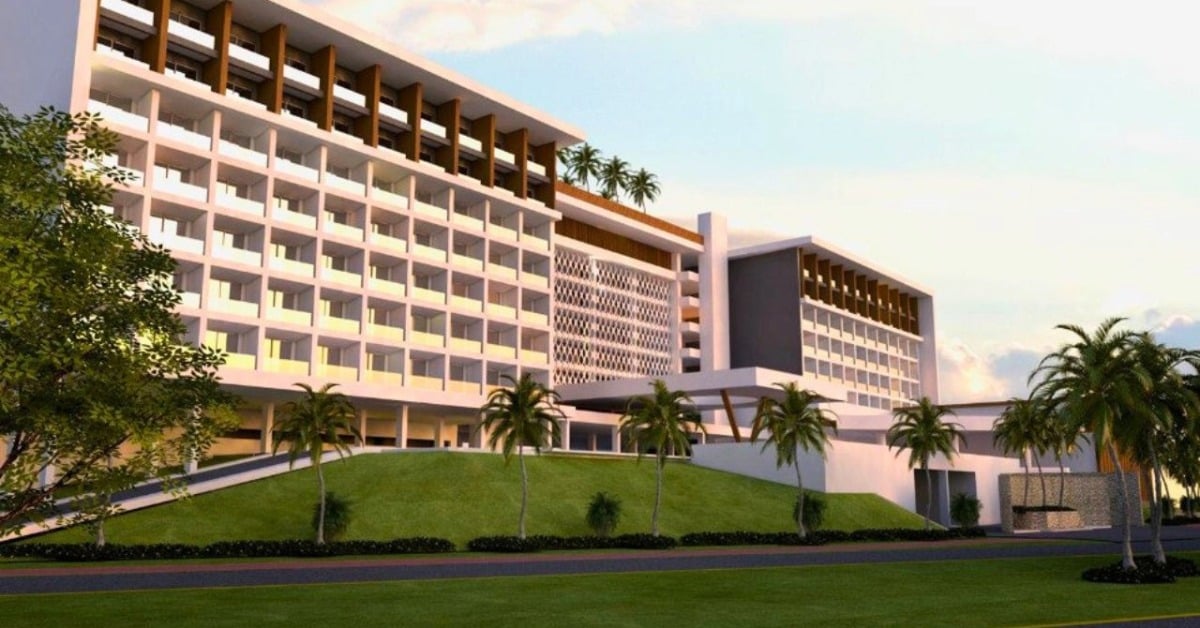
Mexico’s federal environment ministry has moved the controversial Hotel The View Cancún file into a formal public consultation, opening a narrow window for residents, workers, and visitors to weigh in. The plan calls for a 456-room, 15-story tower on Lot 3 of the Hotel Zone’s Third Stage. Officials say comments are accepted through September 18, and the project also seeks a unified land-use change. What’s actually on the table, why this step matters, and how Cancun got here—our guide to the review, the rules, and the stakes.
Hotel The View Cancún
SEMARNAT has put the hotel’s environmental application into public consultation, a key phase that lets anyone submit comments on potential impacts and mitigation. The entry references a 456-room, 15-level tower on Lot 3 of the Hotel Zone’s Third Stage in Benito Juárez (Cancún). The promoter is listed as Hogares Vivenda S.A. de C.V., and the project identifier is 23QR2025TD042. According to local outlets citing the file, the window to weigh in runs from August 20 to September 18, 2025.
Plans described in the executive summary include guest rooms, specialty restaurants, a sports bar, pools and sun decks, and service areas such as kitchens, laundry, security, maintenance, storage, and waste handling. Parking—both covered and open—is contemplated, along with interior corridors, elevators and stairs, landscaped areas, and designated conservation areas.
This consultation is not a final approval. It is the moment when the public record is built: residents, workers, scientists, and NGOs can flag risks, propose mitigation, or support the project with conditions. Under Mexico’s federal framework, SEMARNAT’s impact-assessment arm (DGIRA) must consider those filings before issuing a resolution on the environmental impact statement (MIA) and the companion unified land-use change request, referenced here as DTU-B.
What the record already shows
Coverage tracing the file across 2025 points to the same core elements: a high-rise hotel of 456 rooms over 15 levels at Lot 3 in the Hotel Zone’s Third Stage; a unified request pairing the MIA with a land-use change; and a public-comment period that spans late August to mid-September 2025. Earlier trade reporting also noted the project’s request to change land use over dune vegetation to enable construction. This point often draws scrutiny in Cancún due to the role dunes play in coastal protection.
The environmental questions are familiar to locals: storm-surge exposure, the integrity of remaining dune systems, runoff management into adjacent water bodies, and cumulative impacts from vertical growth in the Hotel Zone. While those issues must be proven in the technical file rather than assumed, this consultation is the public’s formal chance to ask for stronger modeling, tighter safeguards, or monitoring obligations if SEMARNAT ultimately authorizes the project.
What participation looks like in Cancún right now
For this specific file, authorities indicate two channels to participate: in person at SEMARNAT’s office at km 4 of Boulevard Kukulcán, or digitally via the DGIRA portal using the key 23QR2025TD042. Submissions should include a full name and contact details; organizations should add legal representation data. Local outlets reporting from the file say the comment window is open August 20–September 18, 2025.
Projects of this scale often draw comparisons with other recent proposals in Cancún’s Hotel Zone, where high-density plans have triggered formal consultations and heated debate. The pattern is not unusual: a developer files an MIA and, when a consultation is activated, a wider audience tests the science and the mitigation before any federal decision. That broader review is by design; it’s what gives coastal communities a say before anything gets built.
What comes next
DGIRA’s review will weigh the MIA’s technical studies and the public’s submissions. If the agency issues an approval, it can attach extensive conditions: construction timing to avoid sensitive seasons, erosion controls, runoff capture and treatment, biodiversity protections, and post-construction monitoring with reporting. If the measures are inadequate—or if the studies fail to prove viability—DGIRA may deny or return the file for more information. The law allows this staged approach to ensure decisions rest on evidence and an open record.
Nothing in this phase guarantees a green light. It does guarantee a path for the community to put science, lived experience, and practical safeguards into the record—before the bulldozers ever show up. That is the core value of consultation in a coastal city that depends on its beaches, dunes, and reef-buffered lagoon for both livelihoods and protection.